Captain Hale, the Spy
On the 12th of October, Howe embarked a large portion of his army in ninety flat-boats, and landed them on Throgg's Neck, a low peninsula jutting out from the main of Westchester county. He left a sufficient force under Lord Percy to hold the city and guard the British lines toward Harlem. Washington sent Heath to oppose Howe's landing, and to occupy lower Westchester. After encountering many difficulties from the opposition, Howe finally took post on the heights of New Rochelle, across the road leading to White Plains, where he was joined by General Knyphausen with a freshly arrived corps of German troops. Meanwhile Washington had sent McDougall, with his brigade, four miles beyond Kingsbridge, and a detachment to White Plains. He wished to evacuate Manhattan Island entirely, but an order had come from Congress to hold Fort Washington to the last extremity. At a council of war held on the 16th of October, he produced such proofs of the intention of the British to surround his army, that it was determined to move them all into Westchester excepting a garrison for Fort Washington. That was commanded by Colonel Magaw of the Pennsylvania line, with troops who came chiefly from that State. The army marched in four divisions, commanded respectively by Generals Lee (who had just arrived), Health, Sullivan and Lincoln, and moving up the valley of the Bronx River, formed intrenched camps from the heights of Fordham to White Plains. On the 21st, Washington made his headquarters near the village of White Plains. General Greene commanded a small force that garrisoned Fort Lee.
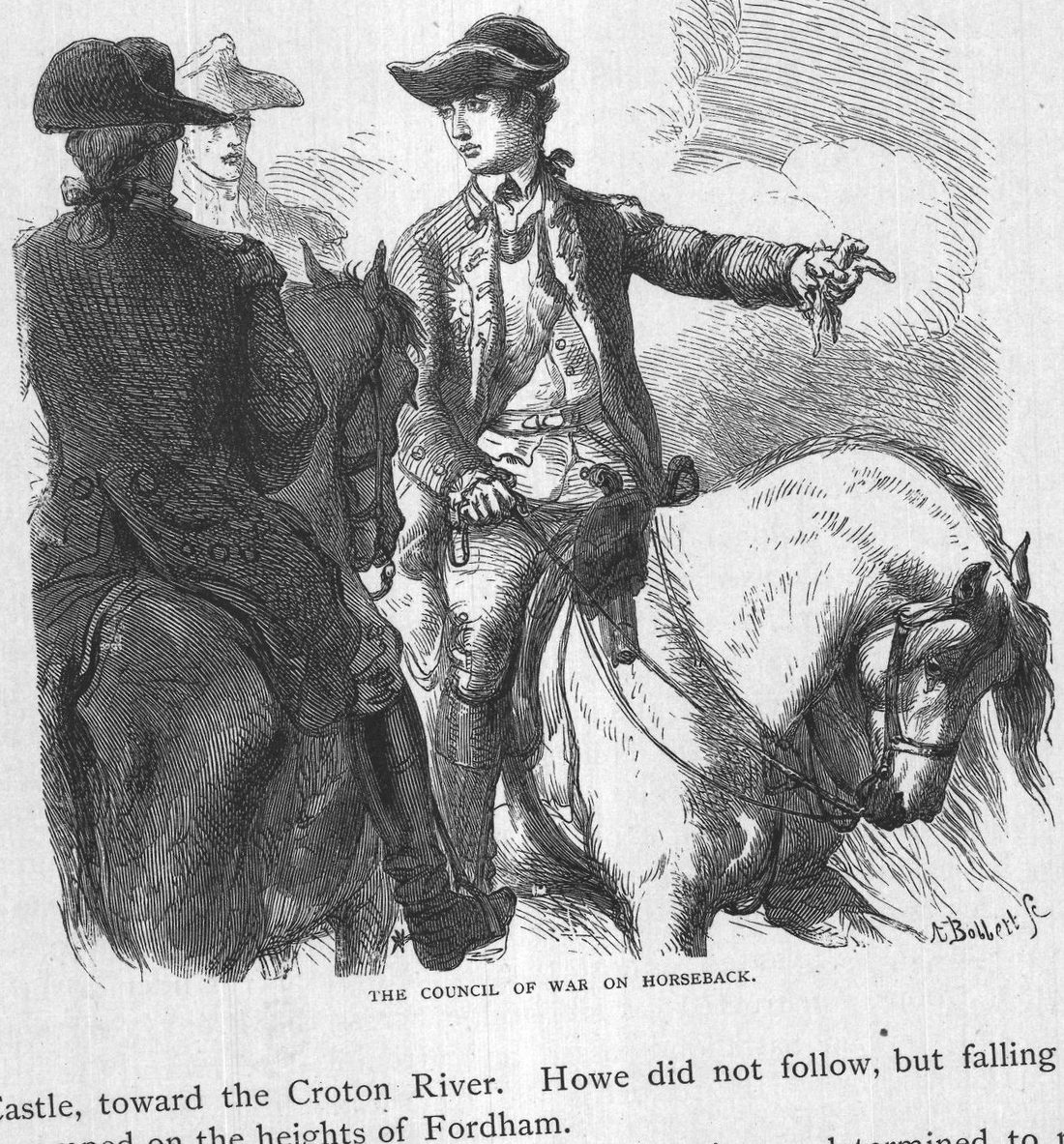
After almost daily skirmishing, the two armies, each about thirteen thousand strong, met in battle array at the village of White Plains, on the 28th of October. The Americans were encamped behind hastily thrown up intrenchments just north of the village, with hills in the rear to retreat to, if necessary. About sixteen hundred men from Delaware and Maryland, and militia under Colonel Haslett, had taken post on Chatterton's Hill, a high eminence on the west side of the Bronx, to which point McDougall was sent with reinforcements on the morning of the 28th, with two pieces of artillery under the charge of Captain Alexander Hamilton. Howe's army approached in two divisions, the right commanded by Sir Henry Clinton, and the left by Generals De Heister and Erskine. Howe was with the latter. He had moved with very great caution since his landing, and now, as he looked upon the Americans behind their apparently formidable breast-works, he hesitated, and held a council of war on horseback. Then he inclined his army to the left, and on the slopes southeast of the present railway station, he planted almost twenty field-pieces. Under cover of these his troops constructed a rude bridge across the Bronx, over which British and German battalions passed, and attempted to ascend the steep, wooded Chatterton's Hill to drive the Americans from it. Hamilton's cannon, which he had placed in battery, annoyed them exceedingly. They recoiled, when they were joined by reinforcements under Leslie, foot and horse, and pushing up more gentle declivities, in the face of a furious tempest of bullets, they drove the Americans from their position. McDougall led his troops to Washington's camp, leaving the British in possession of Chatterton's Hill.
Howe dared not attack Washington's breastworks (composed chiefly of cornstalks covered lightly with earth), but waited for reinforcements. They came, just as a severe storm of wind and rain set in. When it ceased at twilight on the 31st, Washington, perceiving Howe's advantage, withdrew under the cover of darkness behind intrenchments on the hills of North Castle, toward the Croton River. Howe did not follow, but falling back, encamped on the heights of Fordham.
Washington called a council of war, when it was determined to retreat into New Jersey with a large portion of the army, leaving all the New England troops on the east side of the Hudson to defend the passes in the Highlands. These troops were placed under the command of General Heath. Five thousand soldiers crossed the Hudson, some at Tarrytown and some at King's Ferry, now Stony Point. Washington, accompanied by Heath, Stirling (who had lately been exchanged), Mifflin, and Generals George and James Clinton, rode to Peekskill, whence they voyaged in a barge on a tour of inspection of the fortified points in the Highlands, as far as Fort Constitution. It was then decided to fortify West Point opposite that fort. Returning to King's Ferry, the chief hastened southward, gathered his little army near Hackensack in the rear of Fort Lee, and made his headquarters there, on the 14th of November.