British Forays
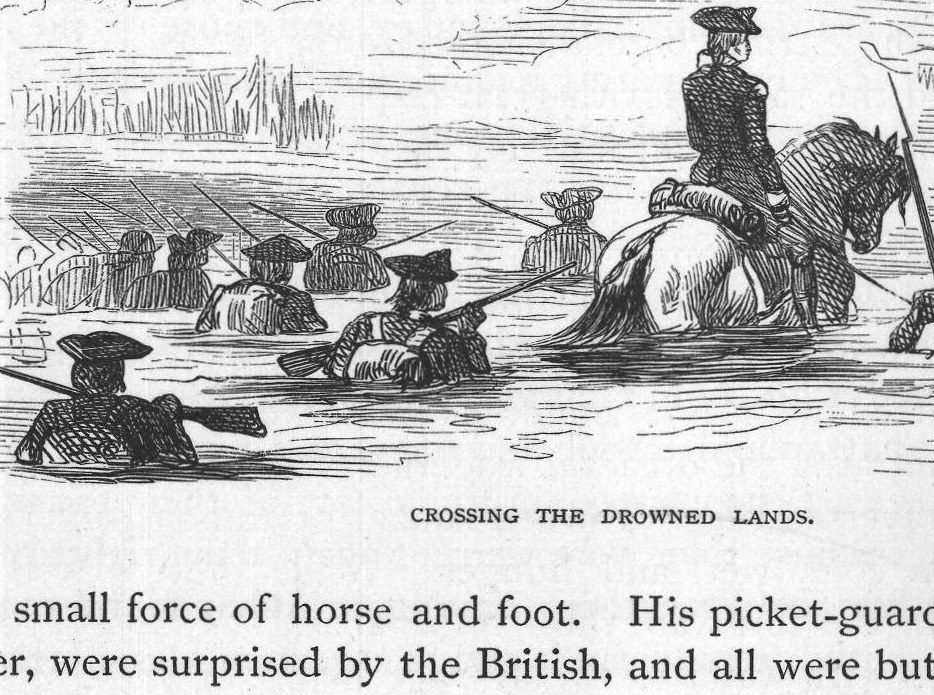
Clarke was in Kentucky when he heard of the recapture of Vincennes. He immediately started with one hundred and seventy-five men for its recovery. They penetrated the dreadful wilderness in February, 1779. For a whole week they traversed the "drowned lands" of Illinois, suffering very great hardships from cold, wet, and hunger. When they arrived at the Little Wabash, where the forks are three miles apart, they found the intervening space covered with water to the average depth of three feet. The points of dry land were five miles apart; and all that distance, these hardy soldiers waded through the cold snow-water sometimes armpit deep. On the evening of the 18th of February, they arrived before Vincennes; and at dawn the next morning, making themselves hideous by blackening their faces with gunpowder, they crossed the river in boats and pushed toward the town. Had they dropped from the clouds the inhabitants would not have been more astonished, for it seemed impossible for them to have traversed the deluged country. It was like a sudden apparition of fiends in human shape. Clarke demanded the surrender of the town, fort, and garrison. Colonel Hamilton was in command in person, and refused; but after a sharp siege of fourteen hours, the garrison became prisoners of war. Hamilton was sent to Virginia, where, because he had incited the savages to make war on the settlements, he was confined for awhile in irons in the common jail at Williamsburg.
From the close of the campaign in Rhode Island to the end of the year, there were no active military operations of importance in the north. The British made some forays from New York, in the vicinity of that city. Cornwallis penetrated New Jersey with a considerable force, late in September, but without much effect; and General Grey surprised Colonel Baylor's cavalry corps at Old Tappan, back of the Hudson River Palisades, and murdered them with the bayonet while they were begging for quarter. In October, a British party under Captain Patrick Ferguson, desolated the country around Little Egg Harbor in New Jersey, and burned several vessels there. The Count Pulaski was then on his way from Trenton to Little Egg Harbor, with a small force of horse and foot. His picket-guard of infantry, thirty in number, were surprised by the British, and all were butchered, for the assailants did not wish to be encumbered with prisoners.
Toward the close of 1778, the theatre of active military operations was changed. Early in November D'Estaing sailed for the West Indies to attack the British possessions there. To defend these, it was necessary for the British fleet in our waters to hasten to that region. Accordingly, Admiral Hotham sailed from New York for the West Indies, with a squadron, on the 3d of November; and when Admiral Byron succeeded Lord Howe early in December, he, too, departed for those waters with some vessels-of-war. This movement would prevent any co-operation between the British fleet and army, in aggressive movements against the populous and now well-defended North, and it was determined to strike a withering blow at the more sparsely-settled South. Late in November Sir Henry Clinton dispatched Lieutenant-Colonel Campbell with about two thousand troops to invade Georgia, then the weakest member of the Union. These troops were sent by way of the sea, and were landed at Savannah, the capital of Georgia, on the morning of the 29th of December. They were confronted by General Robert Howe, of North Carolina, who had hastened up from Sunbury, at the call of the garrison, with less than a thousand dispirited men. At a place known as Brewton's Hill, three miles below Savannah, a sharp fight ensued; but the Americans were compelled, by overwhelming numbers, to retreat. That retreat became a confused flight, partly across submerged rice-fields and a creek. About one hundred Americans were killed or drowned, and more than four hundred were made prisoners. The remainder went up the right side of the Savannah, crossed it at Zubley's Ferry, and took shelter in the bosom of South Carolina.
Now, at the end of the fourth year of the war, the relative position of the belligerents was almost the same as at the close of 1776. The headquarters of Washington were again in New Jersey, and those of the British were in New York city. The British army had accomplished very little more, in the way of conquest, than it had at the end of the second year, while the Americans had gained strength by experience, and had learned much of the arts of war and of civil government. They had also secured the alliance of a powerful European nation, and the sympathies of other European governments. The British forces really occupied the position of prisoners, for, with the exception of those in Georgia, they were closely hemmed in upon two islands (Manhattan and Rhode Island) almost two hundred miles apart. The Americans were strong, too, in the justice of their cause, while the British were weak, because they were warring against the rights of man.