Battle at Malvern Hill
There were severe contests on the morning of the 30th of June, at the main bridge in White Oak Swamp and at Glendale, near by. McClellan's main army had then reached the open country in the region of Malvern Hill. General Franklin had been left with a rear-guard to protect the passage of the bridge and cover the withdrawl of the wagon-trains from that point, and it was with him that the Confederate pursuers had a sharp contest which lasted nearly all day. The latter were kept back; and that night, the Nationals, having destroyed the bridge, withdrew, leaving behind them three hundred of their sick and wounded and some disabled guns. While the strife was going on there, a sanguinary battle was fought at Glendale, not far off, between the Nationals and a column of Confederates led by Longstreet and Hill. In that conflict, Pennsylvania troops, under General McCall, suffered much. That leader was captured, and General Meade was severely wounded. Fresh troops under Hooker, Meagher and Taylor, arrived in time to give the victory at Glendale to the Nationals; and the next day (July 1, 1862) the Army of the Potomac, united for the first time since it was divided by the Chickahominy, were in a strong position on Malvern Hill, within the reach of National gun-boats on the James River. But General McClellan thought the position not a safe one, notwithstanding it is a high plateau, with a bold bank sloping toward the river and flanked by deep ravines; and on the morning of the first of July he went down the James River on the gun-boat Galena and selected a spot at Harrison's Landing, not far from Malvern Hill, as a secure place for his army and base of supplies.
By vigorous movements, Lee compelled the Nationals to fight while their chief leader was away. The Confederates were concentrated at Glendale, and were moved, in a heavy line under Lee's best generals, to carry Malvern Hill by storm. They fell with intense fury upon the Nationals, and one of the most terrible battles of the war was there fought. The brunt of it was borne by the troops of Porter, Couch and Kearney, until toward evening, when Meagher and Richardson came to their aid with fresh soldiers. The Confederates were sorely smitten by well-directed bomb-shells from the gun-boats.
This fierce contest continued, with varying fortunes for both parties, until nine o'clock in the evening, when the Confederates were driven to the shelter of the woods and swamps, utterly broken and dispirited. The victory for the Nationals was so decisive that their leaders expected to pursue Lee's shattered army in the morning, and march into Richmond within twenty-four hours. Their disappointment was grievous when General McClellan, who had been on board the Galena nearly all day while the army was fighting, ordered that army to fall back and encamp at Harrison's Landing. The chief officers felt that the prize for which they were contending, namely, the defeat of Lee's army and the capture of Richmond, now within their grasp, was snatched from them by a timid hand, and obedience was reluctantly but promptly given. It seemed to be a fitting ending of a campaign which had been a series of signal failures, with little fruit, excepting the loss since the 23d of May of more than fifteen thousand men. The army lingered long among the malarious vapors of the James River, until many more had fallen victims of disease.
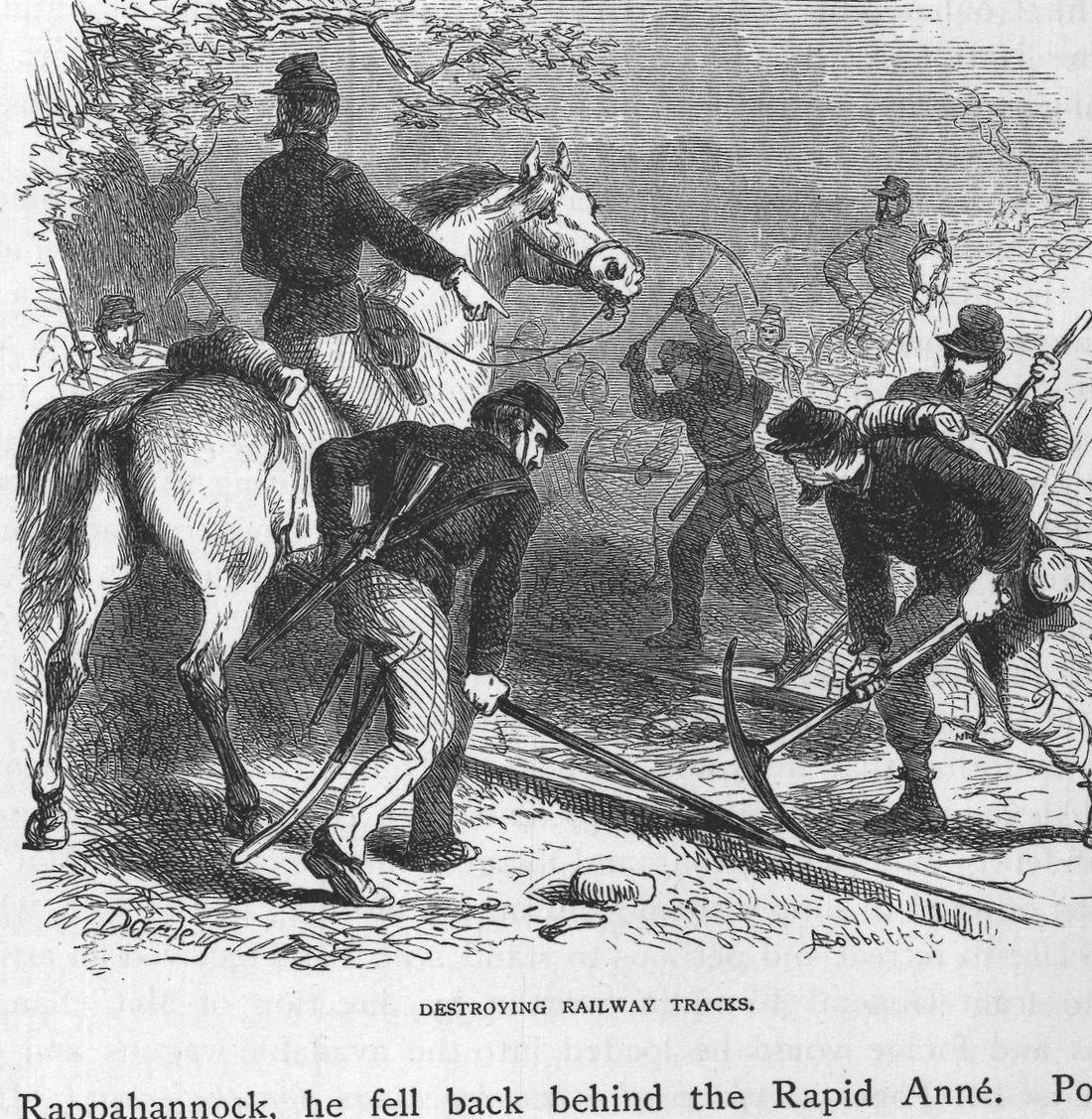
When Halleck succeeded McClellan as chief of the armies, he arranged the troops for the defence of Washington in three corps; and placing them under the command of General John Pope, who had been called from the West, named these forces the Army of Virginia. These corps were commanded respectively by Generals McDowell, Banks and Sigel. When McClellan had retreated to Harrison's Landing, the Confederates at Richmond, satisfied that no further attempts to take that city would be made at that time, ordered Lee to make a dash on Washington. Having information of Lee's preparations for a raid to the northward, Halleck ordered Pope, at the middle of July, to meet the invaders at the outset of the raid. National cavalry were first sent by General Rufus King, at Fredericksburg, who made excursions to within thirty or forty miles of the Confederate capital, and destroyed railway tracks and bridges.
At that time "Stonewall Jackson" was at Gordonsville with a heavy force, and Pope's main army was near Culpepper Court-House. The former, by Lee's orders, crossed the Rapid Anne; and at the foot of Cedar Mountain, a few miles west of the Court-House, he was met by General Banks toward the evening of the 9th of August. There occurred one of the most sanguinary battles of the war. Some of the time the struggle was carried on hand-to-hand, under an awful pall of smoke which, after nightfall, obscured the light of the moon. Banks was pressed back by overwhelming numbers, and sorely pressed, until the timely arrival of Rickett's division of McDowell's corps, which checked the pursuers. In this conflict Banks was ably assisted by Generals Crawford, Augur, Geary and others. The battle ceased at nine o'clock in the evening, though cannonading was kept up until midnight. "I have witnessed many battles during the war," wrote a newspaper correspondent, "but I have seen none where the tenacious obstinacy of the American character was so fully displayed." The National loss was about two thousand men, killed and wounded, and that of the Confederates was about the same.