Banks: John Quincy Adams and Mount Vernon
The commerce of the United States was greatly injured by swarms of privateers under Spanish-American flags, who had degenerated into pirates and so become outlaws, subject to chastisement by any nation. They infested the West Indian seas and the northern coasts of South America. Against these pirates and to protect American commerce, our government sent Commodore Perry, with two ships-of-war, in the spring of 1819. Perry died of yellow fever in the performance of his duty, and very little was then done toward suppressing the pirates; but in 1822 a small American squadron destroyed more than twenty piratical vessels on the coasts of Cuba; and the next year Commodore Porter, with a larger force, completed the good work. It was the policy of the government of the United States to favor the revolt of the Spanish-American provinces, whose flag these pirates had dishonored, as a means for preventing the establishment, in the future, of monarchical powers on the American continent. The latter policy was avowed by the President, and has never been lost sight of by our government, and is known in history as the "Monroe Doctrine." Accordingly, on the recommendation of the President, Congress, early in 1822, resolved by an almost unanimous vote to recognize the independence of five of the revolted colonies, and appropriated $100,000 to defray the expenses of envoys to the seat of government of each, whom the President soon afterwards appointed.
While the Missouri question was pending, an election for President of the United States occurred. Never was a canvass carried on more quietly than this, and Monroe and Tompkins were re-elected by an almost unanimous vote, the old Federal party as a political organization being nearly extinct. Mr. Monroe's second term was not marked by any very important public occurrences, but a pleasing incident in our history distinguished the last year of his administration. It was the visit of General Lafayette to the United States as the "nation's guest," he having been invited to come, by the President at the request of Congress. He declined the offer of a ship-of-the-line for his conveyance to this country, and with his son (George Washington) and his secretary he sailed from Havre for New York, where he arrived on the 15th of August, 1824. In the space of about eleven months he made a tour of about five thousand miles through the principal portions of the United States, and was everywhere greeted with the greatest enthusiasm. His journey was like an almost continual triumphal procession. Congress voted him $200,000 and a township of land, "in consideration of his important services and expenditures during the American Revolution;" and when he was ready to return to France, an American frigate named the Brandywine, in compliment to him (the first battle for our independence in which he was engaged having been fought on the banks of the Brandywine in September, 1777), was sent by our government to convey him back. He had witnessed the greatness of the American republic; on his return he experienced the littleness of the Bourbon dynasty in France, for when on his arrival in Havre, a great concourse of the people assembled to make a demonstration in his honor, they were dispersed by the police.
Many interesting incidents occurred during Lafayette's tour through the country. A touching one was related to the writer, many years ago, by George Washington Parke Custis, the adopted son of General Washington. In October, 1824, Lafayette visited Mount Vernon and the tomb of Washington. He was conveyed to the shore from a steamboat in barge, accompanied by his son (who had lived at Mount Vernon with Custis when they were boys), Secretary John C. Calhoun, and Mr. Custis. At the shore he was received by Lawrence Lewis, a nephew of Washington, and the family of Judge Bushrod Washington, who was absent on official business. He was conducted to the mansion where, forty years before, he took his last leave of the Patriot, whom he most sincerely loved as a father. Then the company proceeded to the tomb of Washington (the old one on the brow of the hill), when Mr. Custis, after a brief speech, presented the general with a gold ring containing a lock of Washington's hair. Lafayette received it with emotion, and after thanking the donor, he affectionately embraced him and the other gentlemen present. Then he fervently pressed his lips to the door of the vault. It was opened, and there were displayed the coffins of Washington and his wife, decorated with flowers. The general descended the steps, kissed the leaden caskets while tears suffused his cheeks, and then reverently retired.
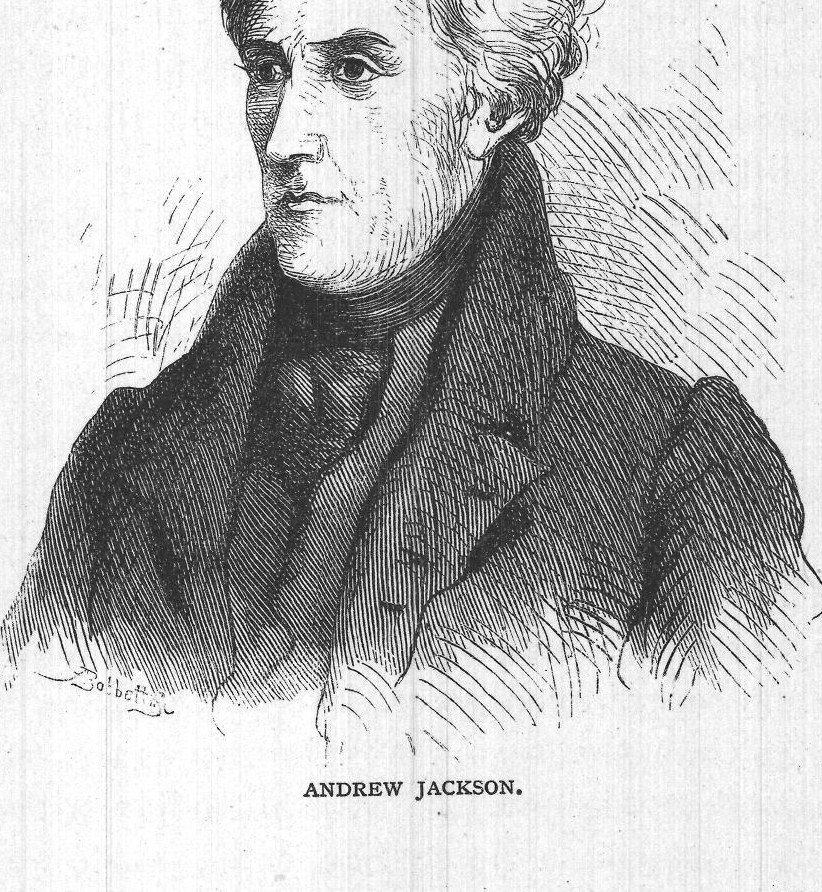
When Monroe's administration of eight years was drawing to a close, the task of choosing his successor devolved upon the people. There were several prominent men spoken of as candidates, and the choice was not a political but a personal affair. The nomination, in the state of political parties at that time, if done with unanimity, would be equivalent to an election. But candidates were too numerous to insure unanimity. The principal ones were William H. Crawford, John Quincy Adams, Henry Clay, John C. Calhoun, and Andrew Jackson. The elections held in the autumn of 1824, showed conclusively that not one of the candidates would be elected by the popular vote, and that the choice would devolve upon the House of Representatives. This was determined by the vote of the electoral colleges; and in February, 1825, the House of Representatives chose John Quincy Adams of Massachusetts for President, and John C. Calhoun of South Carolina for Vice President, by the votes of thirteen States.