Appointment of General Officers
At that time there were very few men in our country thoroughly trained in the art of war; for the Military Academy at West Point, as it now exists, was then in its infancy. A school to be established there had been authorized only ten years before. The elder leading officers of the Continental Army were in their graves, and the younger ones were far advanced in life; yet to the latter, alone, the government felt compelled to look for its military leaders. Henry Dearborn, who had been a meritorious New Hampshire colonel in the Continental Army, was commissioned major-general and commander-in-chief. His principal brigadiers were James Wilkinson, who was on the staff of General Gates in the conflicts near Saratoga; Wade Hampton, who had done good partisan service with Marion, Sumter, and others in South Carolina; William Hull, who had served as colonel in the old war for independence; and Joseph Blomfield, who had been a captain in the New Jersey line.
Hull was, at that time, governor of the Territory of Michigan. The administration party, satisfied that our navy could not cope with that of the British on the ocean, based their hopes for success largely upon the supposed dissatisfaction with imperial rule, of the inhabitants of the Canada's and other British colonial possessions on our borders, who, they believed, would flock to the American standard when it should appear upon their soil. This was the fatal mistake made in 1775. Our people had not profited by the sad experience of the campaign into Canada that year; and our government resolved to begin the war by an invasion of the western portion of the Upper Province by American troops. Canada was then divided into Upper and Lower Provinces, the former extending westward from Montreal along the shores of the St. Lawrence and Lake Ontario, to Lake Huron and the Detroit River. It included about one hundred thousand inhabitants, who were principally of the families of American Loyalists who had been compelled to abandon their homes in the States at the close of the war for independence, and had experienced the fostering care and kindness of the Brirtish government. Their loyalty was stimulated by the recollections of that kindness and by lingering resentments; and they were the last people to count upon as allies of those whom they had been taught, many of them by great suffering, to regard as enemies. This fact does not seem to have been taken into account by the administration.
When war was declared, George, Prince of Wales, was really monarch of Great Britain, for the court physicians had pronounced his father, George the Third, to be hopelessly insane. Great Britain was then waging a tremendous war against the Emperor Napoleon. Wellington was in command of the British forces on the Spanish peninsula, and Great Britain had just formed an alliance with Russia against the ambitious Corsican. Her naval armament on the American station--Halifax, Newfoundland, Jamaica, and the Leeward Islands--then consisted of five ships-of-the-line, nineteen frigates, forty-one brigs and sixteen schooners, and some armed vessels on Lakes Ontario and Erie, with several others a-building. The British land force in Upper Canada did not exceed fifteen hundred men; the aggregate in the two provinces and the British domain on the east was about six thousand. The number of the militia of all the British-American provinces was estimated at forty thousand. They had an assailable frontier of full seventeen hundred miles.
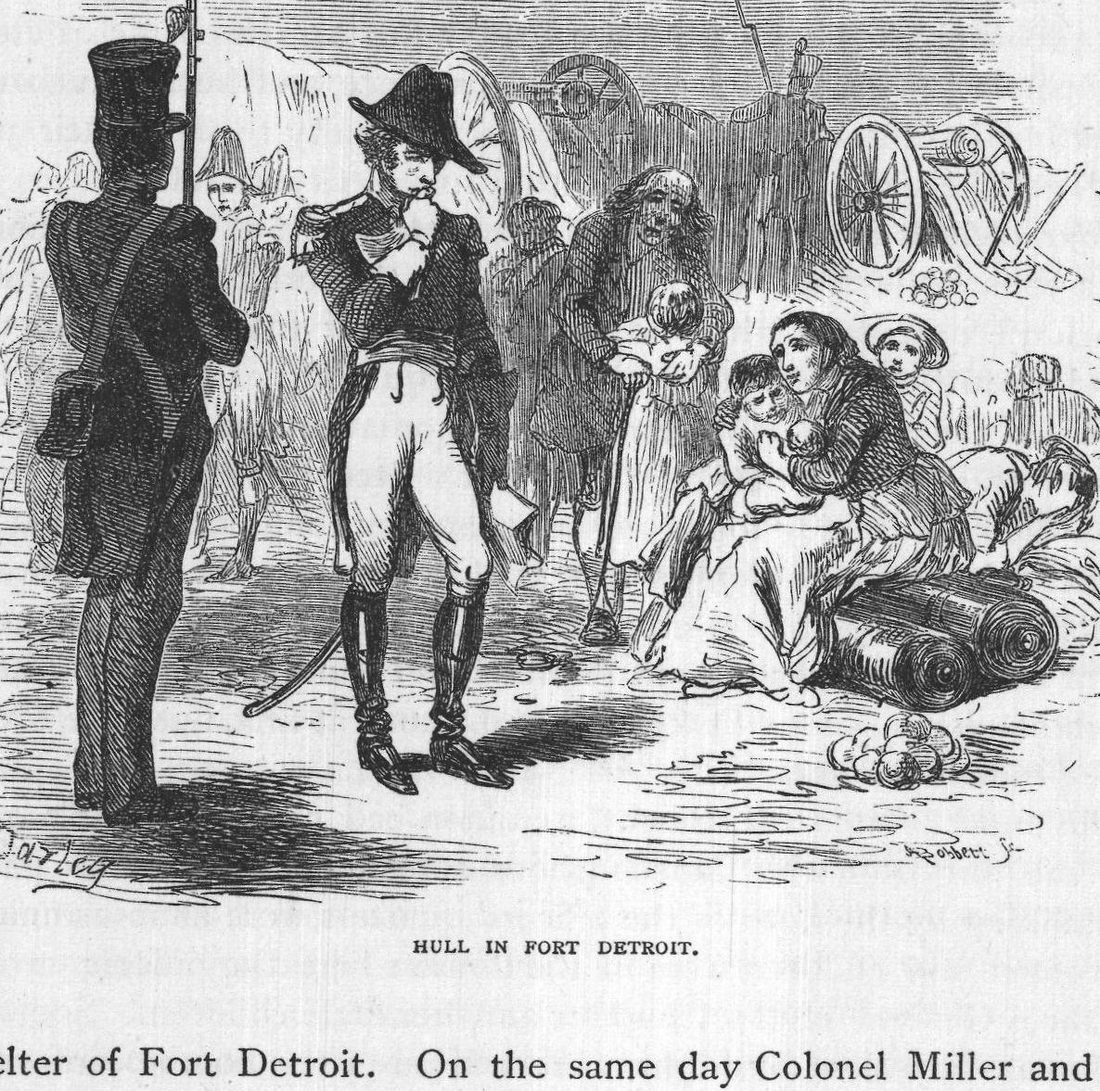
Governor Hull, while in Washington city in the winter of 1812, heard proposals for the invasion of Western Canada. He told the President that success in such a movement might be hoped for, only by having armed vessels on Lake Erie and a competent military force in the northwest as a protection against the hostile savages over whom the British had almost unbounded control. These were showing promises of active warfare in the spring, and Governor Meigs, of Ohio, had summoned the militia of that State to rendezvous at Dayton, to meet the impending danger. Hull accepted the commission of brigadier, that he might lead the troops in defence of the people on the frontiers; and late in May he arrived at Dayton and took command of them. Surrounded by his staff and Colonels Duncan McArthur, James Findlay, and Lewis Cass, in the presence of Governor Meigs and his council, Hull made a stirring speech to the troops, and then marched with them for Detroit, through the almost trackless wilderness. While on his march with about two thousand men, he was informed of the declaration of war, not, however, before the news had reached the British posts in Canada, and his little army was placed in imminent peril. The government then gave him discretionary power for invading Canada.