American Affairs in Europe
AT the beginning of 1770, the quarrel between Great Britain and her American colonies was a chief topic for discussion and speculation in European court-circles. The French were watching the course of events with intense interest. Du Chatelet, in London, was keeping Choiseul well informed of every political movement bearing upon American affairs; and the sentiment of wise men on the continent, as well as the middling-classes of Great Britain, was rapidly drifting in favor of the really persecuted colonists. The British cabinet had not been in perfect unity for some time on the American question, and had just been recast. The Duke of Grafton, at whom "Junius" was then hurling his keenest shafts, had retired from the premiership, and Lord North had become prime minister of England, with a good working majority in Parliament. The Opposition in Parliament were bold, bitter, and defiant. Sir George Saville, in debate, charged the House of Commons with an invasion of the rights of the people; when a ministerial member said: "In times of less licentiousness, members have been sent to the Tower for words of less offence." Saville instantly replied: "The mean consideration of my own safety shall never be put in the balance against my duty to my constituents. I will own no superior but the laws; nor bend the knee to any but to Him who made me." Lord North well knew the strength of the popular will behind these brave words, and bore the reproach quietly. By adroit management he stilled the rising tempest of indignation that was agitating the majority. In the House of Lords, Chatham, whose voice had been silent a long time, spoke warmly in favor of being just toward the Americans. "Let us save the constitution, dangerously invaded at home," he said; "and let us extend its benefits to the remotest corners of the empire. Let slavery exist no-where among us; for whether it be in America, or in Ireland, or here at home, you will find it a disease which spreads by contact, and soon reaches from the extremity to the heart." These words from both houses of Parliament went over the sea as pledges of hope for the Americans, for lately they had received only frowns from the national legislature. The colonists were irritated but calm, because they were conscious of their innate strength and the righteousness of their cause. Their just anger was controlled by wise judgment and marvellous sagacity. The bond of their union was growing stronger every hour because of common danger.
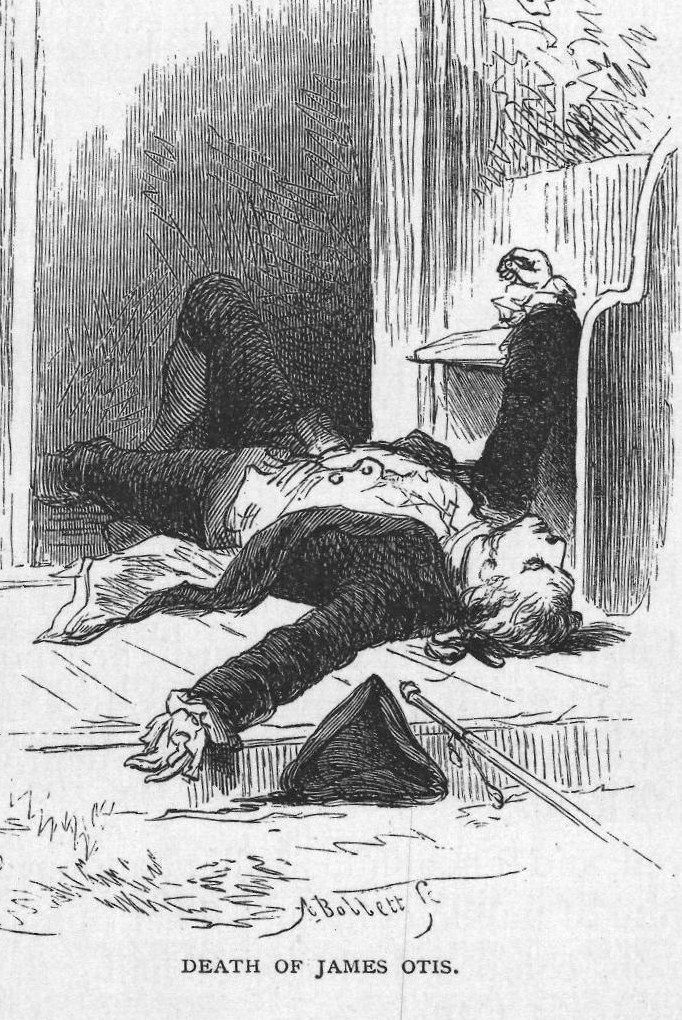
Boston was then the focus of rebellious thought and action in America. Samuel Adams and his compatriots were longing for independence, and boldly prophesying the birth of a new nation in America; but his brave and fiery coadjutor, James Otis, had lately been disabled by the violence of a crown-officer, to which allusion has already been made. Mr. Robinson, one of the commissioners of customs, had misrepresented Otis in England. The latter made a severe attack upon Robinson in a Boston newspaper. For this the commissioner attempted to pull Otis's nose in a coffee-house. A fracas ensued, when Otis was so severely beaten that he never fairly recovered. His brain was disturbed by a blow on the head from a heavy cane. His great usefulness at that crisis was hopelessly impaired. John Adams in his diary for January, 1770, gives a melancholy account of the patriot's mental condition: "Otis," he wrote, "is in confusion yet; he loses himself; he rambles and wanders like a ship without a helm; attempted to tell a story which took up almost all the evening; the story may, at any time, be told in three minutes with all the graces it is capable of, but he took an hour. I fear he is not in his perfect mind. The nervous, the concise and pithy were his character till lately; now the verbose, the round-about, and rambling and long-winded. In one word, Otis will spoil the club. He talks so much and takes up so much of our time, and fills it with trash, obsceneness, profaneness, nonsense and distraction, that we have none left for rational amusements and inquiries. He mentioned his wife; said she was a good wife, too good for him; but she was a tory [she had married her daughter to a British officer], a high tory; she gave him such curtain-lectures, etc. In short, I never saw such an object of admiration, reverence, contempt, and compassion, all at once, as this. I fear, I tremble, I mourn, for the man and his country; many others mourn over him, with tears in their eyes." Poor Otis! He lived, disabled, until the great Revolution (in the earlier stages of which he had borne the most conspicuous part) was almost ended in the independence of his country. Late in May, 1782, while he was standing in the door of a friend at Andover during a thunder-shower, he was instantly killed by a stroke of lightning--a method of dying for which he had often expressed an earnest desire.