Home › Contents › Toasting the Wooden Walls of Columbia
Toasting the Wooden Walls of Columbia
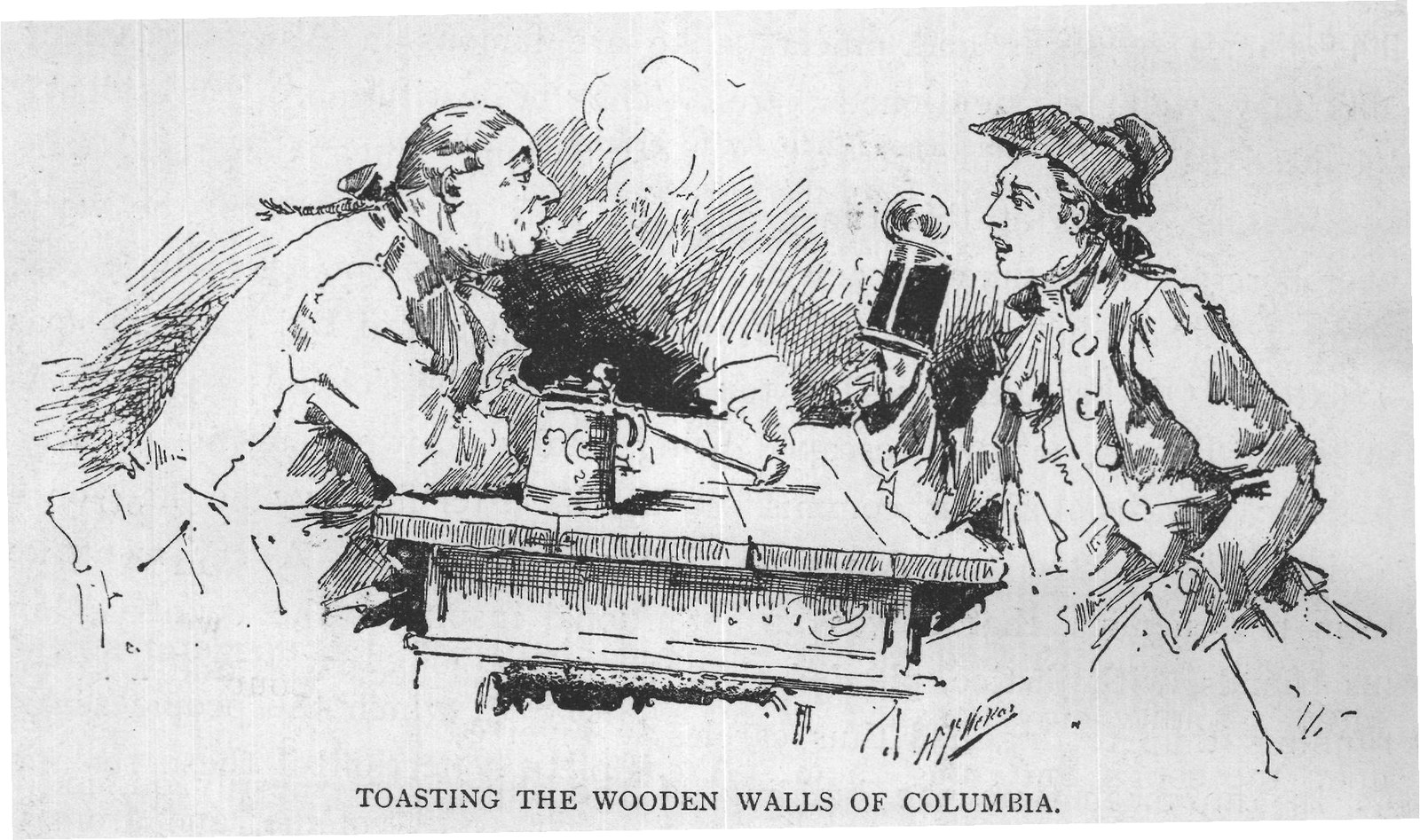
into the water, and, after a graceful dip, rode buoyantly on the placid surface of the Delaware. While the ships were building, the war-feeling against France was steadily growing, and the enthusiasm of the people over the infant navy knew no bounds. Toasts to the "wooden walls of Columbia," and the "rising navy of America," were drunk with cheers at stately public banquets, and by bands of jolly roisterers at tap-houses. The patriotic song writer invaded the columns of the newspapers; and, as these could not afford space for all the poetic effusions, they were printed on broadsides, and hawked about the streets. At Harvard College the students made the chapel walls ring with the ode written by Joseph Story: - "Shall Gallia's clan our coast invade, With hellish outrage scourge. the main, Insult our nation's neutral trade, And we not dare our rights maintain?
Rise, united Harvard's band, Rise, the bulwark of our land."
Admirable as may be the patriotism of this ode, the poetry is not above criticism; but it is classic in comparison with many others. The following stanza and chorus will show the character of one of the most popular street-songs of the day :- "Americans, then fly to arms, And learn the way to use 'em.
If each man fights to 'fend his rights, The French can't long abuse 'em.
Yankee Doodle (mind the tune), Yankee Doodle Dandy; For the French there's trouble brewin':
We'll spank 'em, hand and handy."
From Maine to Georgia the mania for writing such doggerel spread with a rapidity only equalled by the avidity with which the people seized upon the songs, and sung them. A complete collection of these remarkable efforts of poetic art would form an amusing volume, and from it alone a history of political movements in the United States might be written. That even such wretched doggerel had its effect upon popular sentiment, cannot be doubted; for has it not been said, "I care not who makes the laws of a nation, let me but write its songs"? But the manifestation of the growing ill-feeling towards France was not confined to poor but harmless poetizing. The first open rupture took place at Savannah. In the port of that city were lying two long, rakish schooners flying the French tricolor. Their decks were crowded with men, whose rough actions and brutal countenances showed them to be no respecters of law or order. It did not need the rows of cannon protruding from the ports, nor the carefully covered "long Toms" amidships, to indicate to the good people of Savannah that their harbor sheltered two French privateers. Among the seafaring people of the city, the sight of these two vessels aroused the greatest anger. Were they not representatives of the nation whose ships were seizing and burning American vessels in the West Indies almost daily? Perhaps these very vessels were then fresh from an action with some American ship. Who could tell that the holds of the privateers did not at that very minute contain the best part of the cargo of some captured American vessel? Probably the last shot fired from that "long Tom" had crashed into the side of some little brig flying the stars and stripes, and perhaps ended the career of many an American sailor. From suspicions and conjectures, positive statements soon grew. It was whispered about that the two privateers had recently plundered and burned a Yankee ship returning from the West Indies with a goodly store of specie in exchange for her cargo . Those cut-throat-looking Frenchmen were even then stained with the blood of true Americans. The money they threw on the bars of water -side dram-shops, in exchange for the vile rum which was the worst enemy of too many a good jack-tar, was looked upon with suspicion. " What Yankee's pockets did Johnny Crapaud pick to get all that money?" growled the American sailors.
The Frenchmen were not slow in discovering the dislike manifested by the people of Savannah; and like true soldiers of fortune, as they the people of Savannah; and like true soldiers of fortune, as they were, they did nothing to make friends of their enemies. They came ashore in troops instead of singly. Cutlasses hung at their sides. Their tight leather belts held many a knife or clumsy pistol. Their walk on the street was a reckless swagger; and a listener who could understand French could catch in their loud conversation many a scornful sneer or braggart defiance of the Americans.
Such a state of affairs could not long continue. Each party was ready and waiting to fight, and it was not hard to find an excuse. How the waiting to fight, and it was not hard to find an excuse. How the fighting began, no one ever knew; but one night the streets of the little city resounded with cries of rage and groans of agony Soon crowds began to gather; and sailors rushed up and down the streets, crying that the French desperadoes had killed three Americans. The rage of the populace, and particularly of the seafaring community, had no bounds. "Arm! arm! and take bloody vengeance upon the murderers," was the cry in all Bagoare Av. J.B. Purest fran the original by JW Jarvis by p