Home › Ready to Board › Ready to Board
Ready to Board
dogged courage of the English sailor at his best, and had been fairly mowed down by the destructive fire of the Americans. On the "Wasp," the loss of life was slight. The shot of the enemy took effect in the rigging chiefly. The three sailors who were killed were topmen at their posts, and the five wounded were almost all stationed in the rigging. The Americans were not destined to enjoy their triumph long. Shattered though the "Frolic" was, Lieut. Biddle, with a prize-crew, took charge of her, and was in hopes of taking her safely to port; but his plan was rudely shattered by the appearance of an English frigate, only a few hours after the action ceased. For the "Frolic" to escape, was out of the question. Both her masts had gone by the board shortly after her flag was struck; and, when the new enemy hove in sight, the prize-crew was working hard to clear from her decks the tangled mass of rigging, wreckage, and dead bodies, that made the tasks of navigation impossible. The ship was rolling like a log, in the trough of the sea, and was an easy prize for an enemy of even less strength than the man-of-war which was then bearing down upon her. The vessel which came rapidly down before the wind was the "Poictiers," a British seventy-four-gun ship, which would have been more than a match for the little "Wasp," even though the latter had been fresh and ready for battle, instead of shattered by desperate fight. Seeing no chance for a successful resistance, Capt. Jones determined upon flight, and ordered all hands aloft, to make sail. But the sails when shaken out were found to have been cut to pieces by the "Frolic's" shot; and the "Poictiers" soon came alongside, and changed the triumph of the Americans to defeat.
Though Capt. Jones and his gallant crew were thus deprived of their hard-won conquest, they received their full meed of praise from their countrymen. They were soon exchanged, voted twenty-five thousand dollars prize-money by Congress, and lauded by every newspaper and legislative orator in the country. The song-writers of the day undertook to celebrate in verse the famous victory, and produced dozens of songs, of which the following stanza may be taken for a fair sample:- "Like the fierce bird of Jove the 'Wasp' darted forth, And he the tale told, with amazement and wonder.
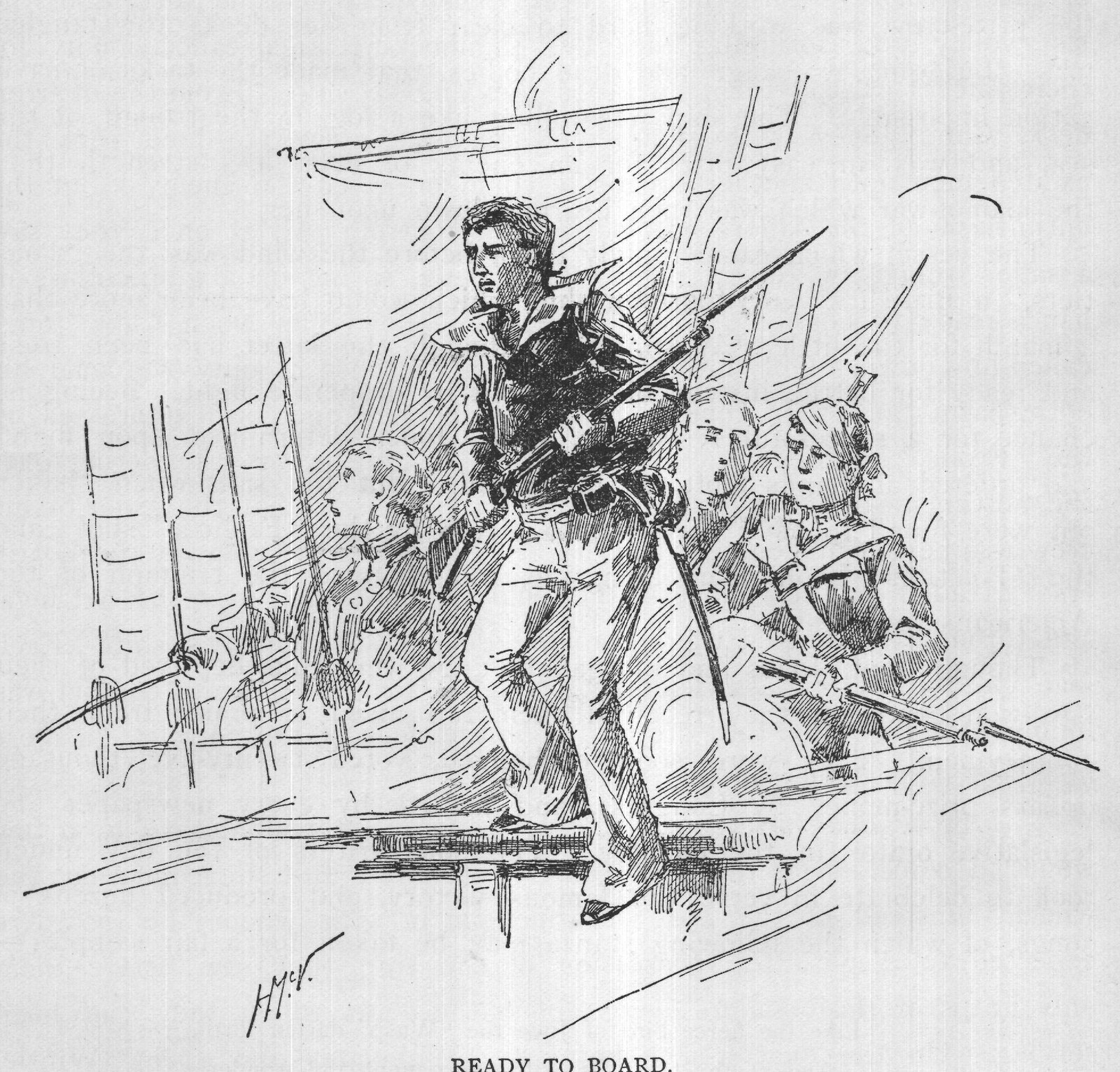
She hurled on the foe from her flame-spreading arms, The fire-brands of death and the red bolts of thunder. And, oh! it was glorious and strange to behold What torrents of fire from her red mouth she threw; And how from her broad wings and sulphurous sides, Hot showers of grape-shot and rifle-balls flew!"
Let us now turn to Commodore John Rodgers, whose unlucky cruise at the opening of the war we have already noted. Having refitted his squadron in the port of New York, he set sail on a second cruise, leaving behind him the "Hornet." Again he seemed to have fallen upon unprofitable times, for his ships beat up and down in the highway of commerce without sighting a single sail. After several days of inaction, it was determined to scatter the squadron; and to this end the frigate "United States," Commodore Decatur, and the sixteen-gun brig "Argus," Capt. Sinclair, left the main body of ships and started off on a cruise in company. After the two ships left the main body, Commo dore Rodgers met with better success, capturing a Jamaica packet with two hundred thousand dollars in her hold, and chasing a British frigate for two hours, but without overhauling her.