Home › Opening of the American Revolution. - The › Opening of the American Revolution. - The: Newport
Opening of the American Revolution. - The: Newport
Between Providence and Newport, illicit trade flourished; and the waters of Narragansett Bay were dotted with the sail of small craft carrying cargoes on which no duties had ever been paid. In order to stop this nefarious traffic, armed vessels were stationed in the Bay, with orders to chase and search all craft suspected of smuggling. The presence of these vessels gave great offence to the colonists, and the inflexible manner in which the naval officers discharged their duty caused more than one open defiance of the authority of King George. The first serious trouble to grow out of the presence of the British cruisers in the bay was the affair of the schooner "St. John." This vessel was engaged in patrolling the waters of the bay in search of smugglers. While so engaged, her commander, Lieut. Hill, learned that a brig had discharged a suspicious cargo at night near Howland's Ferry. Running down to that point to investigate, the king's officers found the cargo to consist of smuggled goods; and, leaving a few men in charge, the cruiser hastily put out to sea in pursuit of the smuggler. The swift sailing schooner soon overtook the brig, and the latter was taken in to Newport as a prize. Although this affair occurred early in 1764, the sturdy colonists even then had little liking for the officers of the king. The sailors of the "St. John," careless of the evident dislike of the citizens of the town, swaggered about the streets, boasting of their capture, and making merry at the expense of the Yankees. Two or three fights between sailors and townspeople so stirred up the landsmen, that they determined to destroy the "St. John," and had actually fitted up an armed sloop for that purpose, when a second man-of-war appeared in the harbor and put a final stopper to the project. Though thus balked of their revenge, the townspeople showed their hatred for the king's navy by seizing a battery, and firing several shots at the two armed vessels, but without effect. During the same year, the little town of Newport again gave evidence of the growth of the revolutionary spirit. This time the good old British custom of procuring sailors for the king's ships by a system of kidnapping, commonly known as impressment, was the cause of the outbreak. For some months the British man-of-war "Maidstone" lay in the harbor of Newport, idly tugging at her anchors. It was a period of peace, and her officers had nothing to occupy their attention. Therefore they devoted themselves to increasing the crew of the vessel by means of raids upon the taverns along the water-front of the city.
The seafaring men of Newport knew little peace while the "Maidstone" was in port. The king's service was the dread of every sailor; and, with the press-gang nightly walking the streets, no sailor could feel secure. All knew the life led by the sailors on the king's ships. Those were the days when the cat-o'-nine-tails flourished, and the command of a beardless bit of ト a midshipmen was enough to send a poor fellow to the gratings, to have his back cut to pieces by the merciless lash. The Yankee sailors had little liking for this phase of sea-life, and they gave the men-of-war a wide berth.
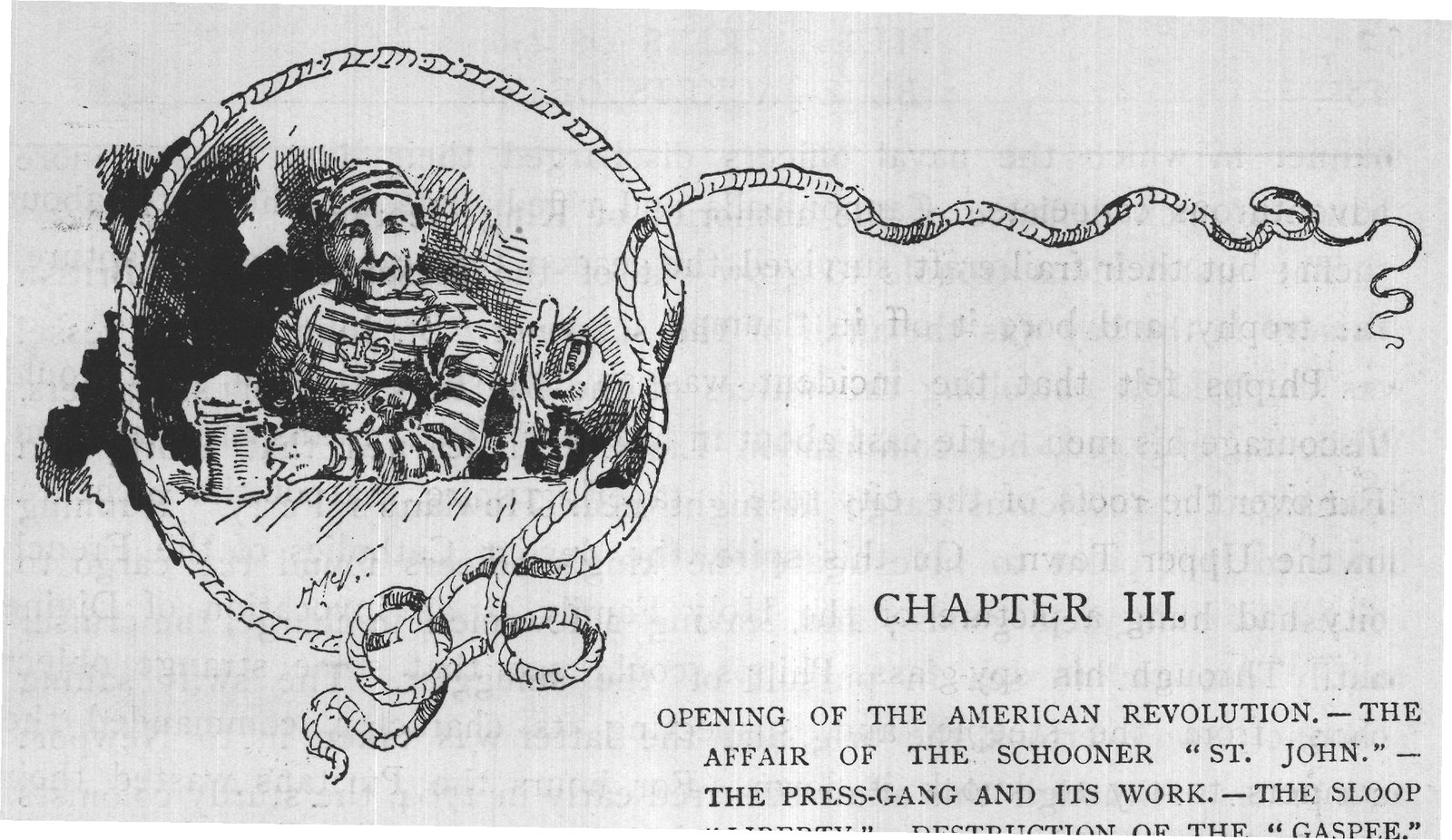
Often it happened, however, that a party of jolly mariners sitting over their pipes and grog in the snug parlor of some sea-shore tavern, spinning yarns of the service they had seen on the gun-decks of his Majesty's ships, or of shipwreck and adventure in the merchant service, would start up and listen in affright, as the measured tramp of a body of men came up the street. Then came the heavy blow on the door. "Open in the king's name," shouts a gruff voice outside; and the entrapped sailors, overturning the lights, spring for doors and windows, in vain attempts to escape the fate in store for them. The press-gang seldom returned to the ship empty handed, and the luckless tar who once fell into their clutches was wise to accept his capture good naturedly; for the bos'n's cat was the remedy commonly prescribed for sulkiness. As long as the "Maidstone" lay in the harbor of Newport, raids such as this were of common occurrence. The people of the city grumbled a little; but it was the king's will, and none dared oppose it. The wives and sweethearts of the kidnapped sailors shed many a bitter tear over the disappearance of their husbands and lovers; but what were the tears of women to King George? And so the press-gang of the "Maidstone" might have continued to enjoy unopposed the stirring sport of hunting men like beasts, had the leaders not committed one atrocious act of inhumanity that roused the long-suffering people to resistance.
One breezy afternoon, a stanch brig, under full sail, came up the bay, and entered the harbor of Newport. Her sides were weather-beaten, and her dingy sails and patched cordage showed that she had just completed her long voyage. Her crew, a fine set of bronzed and hardy sailors, were gathered on her forecastle, eagerly regarding the cluster of cottages that made up the little town of Newport. In those cottages. were many loved ones, wives, mothers, and sweethearts, whom the brave fellows had not seen for long and weary months; for the brig was just returning from a voyage to the western coast of Africa. It is hard to describe the feelings aroused by the arrival of a ship in port after a long voyage. From the outmost end of the longest wharf the relatives and friends of the sailors eagerly watch the approaching vessel, striving to find in her appearance some token of the safety ci the loved ones on board. If a flag hangs at half-mast in the rigging, bitter is the suspense, and fearful the dread, of each anxious waiter, lest her husband or lover or son be the unfortunate one whose death is mourned. And on the deck of the ship the excitement is no less great. Even the hardened breast of the sailor swells with emotion when he first catches sight of his native town, after long months of absence. With eyes sharpened by constant searching for objects upon the broad bosom of the ocean, he scans the waiting crowd, striving to distinguish in the distance some well-beloved face. His spirits are light with the happy anticipation of a season in port with his loved ones, and he discharges his last duties before leaving the ship with a blithe heart. VIS So it was with the crew of the home-coming brig. Right merrily they sung out their choruses as they pulled at the ropes, and brought the vessel to anchor. The rumble of the hawser through the hawseholes was sweet music to their ears; and so intent were they upon the crowd on the dock, that they did not notice two long-boats which had put off from the man-of-war, and were pulling for the brig. The captain of the merchantman, however, noticed the approach of the boats, and wondered what it meant. "Those fellows think I've smuggled goods aboard," said he. "However, they can spend their time searching if they want. I've nothing in the hold I'm afraid to have seen.” The boats were soon alongside; and two or three officers, with a handful of jackies, clambered aboard the brig. "Muster your men aft, captain," said the leader, scorning any response to the captain's salutation. "The king has need of a few fine fellows for his service." "Surely, sir, you are not about to press any of these men," protested the captain. "They are just returning after a long voyage, and have not yet seen their families." “ "What's that to me, sir?" was the response. "Muster your crew without more words."