Home › In the Storm. - Arrival in America › In the Storm. - Arrival in America: Dale
In the Storm. - Arrival in America: Dale
Lieut. Dale remained in command of the "Serapis." Seating himself on the binnacle, he ordered the lashings which had bound the two ships throughout the bloody conflict to be cut. Then the head-sails were braced back, and the wheel put down. But, as the ship had been anchored at the beginning of the battle, she refused to answer either helm or canvas. Vastly astounded at this, Dale leaped from the binnacle; but his legs refused to support him, and he fell heavily to the deck. His followers sprang to his aid; and it was found that the lieutenant had been severely wounded in the leg by a splinter, but had fought out the battle without ever noticing his hurt.
So ended this memorable battle. But the feelings of pride and exultation so natural to a victor died away in the breast of the American captain as he looked about the scene of wreck and carnage. On all sides lay the mutilated bodies of the gallant fellows who had so bravely stood to their guns amid the storm of death-dealing missiles. There they lay, piled one on top of the other, - some with their agonized writhings caught and fixed by death; others calm and peaceful, as though sleeping. Powder-boys, young and tender, lay by the side of grizzled old seamen. Words cannot picture the scene. In his journal Capt. Jones wrote:- "A person must have been an eye-witness to form a just idea of the tremendous scene of carnage, wreck, and ruin that everywhere appeared. Humanity cannot but recoil from the prospect of such finished horror, and lament that war should produce such fatal consequences." But worse than the appearance of the main deck was the scene in the cockpit and along the gun-deck, which had been converted into a temporary hospital. Here lay the wounded, ranged in rows along the deck. Moans and shrieks of agony were heard on every side. The surgeons were busy with their glittering instruments. The tramp of men on the decks overhead, and the creaking of the timbers of the waterlogged ship, added to the cries of the wounded, made a perfect bedlam of the place.
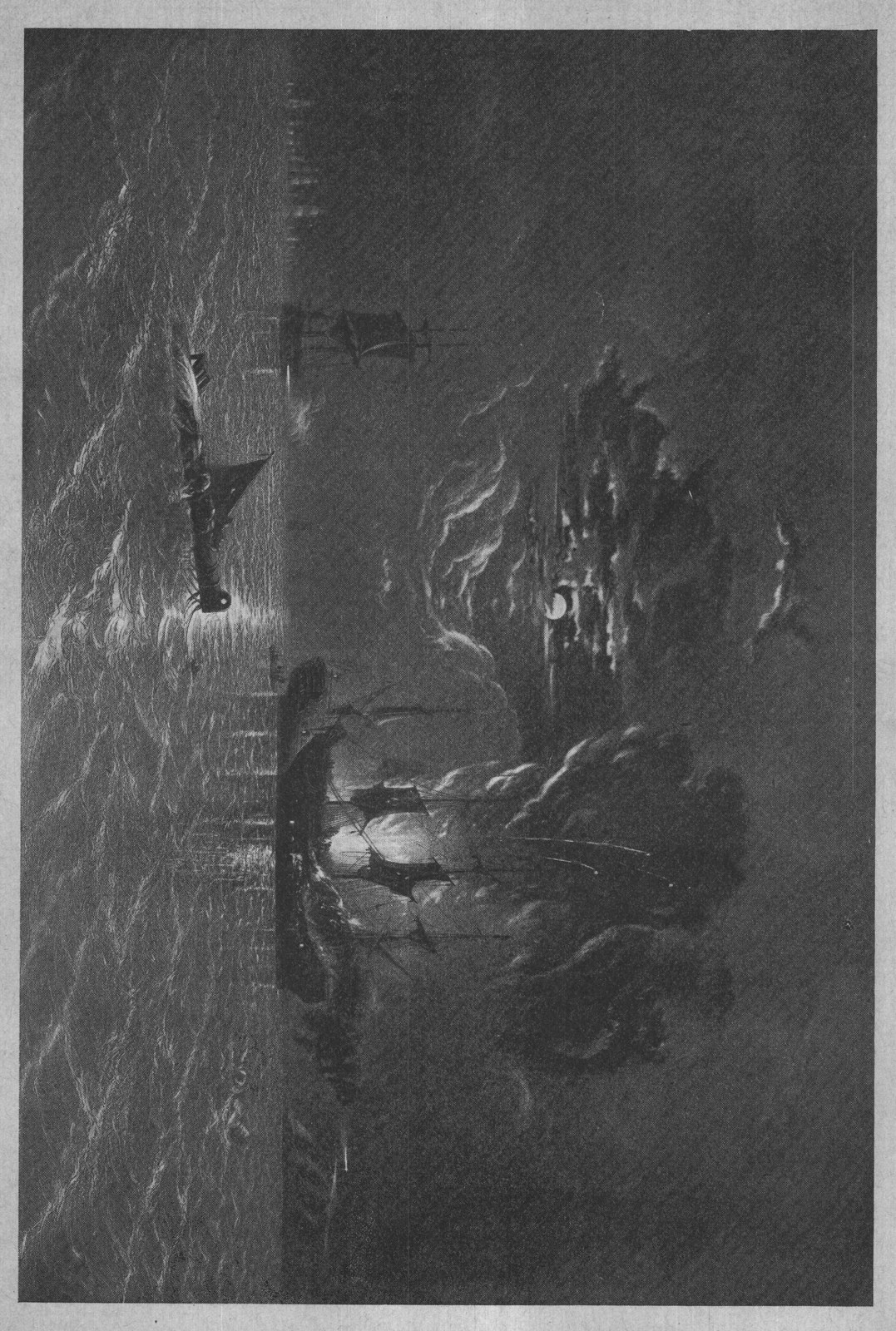
It did not take long to discover that the "Bon Homme Richard" was a complete wreck, and in a sinking condition. The gallant old craft had kept afloat while the battle was being fought; but now, that the victory had remained with her, she had given up the struggle against the steadily encroaching waves. The carpenters who had explored the hold came on deck with long faces, and reported that nothing could be done to stop the great holes made by the shot of the "Serapis." Therefore Jones determined to remove his crew and all the wounded to the "Serapis," and abandon the noble "Richard" to her fate. Accordingly, all available hands were put at the pumps, and the work of transferring the wounded was begun. Slings were rigged over the side; and the poor shattered bodies were gently lowered into the boats awaiting them, and, on reaching the "Serapis," were placed tenderly in cots ranged along the main deck. All night the work went on; THE ACTION BETWEEN THE "BON HOMME RICHARD" AND THE "SERAPIS," SEPTEMBER 23, 1779 and by ten o'clock the next morning there were left on the "Richard" only a few sailors, who alternately worked at the pumps, and fought the steadily encroaching flames.
For Jones did not intend to desert the good old ship without a struggle to save her, even though both fire and water were warring against her. Not until the morning dawned did the Americans fully appreciate how shattered was the hulk that stood between them and a watery grave. Fenimore Cooper, the pioneer historian of the United States navy, writes: - "When the day dawned, an examination was made into the situation of the 'Richard.' Abaft on a line with those guns of the 'Serapis ' that had not been disabled by the explosion, the timbers were found to be nearly all beaten in, or beaten out, — for in this respect there was little difference between the two sides of the ship, — and it was said that her poop and upper decks would have fallen into the gun-room, but for a few buttocks that had been missed. Indeed, so large was the vacuum, that most of the shot fired from this part of the 'Serapis,' at the close of the action, must have gone through the 'Richard' without touching any thing. The rudder was cut from the stern post, and the transoms were nearly driven out of her. All the after-part of the ship, in particular, that was below the quarter-deck was torn to pieces; and nothing had saved those stationed on the quarter-deck but the impossibility of sufficiently elevating guns that almost touched their object." Despite the terribly shattered condition of the ship, her crew worked manfully to save her. But, after fighting the flames and working the pumps all day, they were reluctantly forced to abandon the good ship to her fate. It was nine o'clock at night, that the hopelessness of the task became evident. The "Richard" rolled heavily from side to side. The sea was up to her lower port-holes. At each roll the water gushed through her port-holes, and swashed through the hatchways. At ten o'clock, with a last dying surge, the shattered hulk plunged to her final resting-place, carrying with her the bodies of her dead. They had died the noblest of all deaths, - the death of a patriot killed in doing battle for his country. They receive the grandest of all burials, - the burial of a sailor who follows his ship to her grave, on the hard, white sand, in the calm depths of the ocean.
How many were there that went down with the ship? History does not accurately state. Capt. Jones himself was never able to tell how great was the number of dead upon his ship. The most careful estimate puts the number at forty-two. Of the wounded on the American ship, there were about forty. All these were happily removed from the "Richard" before she sunk.
On the "Serapis" the loss was much greater; but here, too, history is at fault, in that no official returns of the killed and wounded have been preserved. Capt. Jones's estimate, which is probably nearly correct, put the loss of the English ship at about a hundred killed, and an equal number wounded.
The sinking of the "Richard" left the "Serapis" crowded with wounded of both nations, prisoners, and the remnant of the crew of the sunken ship. No time was lost in getting the ship in navigable shape, and in clearing away the traces of the battle. The bodies of the dead were thrown overboard. The decks were scrubbed and sprinkled with hot vinegar. The sound of the hammer and the saw was heard on every hand, as the carpenters stopped the leaks, patched the deck, and rigged new spars in place of those shattered by the "Richard's" fire. All three of the masts had gone by the board. Jury masts were rigged; and with small sails stretched on these the ship beat about the ocean, the plaything of the winds. Her consorts had left her. Landais, seeing no chance to rob Jones of the honor of the victory, had taken the "Alliance" to other waters. The "Pallas" had been victorious in her contest with the "Countess of Scarborough;" and, as soon as the issue of the conflict between the "Bon Homme Richard" and the "Serapis" had become evident, she made off with her prize, intent upon gaining a friendly port. The "Richard," after ten days of drifting, finally ran into Texel, in the north of Holland.
The next year was one of comparative inactivity for Jones. He enjoyed for a time the praise of all friends of the revolting colonies. He was the lion of Paris. Then came the investigation into the action of Landais at the time of the great battle. Though his course at that time was one of open treachery, inspired by his wish to have Jones strike to the "Serapis," that he might have the honor of capturing both ships, Landais escaped any punishment at the hands of his French compatriots. But he was relieved of the command of the "Alliance," which was given to Jones. Highly incensed at this action, the erratic Frenchman incited the crew of the "Alliance" to open mutiny, and, taking command of the ship himself, left France and sailed for America, leaving Commodore Jones in the lurch. On his arrival at Philadelphia, Landais strove to justify his action by blackening the character of Jones, but failed in this, and was dismissed the service. His actions should be regarded with some charity, for the man was doubtless of unsound mind. His insanity became even more evident after his dismissal from the navy; and from that time, until the time of his death, his eccentricities made him generally regarded as one mentally unsound. Jones, having lost the "Alliance" by the mutiny of Landais, remained abroad, waiting for another ship. He travelled widely on the Continent, and was lavishly entertained by the rich and noble of every nation. Not until October, 1780, did he again tread the deck of a vessel under his own command.