Home › Hull Makes a Reconnoissance › Hull Makes a Reconnoissance
Hull Makes a Reconnoissance
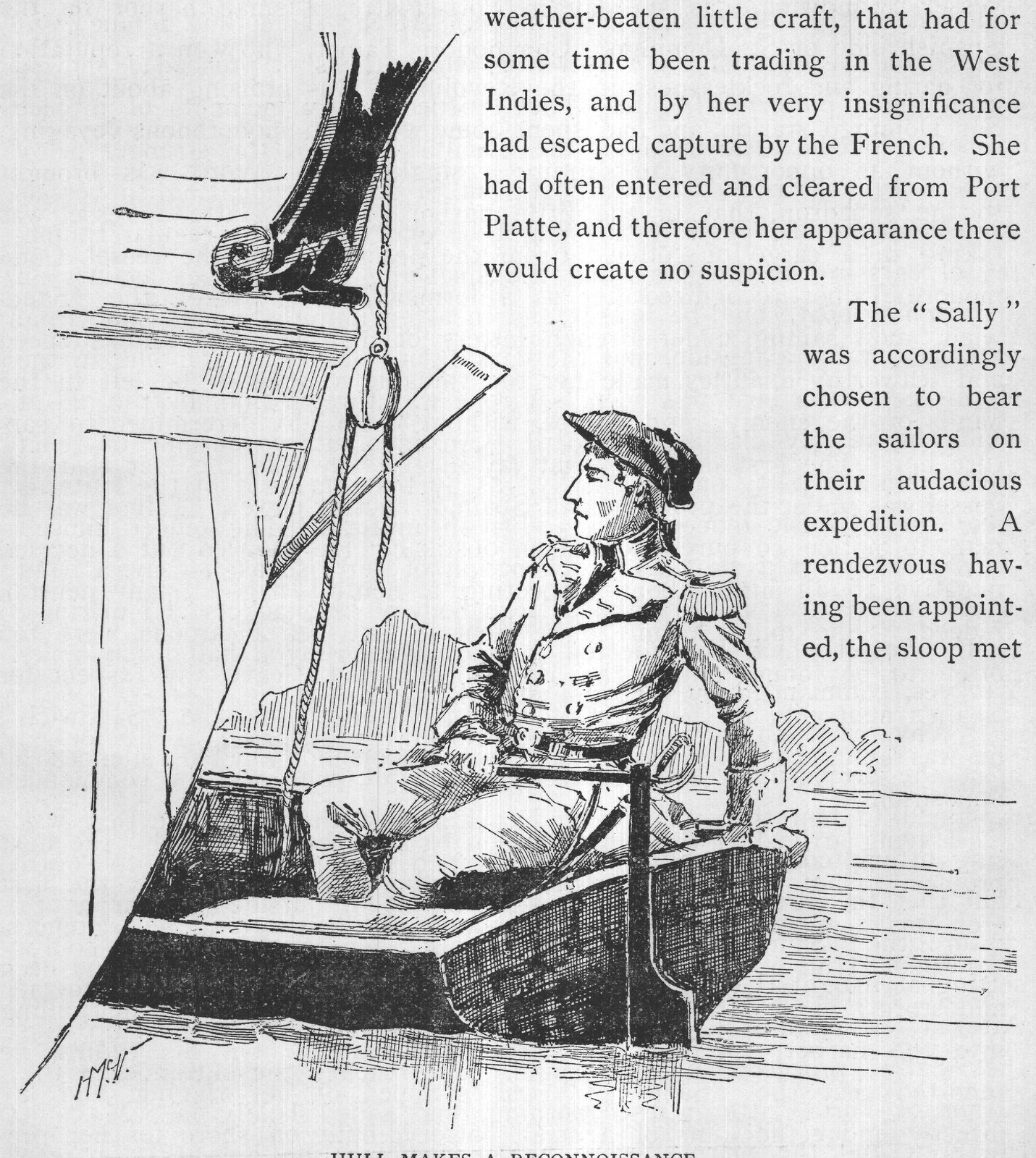
the "Constitution" far out at sea; and a large body of blue-jackets and marines left the frigate, and took quarters on the clumsy little merchantman, which then laid her course for Port Platte. About midnight the lookouts on the "Sally" saw a vessel's lights near at hand; but, beyond reporting to the officer of the deck, they paid no heed to their neighbor. Suddenly, however, out of the darkness came a bright flash; and the hum of a heavy shot in the air above the "Sally" was followed by the dull report of a cannon. At the same time a blue light burned on the deck of the vessel from which the shot proceeded, showed her to be a powerful frigate. Then ensued a few moments of intense suspense for the little band on the "Sally." Should the stranger prove to be a French frigate, all was lost; but in that latitude English vessels were common, and possibly this might be one. Soon the regular thumping of oars in the tholepins, and the splashing of the waves against an approaching boat, could be heard; and in a few minutes a hail came from the black water alongside, and the dark figure of a man standing in the stern-sheets of a boat was seen. A rope was thrown him, by the aid of which he nimbly clambered aboard. An involuntary murmur of relief arose from the party on the "Sally," as by the dim light of the lanterns they saw that the officer wore a British uniform. The officer himself could not repress a start and exclamation of surprise as he saw a band of officers in naval uniform, and a large body of blue-jackets and marines, on the vessel which he expected to find manned by a half-dozen lanky Yankees, commanded by a down-east "skipper." "Why, what ship's this?" he exclaimed in surprise, as he looked upon the armed men about him. Lieut. Hull, who was in command, explained to him the situation, and told him of the adventure that was being attempted. The officer seemed much disappointed, and told Mr. Hull that the British frigate was standing about outside the harbor, to capture the "Sandwich" as she came out; but the idea of so boldly setting at naught the principles of neutrality had not occurred to them. After a few minutes' conversation, the visitor returned to his ship, and the "Sally" proceeded on her errand. She reached the entrance to the harbor of Port Platte in the morning, and sailed boldly in. Most of the crew and the marines were hidden beneath the bulwarks, or sent below; so that the people on the "Sandwich" gave but a glance to the approaching vessel, until she ran so close to their vessel's bows that they feared an accident. "Look out there, or you'll run foul of us!" shouted a mate from the ८ deck of the "Sandwich; and, as if his cry was a signal, the helm of the "Sally" was put down, the vessel ranged up alongside, and in an instant a torrent of armed men poured over the sides of the surprised Frenchman, and drove the crew below. There was no resistance. The ship was captured in five minutes. The marines of the expedition had been sent ashore to spike the guns of the battery, and their work was performed with equal promptitude. Then all hands set to work rigging the captured vessel, and getting her ready for sea. On the shore the people were in the greatest excitement, beating drums, parading the few militia, and threatening dire revenge in the name of outraged Spain. But the captors of the vessel paid but little attention to their enemies; and by sunset the "Sandwich," with all sails set, left the harbor, and joined the United States squadron.
The news of this achievement, lawless as it was, evoked great enthusiasm in the United States. A nation's conscience is elastic; and the people praised the heroes of the "Sandwich" episode, much as sixty-five years later they commended the commander of the "Wachuset" for running down and capturing the Confederate ship "Florida," which was relying upon the protection of a neutral port in Brazil. Yet in 1814, when two British frigates attacked and captured the "Essex" in the harbor of Rio Janeiro, the good people of the United States were loud in their denunciations of the treachery of a commander who would so abuse the protection of a neutral nation. Such inconsistencies are only too common in the history of nations. In the end, however, the affair of the "Sandwich" terminated disastrously for the bold adventurers; for the protests of Spain were too forcible to be disregarded, and the prizemoney of all concerned in the exploit was confiscated to pay the damages awarded the injured party.