Home › Drilling the Raw Recruits › Drilling the Raw Recruits: Americans
Drilling the Raw Recruits: Americans
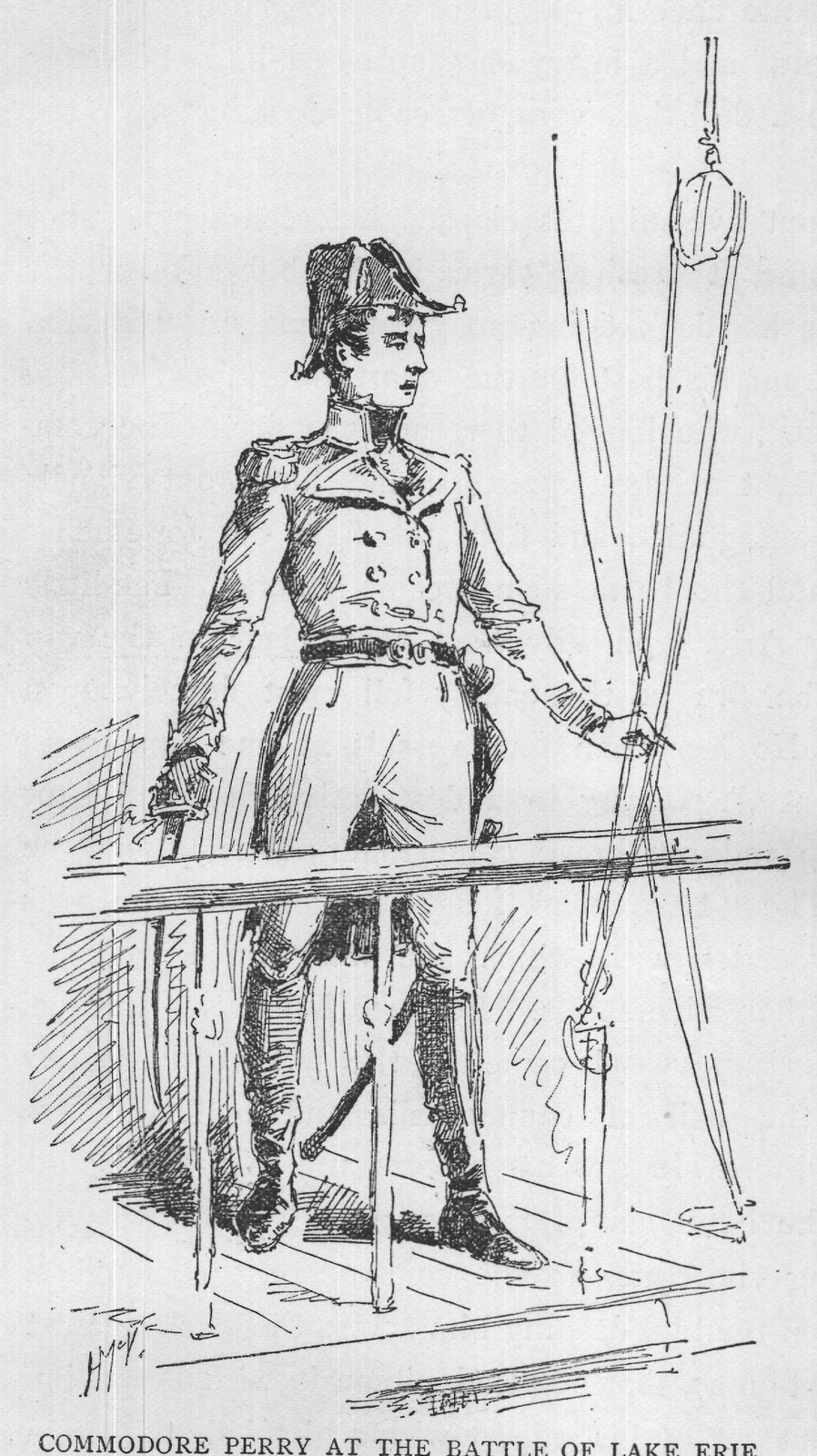
For some time the Americans held back, manœuvring to get the weather-gauge; but Perry's impatience for the fray got the better of his caution, and he determined to close at once. His first officer remonstrated, saying, "Then you'll have to engage the enemy to leeward." "I don't care," responded the commodore. "Leeward or windward, they shall fight to-day." Then, turning to the quartermaster, he called for the battle-flag, which being brought, he mustered the crew aft, and addressed them briefly, telling them of the task before them, and urging them to fight bravely for the victory. "My brave lads," he concluded, "this flag bears the last words of Capt. Lawrence. Shall I hoist it?" دو "Ay, ay, sir!" cried the jackies, in unison; and, as the flag was swiftly run to the masthead, the cheers of the sailors on the deck of the "Lawrence were echoed from the neighboring vessels, as the white letters showed boldly against the blue flag, bearing to each commander the exhortation, "Don't give up the ship!"
The battle-signal being thus displayed, the vessels moved onward to the attack. As the crew of the "Lawrence" stood at their guns, the cooks passed along the decks, handing to each man a bit of food, that his strength might not leave him in the coming struggle. Then followed boys with boxes of sand, which they strewed upon the decks, to afford a firm foothold for the men at the guns. The hammocks were stowed along the nettings, to serve as some little protection against flying shot. The men stood silent and pale at their quarters, each occupied with his own grave thoughts, but all determined to fight like brave men and true for the honor of the flag. By Perry's side stood his brother, a boy thirteen years old, armed and ready to do his duty as well as the older men. The British came on gallantly. Barclay had lost all his diffidence, and brought up his vessels like a veteran. His ships were kept close together; the ship "Detroit" under short sail, that the pygmy sloop "Little Belt" might not be left in the rear. The Americans came down in single file, headed by the schooner "Scorpion." Suddenly through the still air rang out the sharp notes of a bugle-call on the enemy's flag-ship. It was the signal for action; and, as the last notes died away, the bands struck up "Rule, Britannia." The Americans answered with cheers; and in the midst of the cheering, a jet of smoke and fire spurted from the side of the "Detroit," and a heavy shot splashed into the water near the "Lawrence," while a dull, heavy report came booming over the water.
The battle was opened, but five minutes elapsed before a second shot was fired. When it did come, it crashed through the bulwarks of the "Lawrence," and sped across her deck, doing no great damage. "Steady, lads, steady," cried Perry, from his post on the quarter-deck, as he saw an uneasy stir among his men, who longed to return the fire. The commodore was determined to fight at close quarters, and hung out signals for each ship to choose its antagonist, and fight the fight out for itself. It was then high noon, and the battle soon became general. The little schooners "Scorpion" and "Ariel" pluckily kept their place in the van of the American line, but the fire of the enemy fell most fiercely upon the flag-ship "Lawrence." No less than four vessels at one time were grouped about the "Lawrence," pouring in a destructive fire, and bent upon destoying the flag-ship and her brave commander; then taking the smaller vessels in detail. The "Lawrence" fought bravely, but the odds were too great. The carronades with which she was armed were no match for the long guns of her adversaries. For two hours the unequal combat raged, and no American vessel came to the aid of the sorely smitten flag-ship. Amid the hail of cannon-balls and bullets, Perry seemed to bear a charmed life. He saw his officers and men falling all about him. John Brooks, the lieutenant of marines, fought by the commodore's side. While speaking cheerfully to the commodore, a cannon-ball struck the young lieutenant on the hip, dashing him across the deck against the bulwark, and mutilating him so, that he plead piteously with Perry, imploring that he might be put out of his misery with a pistol-shot. From this awful spectacle Perry turned to speak to the captain of a gun, when the conversation was abruptly cut short by a shot which killed the seaman instantly. Perry returned to the quarter-deck. The first lieutenant came rushing up, his face bloody, and his nose swelled to an enormous size from a splinter which had perforated it. "All the officers in my division are killed," he cried. "For God's sake, give me more!" Perry sent some men to his aid; but they soon fell, and the cry for more men arose again. One of the surgeons who served in the cockpit on that dreadful day states, that, in the midst of the roar of battle, Perry's voice was heard calling down the hatchway, and asking any surgeon's mates who could be spared, to come on deck and help work the guns. Several went up; but the appeal was soon repeated, and more responded. When no more men could be obtained, the voice of the commodore took a pleading tone. "Can any of the wounded pull a rope?" said he; and such was his ascendency over the men, that several poor mangled fellows dragged themselves on deck, and lent their feeble strength to the working of the guns.