Home › Cutting Away the Flag › Cutting Away the Flag
Cutting Away the Flag
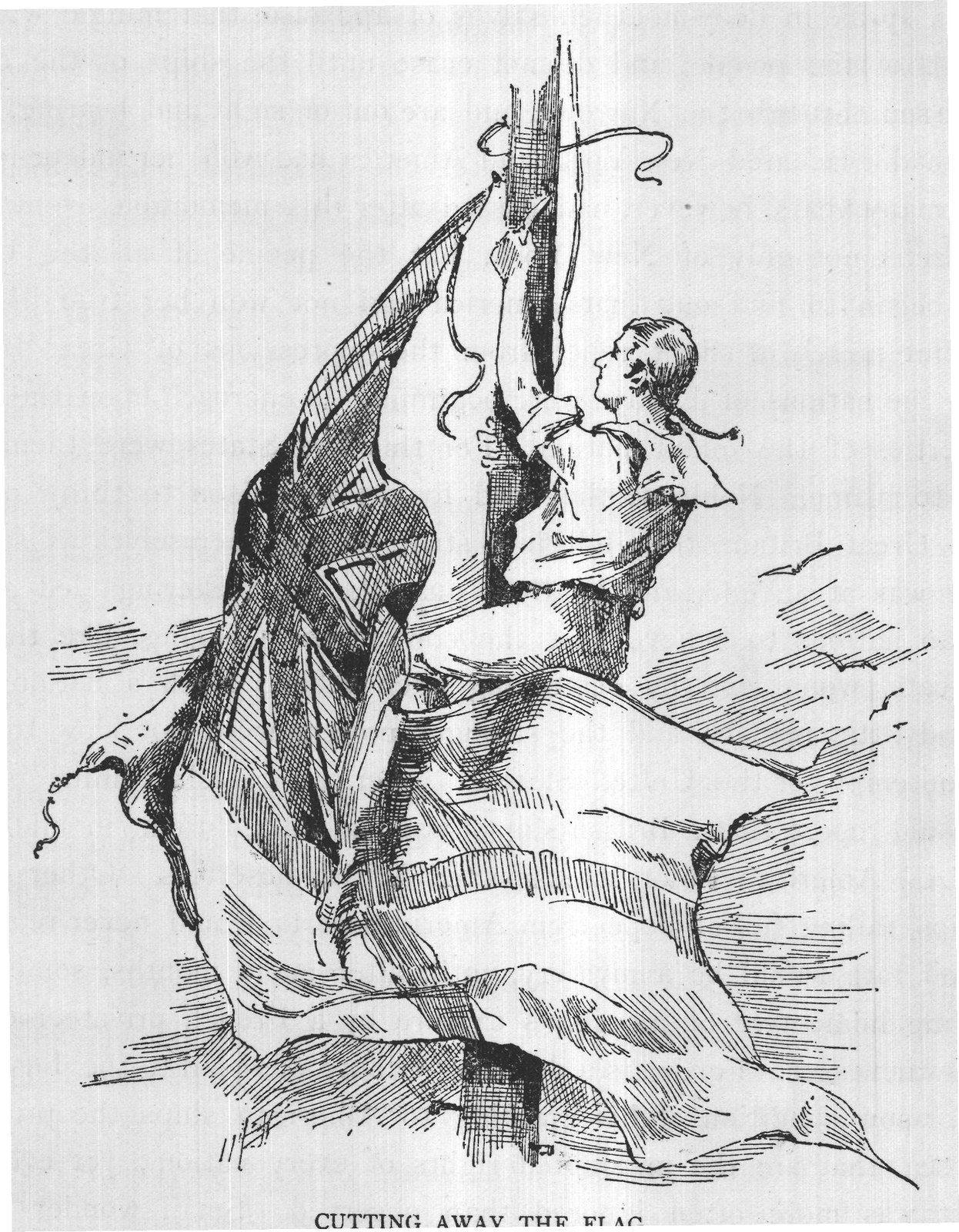
to the scene of action; and again the sailor-boy becomes the hero of the moment. With his pockets filled with cleats, and his mouth stuffed with nails, he begins again his ascent of the slippery staff. He nails cleat after cleat upon the pole, and step by step mounts toward the top. At last he reaches the flag; and, with a few quick jerks, it is torn from the pole, and thrown contemptuously out into the air, to float down upon the crowd, and be torn to pieces by curiosity seekers. Then the halliards are lowered, and soon the flag of the young and struggling nation floats in the cool breeze; while from the neighboring heights the cannon of the forts speak in deep-mouthed salvos of applause, that mingle with the rejoicings of the people, and do not cease until the ships of the enemy have passed through the Narrows, and are out of sight and hearing. The British had evacuated New York, and America had won her independence. Not many years, however, had passed after this memorable event, when the citizens not only of New York, but the people of all the United States, began to find out that America had not won her true independence, but merely a slight relief from the oppressions of Great Britain. Already the nations of Europe were beginning to encroach upon the rights and liberties of the infant nation. For this the States were themselves greatly to blame. Nobly as they had fought in unison to throw off the yoke of Great Britain, they fell into strife among themselves as soon as the war was at an end, and by their quarrels and bickerings led all the European nations to believe that the contentious Colonies, like the Kilkenny cats, would end by destroying each other. Such a nation could command little respect, and the stronger powers were not slow to show their contempt for the United States. American vessels, coming back to port, would report that a British ship-of-war had halted them in mid-ocean, and seized American sailors as suspected British deserters. Other American ships, sailing full of hope from American ports, would never re-appear, and their fate would be a mystery, until, after many months, some sailor wandering home told of his ship's capture by a French privateer or Tripolitan war vessel. For years a debasing tribute was paid to the Bashaw of Tripoli, upon condition of his granting to American ships the privileges of the sea, that are the undoubted rights of every nation; yet even this compact was more often ignored than observed. Small wonder was it that the sage old statesman, Benjamin Franklin, on hearing a young man speak of the "glorious war for independence," responded gravely, "Say rather the war of the revolution: the war for independence is yet to be fought."
In the year 1789, the States, after much debate and bickering, finally ratified the document known as the Constitution of the United States. While the work of the American Revolution was thus being completed, and a new nation was being formed, events were transpiring on the other side of the Atlantic that were destined to affect gravely the growth of the new nation. The oppressed peasantry and laborers of France, smarting under the wrongs of centuries, rose in a mighty wave, and swept away the nobles, their masters. The royal head of King Louis fell a prey to the remorseless spirit of the guillotine, and the reign of terror in Paris began. Soon the roll of the drum was heard in every European city, and the armies of every nation were on the march for France. England was foremost in the fray; and the people of the United States, seeing their old enemy at war with the country of Lafayette, fired by generous enthusiasm, were ready to rush to the aid of their old ally. But the wise prudence of their rulers restrained them; and for the next twenty years the United States were neutrals, while all the nations of Europe were plunged in war.