Home › Contents › Commodore Perry
Commodore Perry
Several days passed, as the "Sampson" lay becalmed in the tropics. Barney, though too old a sailor to be cast down by misfortune, nevertheless chafed under his situation. From prize-master and prize-crew he received nothing but scurrilous epithets; and the oft-repeated murmurs of "Rebel rascal!" "Yankee traitor!" "Blow out his brains!" and "Throw him overboard!" made it hard for him to believe the Revolution over, and the United States and England at peace. Even while they thus abused the captain, the rogues were feasting upon his provisions and drinking his wines; and only his firm refusal to give up his keys prevented their rifling his iron chest, and filling their pockets with his dollars. At last he began to feel that his life was no longer safe in the hands of his captors; and, though he had by him but three men of his original crew, he determined to attempt to recapture the ship. One evening the captain managed to catch a few minutes' conversation with the carpenter and boatswain of his own crew, and broached to them the project for a recapture. No argument was needed to induce these bold men to embark in the perilous enterprise. Indeed, from the very moment of the capture, they must have cherished some such purpose; for each had hidden away in his bunk a gun and bayonet. Barney, on his part, had secreted a small brass blunderbuss and a broad-sword; and with this meagre armament the three determined to take the ship from its captors.
The success of the project then depended upon a favorable opportunity, and the three conspirators watched eagerly for the decisive moment to arrive. At last there came a day so squally that all the prize-crew were kept busy with the sails all the morning. Much exhausted, the sailors sat down to their dinner on the forecastle at noon, while the three British officers spread their mess amidships. Barney saw that the moment had arrived; and, giving the signal to his men, the plotters went below for their weapons. Barney was the first to re-appear, the blunderbuss, loaded and cocked, in his hand, and the naked cutlass under his arm. Hardly had he stepped on deck when one of the officers saw him, and, throwing down dishes and dinner, sprang at the American and grappled with him. Barney struggled violently, and soon managing to get the blunderbuss against his enemy's shoulder, fired it, filling the wretch's arm and side with buckshot. Freed from his adversary, the gallant captain cut down with a blow of his cutlass the second prize officer, who was advancing upon him; and the third, seeing his two companions lying, drenched with blood, upon the deck, ran below. In the mean time the crew, startled from their dinner by the report of the blunderbuss, had rushed below for their weapons; but the last man had hardly dived down the hatchway when the wily carpenter and boatswain rushed forward, clapped on the hatches, and in a trice had the British sailors nicely cooped up in the forecastle. The two wounded officers were quickly cared for, and the unhurt fugitive secured; and Barney found himself again in control of the ship.
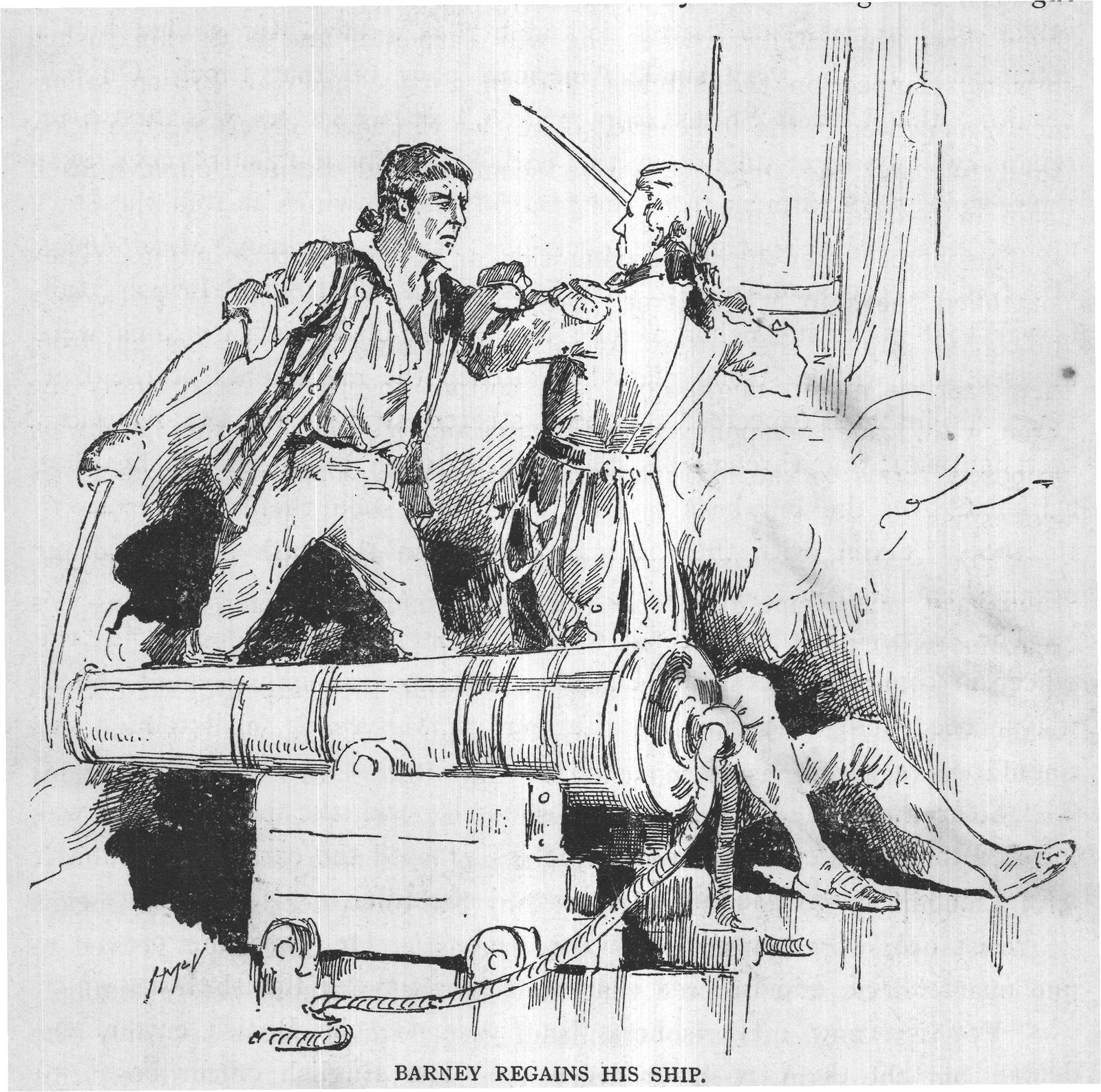
The victors then held a consultation as to their future action. They controlled the ship, it was true; but what were three men to do with a full-rigged ship on the stormy Atlantic? Clearly they must get aid from their captives, or all might go to the bottom together. Accordingly the three, with loaded weapons, went forward, and standing at the hatchway, proposed terms to the imprisoned sailors below. Capt. Barney acted as spokesman. "You shall be released from confinement," cried he to the captives, "and may now come on deck one at a time, each one bringing his weapons with him."
The hatches were then thrown back, and the carpenter and boatswain stood with cutlasses and muskets ready to cut down the first who should make an offensive movement. The British saw the preparations for their reception, and came up one at a time as ordered. As each came up, his arms were seized and thrown overboard, and a gruff order given for him to go forward. Before long the crew, deprived of all means of resistance, were gathered on the forecastle. Barney then retired to the quarter-deck, and ordered that the crew be mustered before him. "You are now my prisoners," said he; "and I have not only the power, but the right, to hang every man jack of you. You seized this vessel without any just cause, and simply because you were the stronger; and you have further used that strength to abuse and ill-treat me and waste my property. I do not propose to execute you, but will give you the choice of two alternatives. You may either stay with me and work this ship to Baltimore, there to be discharged with wages; or I will give you a small boat with provisions, and set you adrift to shift for yourselves. One condition I attach to the first alternative. If one of you is seen talking with his former officers, or if one man steps abaft the mainmast, he shall be instantly shot." The crew wasted no time in deliberation, but decided to stay with the ship, and at once went forward on duty. Then began a fortnight مدور