Home › CHAPTER VIII › CHAPTER VIII: Stewart
CHAPTER VIII: Stewart
When, by the gray light of early morning, the lookout on the "Constellation" saw the British fleet lying quietly at their anchorage down the bay, he reported to Capt. Stewart; and the latter saw that, for a time, he must be content to remain in port. Stewart's reputation for bravery and devotion to his country leaves no doubt that the prospect of prolonged idleness was most distasteful to him. But he had little time to mourn over his disappointment. The position of the frigate was one of great danger. At any moment she might be exposed to attack by the hostile fleet. Accordingly, she dropped down abreast of Craney Island, where she was secure from attack by the British vessels, but still open to the assaults of their boats.
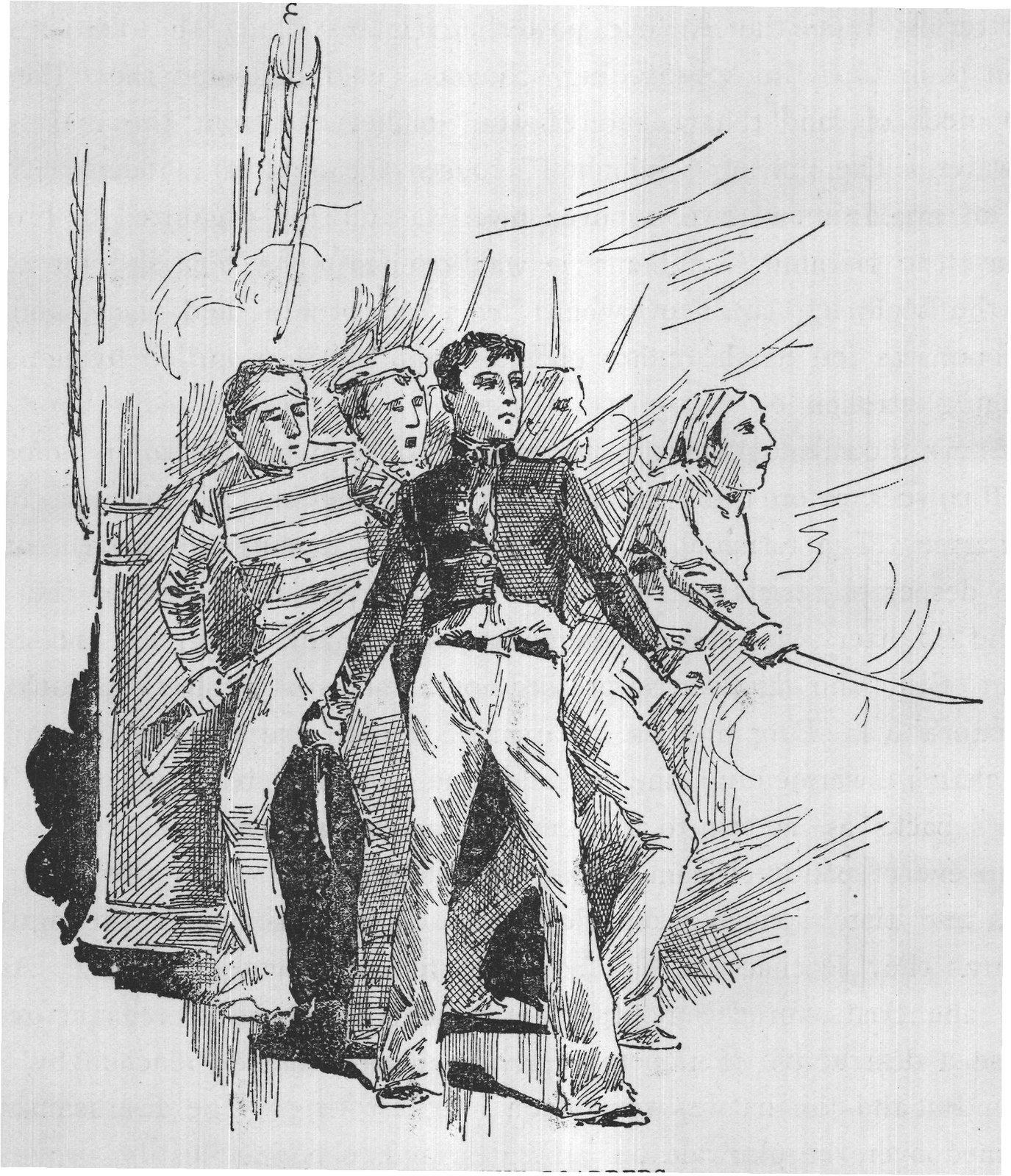
To meet this danger, Capt. Stewart took the most elaborate precautions. His ship was anchored in the middle of the narrow channel; and on either side were anchored seven gunboats, officered and manned by the men of the frigate. Around the gunboats and frigate extended a vast circle of floating logs, linked together by heavy chains, that no boarders might come alongside the vessels. The great frigate towered high above the surrounding gunboats, her black sides unbroken by an open port; for the gun-deck ports were lashed down, and the guns housed. Not a rope's end was permitted to hang over the side; the stern ladders were removed, and the gangway cleats knocked off. An enemy might as well hope to scale the unbroken front of a massive wall of masonry, as that dark, forbidding hull. From the bulwarks rose on all sides, to the ends of the yards, a huge net made of ratlin stuff, boiled in pitch until it would turn the edge of a cutlass, and further strengthened by nail-rods and small chains. The upper part of the netting was weighted with kentledge, the pigs of iron used for ballast; so that, should the hardy assailants succeed in coming alongside and scaling the side, a few blows of an axe would let fall the heavily weighted nettings, sweeping the boarders into the sea, and covering boats and men with an impenetrable mesh, under which they would be at the mercy of the sailors on the frigate's decks. The carronades and howitzers were loaded with grape; and the officers and men felt that only bravery on their part was essential to the defeat of any force that Great Britain could send against the ship. Heedless of these formidable preparations for their reception, the enemy set under way two expeditions for the capture of the "Constellation." In neither case did the antagonists actually come to blows, for the approach of the British was discovered before they came within pistol-shot; and, as their only chance lay in surprising the Americans, they retired without striking a blow. The coming of the first expedition was known upon the "Constellation" the day before it actually set out. A Portuguese merchantman, trying to beat out of the bay, had been stopped by the British, and anchored a few miles below the American frigate. A guard and lookout from the English fleet were stationed on the Portuguese to watch the "Constellation." In an unguarded moment, these men let fall a hint of the movement under way; and an American passenger on the Portuguese vessel quickly carried the news to Capt. Stewart, and volunteered to remain and aid in the defence. The next night was dark and drizzly; and the British, to the number of two thousand, set out in boats for the "Constellation." Hardly were they within gun-shot, when two lanterns gleamed from the side of a watchful guard-boat; and the roll of drums and sound of hurrying feet aboard the frigate told that the alarm was given. The assailants thereupon abandoned the adventure, and returned to their ship. The next night they returned, but again retreated discomfited. Several nights later, a third expedition came up. This time the guard-boat was far down the bay; and, seeing the huge procession of boats, the Americans calmly edged in among them, and for some time rowed along, listening to the conversation of the British, who never dreamed that an enemy could be in their midst. Suddenly a sailor, more sharp-eyed than the rest, caught sight of the interlopers; and the cry was raised, "A stranger!" The Americans tugged at their oars, and were soon lost to sight; but, not being pursued, returned, and accompanied their foes up the bay, and even anchored with the flotilla at a point above the "Constellation." The enemy, finding the Americans constantly on the watch, abandoned their designs on the ship, and vowed that Capt. Stewart must be a Scotchman, as he could never be caught napping. Some days later, an officer, sent with a flag of truce to the British fleet, vastly chagrined the officers there by repeating their remarks overheard by the guard-boat officers who joined the British flotilla in the dark. These three escapes confirmed the reputation borne by the "Constellation," as a "lucky ship;" and although she remained pent up in port throughout the war, doing nothing for her country, her luck was unquestioned in the minds of the sailors. With her they classed the "Constitution" and "Enterprise," while the "Chesapeake" and "President" were branded as unlucky. Certainly the career of these ships in the War of 1812 went far to confirm the superstitious belief of the sailors. In the course of the next two months, Chesapeake Bay was the scene of two gallant adventures, in which American privateersmen were opposed to the British sailors. On Feb. 8, the privateer schooner "Lottery " was standing down the bay under easy sail, out-bound on a voyage to Bombay. The schooner was one of the clipper-built craft, for which Baltimore ship-builders were famous the world over. Her battery consisted of six twelve-pounder carronades, and her crew numbered twenty five men. Near the point at which the noble bay opens into the Atlantic ocean, a narrow sheet of water extends into the Virginia shore, winding in sinuous courses several miles inland. This is known as Lynnhaven Bay; and on its placid surface there lay, on the morning of the "Lottery's" appearance, four powerful frigates flying the British flag. From their tops the approaching schooner could be seen across the lowlying neck of land that separated the smaller bay from the main body of water. The cry of "Sail, ho!" roused the fleet to sudden activity; and an expedition of two hundred men was quickly organized to proceed against the privateer. Fortune seemed to favor the British; for hardly had the boats left the fleet, when the fresh breeze died away, and the schooner was left at the mercy of the boats, which, propelled by the long, swinging strokes of man-o'-war oarsmen, bore down rapidly upon her. Capt. Southcomb of the "Lottery" was an American sailor, who had smelt powder before; and he had no idea of yielding up his ship without a struggle. The formidable force sent against him merely moved him to more desperate resistance. When the boats came within range, the guns of the "Lottery" opened upon them with a hail of grape and round shot. Still the assailants pressed on, and soon came beneath the schooner's lee. Dropping their oars, the plucky British tars sprang into the chains, swarmed up the bobstay and over the bow, and used each other's backs as ladders to aid them to reach the schooner's deck. The little crew of privateersmen fought viciously, guarding the side with cutlasses and pistols, hurling the boarders back into the sea, or cutting them down as they reached the deck. Cold shot and kentledge were dashed upon the boats, in the hopes of sinking them; while the carronades poured a destructive fire upon such boats as could be reached by their shot. But the conflict was too unequal to last long. The English sailors swarmed over the gunwale on all sides, and, cheering lustily, drove the small remnant of defenders below. Capt. Southcomb was cut down, and lay mortally wounded upon the deck when the enemy took possession of the ship. When the victors came to look about the captured vessel, they found such proofs of a desperate resistance, that their admiration was open and pronounced. Five only of the schooner's crew were unhurt, while the British paid for their success with the loss of thirteen men. Capt. Southcomb, in a dying condition, was taken aboard the frigate "Belvidera," where he received the tenderest treatment, and was shown marked respect on account of his bravery.
In the next encounter between the blockaders and a privateer, the n