Home › Beating to Quarters › Beating to Quarters: Broke
Beating to Quarters: Broke
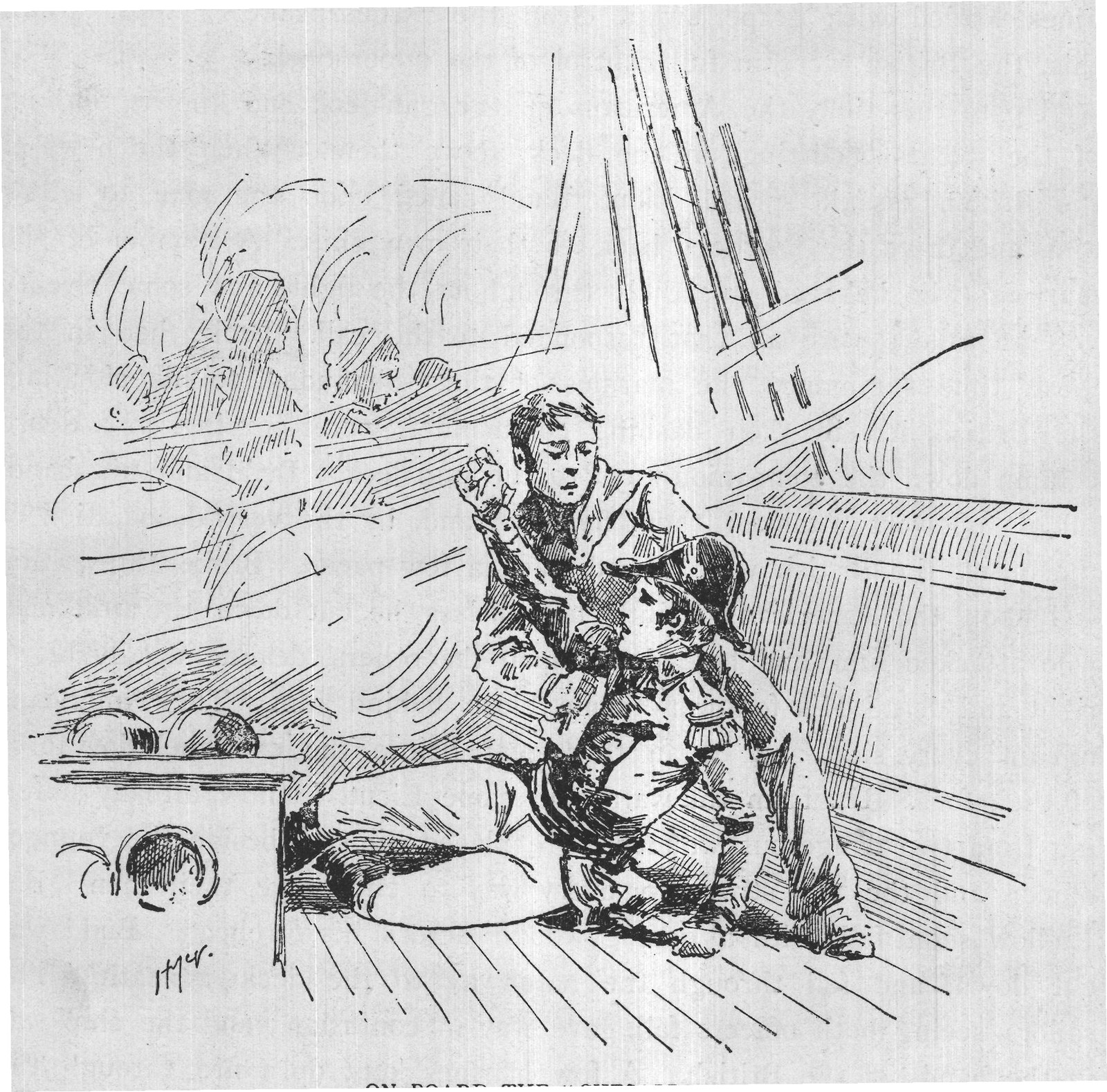
The British reached the quarter-deck with hardly the loss of a man. Here stood Mr. Livermore, the chaplain of the "Chesapeake," who had cruised long with Lawrence, and bitterly mourned the captain's fate. Determined to avenge the fallen captain, he fired a pistol at Broke's head, but missed him. Broke sprang forward, and dealt a mighty stroke of his keen cutlass at the chaplain's head, who saved himself by taking the blow on his arm. While the boarders were thus traversing the upper deck, the sailors in the tops of the "Chesapeake" were keeping up a well-directed fire, before which many of the Englishmen fell. But this resistance was not of long duration; for one of the "Shannon's" long nines, loaded with grape, swept clean the "Chesapeake's" tops. With this, the British were in full control of the upper deck. Up to this time, the Americans on the gun-deck had known nothing of the events occurring on the deck above them. When the news of the British assault spread, Lieut. Budd called upon the men to fellow him, and drive the boarders back to their own ship. A number of the marimes (who behaved splendidly throughout the fight) and some twenty veteran sailors were all that responded to the call. Broke had in the mean time summoned the marines of the "Shannon" to his aid; and the British, led by their dashing commander, were pouring in a dense column down the companion-ways to the gun-deck. Budd and his handful of followers attacked them fiercely; and, by the very desperation of the onset, the British were forced back a few paces. Broke threw himself upon the Americans. With his cutlass he cut down the first man who attacked him, and bore down upon the others, dealing deadly blows right and left. His followers came close behind him. The Americans fell on every side, and began to retreat before the overwhelming force of their foes. Up from the wardroom came Lieut. Ludlow, already suffering from two dangerous wounds. He placed himself beside the younger officer, and the two strove in every way to encourage their men Ludlow soon fell, with a gaping wound across his forehead. Budd was cut down, and fell through the hatchway to the deck beneath. The sailors, seeing both officers fall, gave way in confusion; and the ship was in the hands of the British. A few marines kept up a fire through the hatchway, but soon were silenced.
But An English officer, Lieut. Watts, ran to the halliards to haul down the American flag. But it would seem that the good genius which had watched over that starry banner throughout the war was loath to see it disgraced; for the officer had hardly finished his work, when a grape-shot from his own ship struck him, and he fell dead.
The noise of the battle had by this time died away, and the fresh breezes soon carried off the smoke that enveloped the combatants. It was an awful scene thus exposed to view. On the "Chesapeake ورد were sixty-one killed, and eighty-five wounded men. On the "Shannon" were thirty-three dead, and fifty wounded. On a cot in the wardroom lay Capt. Lawrence, his mortal wound having mercifully rendered him unconscious, so that he knew nothing of the loss of his ship. Broke had been made delirious by the fevered throbbing of the wound he had so long neglected. Everywhere were evidences of carnage and desolation. Little time was lost in getting the ships in order after the surrender. The noise of the hammer and saw was heard in every quarter. The wounded were taken to the sick-bay, and the bodies of the dead were committed to the ocean. Floods of water and the heavy holystones took from the decks the stains of blood. The galley cooks marched up and down the decks, sprinkling hot vinegar with a lavish hand. The British prize-crew took possession of the captured ship, and in a few hours the captor and captive were well on their way toward Halifax. They reached port on the 7th of June; and the sight of the "Shannon," followed by the "Chesapeake" with the British ensign flying proudly over the stars and stripes, stirred the little city to the utmost enthusiasm. As the two ships pursued their stately course up the harbor, the British men-of-war on all sides manned their yards, and fired salutes in honor of the victory. The thunders of the cannon brought the town'speople to the water-side, and their cheers rang out lustily to welcome their conquering countrymen to port.
Capt. Lawrence had died the day before; and his body, wrapped in an American flag, lay on the quarter-deck of his frigate. Three days later, his body, with that of his gallant lieutenant Ludlow, was laid to rest with imposing naval honors, in the churchyard of Halifax. But his country, honoring him even in the day of his defeat, was not content that his body should lie in the soil of an enemy's country. Two months after the battle, an American vessel, the "Henry" of Salem, entered the harbor of Halifax, under cover of a flag of truce, and took on board the bodies of Lawrence and Ludlow. They were conveyed first to Salem and later to New York, where they now lie under a massive monument of sandstone, in a corner of Trinity churchyard. A few feet away, the ceaseless tide of human life rolls on its course up and down Broadway; few of the busy men and women pausing to remember that in the ancient churchyard lies the body of the man whose dying words, "Don't give up the ship," were for years the watchword and motto of the United States navy.
Batters the year 1887. יין