Home › Contents › Assuming to Be British Men-Of-War
Assuming to Be British Men-Of-War
to convey to England. For him to give battle to the "Hornet," would therefore be unwise, as he would put in jeopardy this money which it was his duty to guard. This response was conclusive, and the English. man must be admitted to have acted wisely; but the knowledge of the valuable cargo of the "Bonne Citoyenne" only increased the desire of the Americans to capture her. The "Hornet" accordingly remained outside the harbor, as a blockader, while the "Constitution" continued her cruise alone.
She had not far to go in order to meet an enemy well worthy of her metal. Three days after parting with the "Hornet," two sail were made, well in shore. One of the vessels so sighted seemed to make for the land, as though anxious to avoid meeting the American ship; while the other came about, and made her course boldly toward the "Constitution." It was about nine o'clock on a bright December morning that the "Constitution" encountered the strange vessel, which bore down upon her. A light breeze, of sufficient force to enable the vessels to manœuvre, was blowing; but the surface of the ocean was as placid as a lake in summer. The build of the stranger left no doubt of her warlike character, and the bold manner in which she sought a meeting with the American ship convinced Bainbridge that he had fallen in with an enemy. The "Constitution" did not for a time meet the enemy's advances in kind. Back of the advancing frigate could be seen the low, dark coast-line of Brazil, into whose neutral waters the Englishman could retreat, and thus gain protection, if the conflict seemed to go against him. Bainbridge determined that the coming battle should be fought beyond the possibility of escape for the vanquished, and therefore drew away gradually as the stranger came on. By noon the two ships were near enough together for flags to be visible, when Bainbridge set his colors, and displayed private signals. The enemy did the same ; and, though his signals were unintelligible, the flag that fluttered at the masthead was clearly the flag of Great Britain. Bainbridge continued his retreat for an hour longer, then, being far enough from land, took in his main-sail and royals, and tacked toward the Englishman.
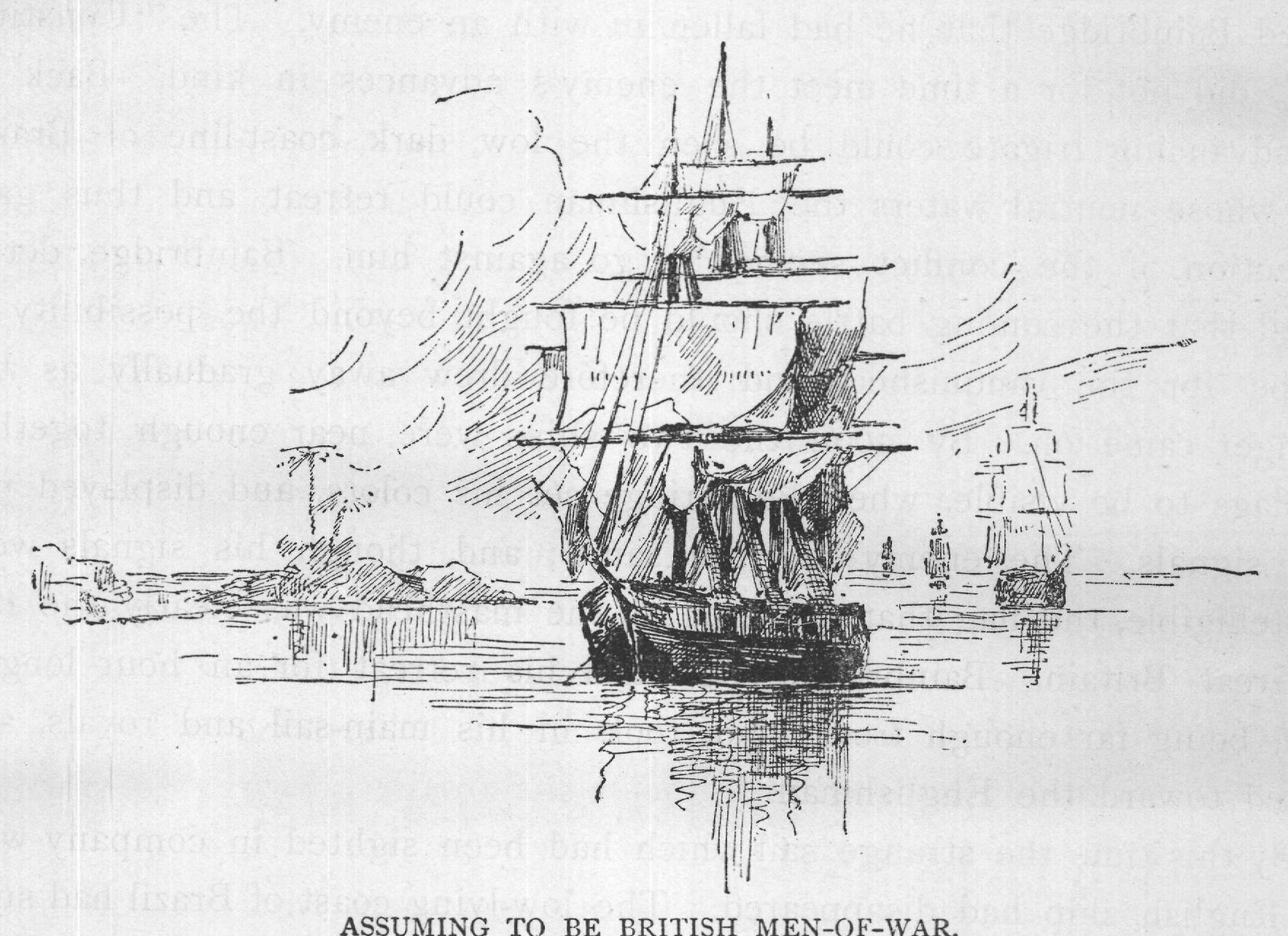
By this time the strange sail which had been sighted in company with the English ship had disappeared. The low-lying coast of Brazil had sunk below the horizon. From the deck of the "Constitution," nothing could be seen but the vast circle of placid ocean, and the English frigate about a mile to the windward, bearing down to open the fight. The drums beat, and the crew went quietly and in perfect order to their quarters. They were no longer the raw, untrained crew that had joined the ship some months before. They were veterans, with the glorious victory over the "Guerriere" fresh in their remembrance, and now animated with a desire to add to their trophies the strange vessel then in sight.
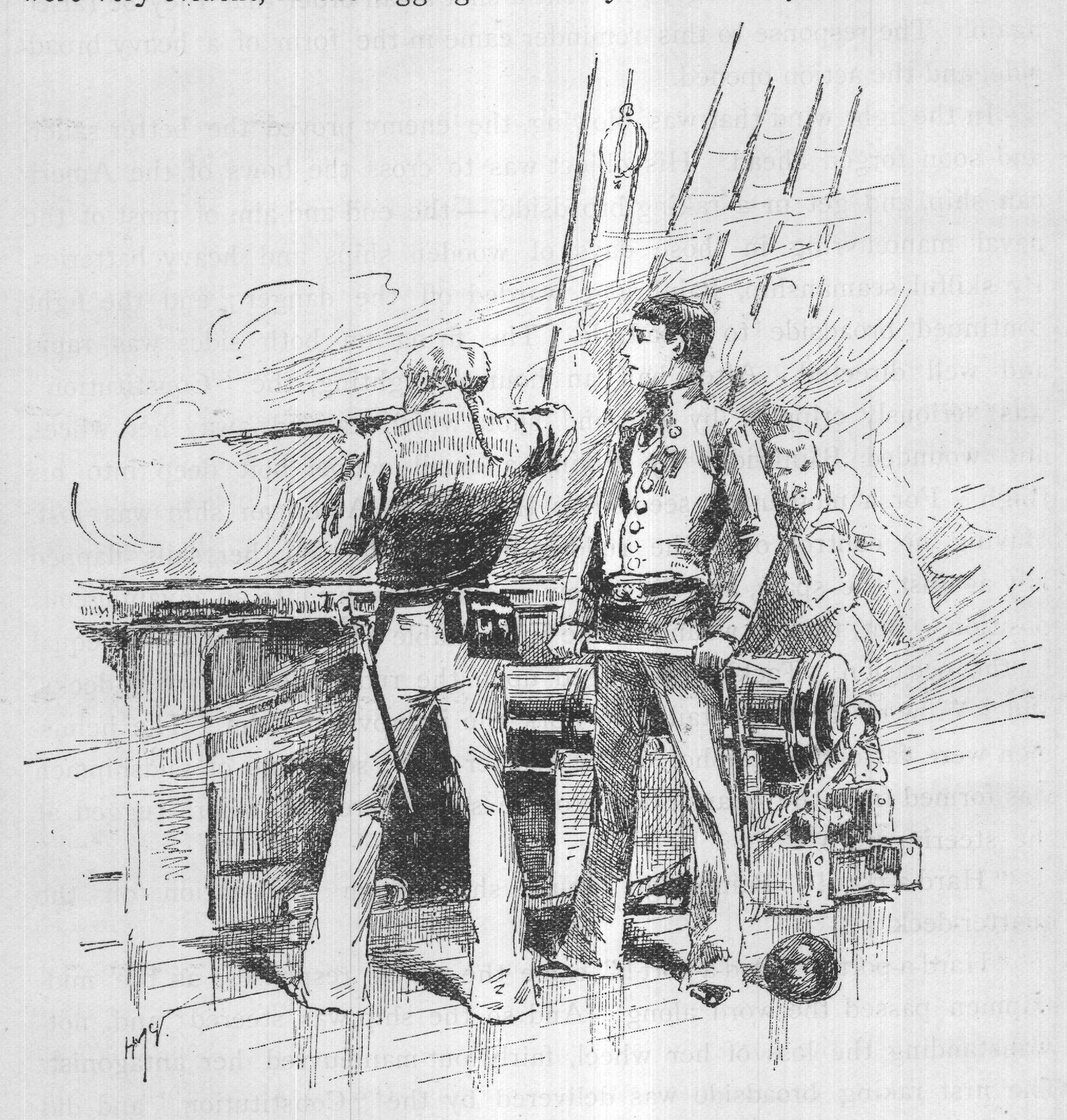
As the enemy, which proved to be the "Java," thirty-eight, Capt. Lambert, came nearer, she hauled down her colors, leaving only a jack flying. A jack is a small flag hoisted at the bowsprit cap. The Union jack of the United States navy is a blue flag dotted with stars, but without the stripes of the national flag; the jack of Great Britain has the scarlet cross of St. George on a blue field. The Englishman's action in hauling down his ensigns puzzled Bainbridge, who sent a shot as an order that they be raised again. The response to this reminder came in the form of a heavy broadside, and the action opened. In the light wind that was blowing, the enemy proved the better sailer, and soon forged ahead. His object was to cross the bows of the American ship, and get in a raking broadside, - the end and aim of most of the naval manœuvring in those days of wooden ships and heavy batteries. By skilful seamanship, Bainbridge warded off the danger; and the fight continued broadside to broadside. The firing on both sides was rapid and well directed. After half an hour of fighting, the "Constitution" was seriously crippled by a round shot, which carried away her wheel, and wounded Bainbridge by driving a small copper bolt deep into his thigh. For a moment it seemed as though the American ship was lost. Having no control over the rudder, her head fell off, her sails flapped idly against the spars, and the enemy was fast coming into an advantageous position. But, though wounded, the indomitable Yankee captain was equal to the occasion. Tackle was rigged upon the rudder-post between decks, and a crew of jackies detailed to work the improvised helm. The helmsmen were far out of earshot of the quarter-deck: so a line of midshipmen was formed from the quarter-deck to the spot where the sailors tugged at the steering-lines. "Hard-a-port!" Bainbridge would shout from his station on the quarter-deck. 66 Hard-a-port! Hard-a-port!" came the quick responses, as the midshipmen passed the word along. And so the ship was steered; and, notwithstanding the loss of her wheel, fairly out-manœuvred her antagonist. The first raking broadside was delivered by the "Constitution," and did terrible execution along the gun-deck of the English ship. The two ships then ran before the wind, exchanging broadsides at a distance of half pistol-shot. At this game the American was clearly winning: so the Englishman determined to close and board, in the dashing, fearless way that had made the tars of Great Britain the terror of all maritime peoples. The frigate bore down on the "Constitution," and struck her on the quarter; the long jib-boom tearing its way through the rigging of the American ship. But, while this movement was being executed, the American gunners had not been idle; and the results of their labors were very evident, in the rigging of the "Java." Her jib-boom and bow. 3000