Home › Warren Gamaliel Harding › Warren Gamaliel Harding
Warren Gamaliel Harding
EVERY time we elect a new President we learn what a various creature is the Typical American.
When Mr. Roosevelt was in the White House the Typical American was gay, robustious, full of the joy of living, an expansive spirit from the frontier, a picaresque twentieth century middle class Cavalier. He hit the line hard and did not flinch. And his laugh shook the skies.
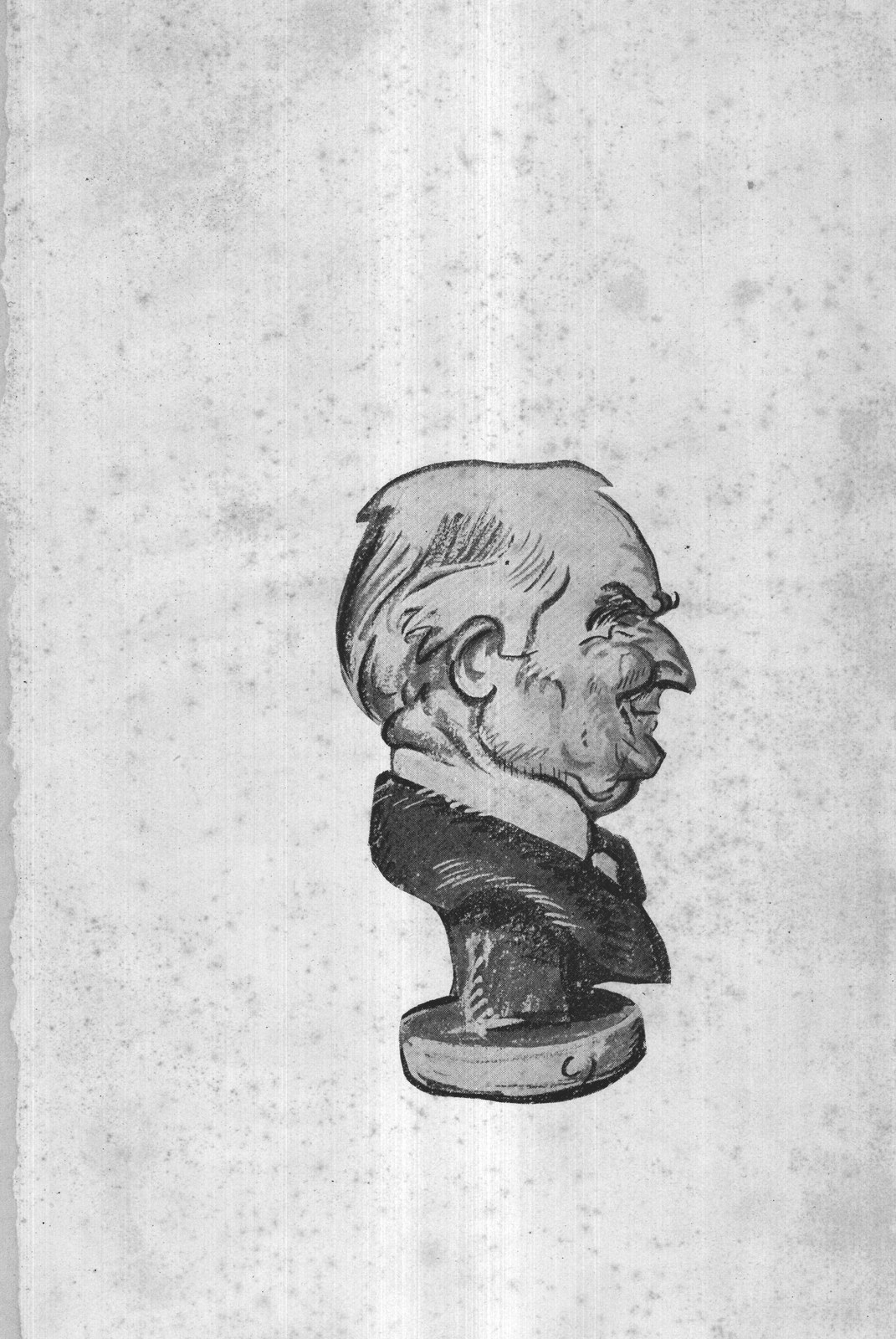
Came Wilson. And the Typical American was troubled about his soul. Rooted firmly in the church-going past, he carried the banner of the Lord, Democracy, idealistic, bent on perfecting that old incorrigible Man, he cuts off the right hand that offends him and votes for prohibition and woman suffrage, a Round Head in a Ford.
Eight years and we have the perfectly typical American, Warren Gamaliel Harding of the modern type, the Square Head, typical of that America whose artistic taste is the movies, who reads and finds mental satisfaction in the vague inanities of the small town newspaper, who has faith in America, who is for liberty, virtue, happiness, prosperity, law and order and all the standard generalities and holds them a perfect creed; who distrusts anything new except mechanical inventions, the standardized product of the syndicate which supplies his nursing bottle, his school books, his information, his humor in a strip, his art on a screen, with a quantity production mind, cautious, uniformly hating divergence from uniformity, jailing it in troublous times, prosperous, who has his car and his bank account and can sell a bill of goods as well as the best of them.
People who insist upon having their politics logical demand to know the why of Harding. Why was a man of so undistinguished a record as he first chosen as a candidate for President and then elected President?
As a legislator he had left no mark on legislation. If he had retired from Congress at the end of his term his name would have existed only in the old Congressional directories, like that of a thousand others. As a public speaker he had said nothing that anybody could remember. He had passed through a Great War and left no mark on it. He had shared in a fierce debate upon the peace that followed the war but though you can recall small persons like McCumber and Kellogg and Moses and McCormick in that discussion you do not recall Harding. To be sure he made a speech in that debate which he himself says was a great speech but no newspaper thought fit to publish it because of its quality, or felt impelled to publish it in spite of its quality because it had been made by Harding.
He neither compelled attention by what he said nor by his personality. Why, then, without fireworks, without distinction of any sort, without catching the public eye, or especially deserving to catch it, was Warren Harding elected President of the United States?
One plausible reason why he was nominated was that given by Senator Brandegee at Chicago, where he had a great deal to do with the nomination. "There ain't any first raters this year. This ain't any 1880 or any 1904. We haven't any John Shermans or Theodore Roosevelts. We've got a lot of second raters and Warren Harding is the best of the second raters."
Once nominated as a Republican his election of course inevitably followed. But to accept Mr. finds mental satisfaction in the vague inanities of the small town newspaper, who has faith in America, who is for liberty, virtue, happiness, prosperity, law and order and all the standard generalities and holds them a perfect creed; who distrusts anything new except mechanical inventions, the standardized product of the syndicate which supplies his nursing bottle, his school books, his information, his humor in a strip, his art on a screen, with a quantity production mind, cautious, uniformly hating divergence from uniformity, jailing it in troublous times, prosperous, who has his car and his bank account and can sell a bill of goods as well as the best of them.
People who insist upon having their politics logical demand to know the why of Harding. Why was a man of so undistinguished a record as he first chosen as a candidate for President and then elected President?
As a legislator he had left no mark on legislation. If he had retired from Congress at the end of his term his name would have existed only in the old Congressional directories, like that of a thousand others. As a public speaker he had said nothing that anybody could remember. He had passed through a Great War and left no mark on it. He had shared in a fierce debate upon the peace that followed the war but though you can recall small persons like McCumber and Kellogg and Moses and McCormick in that discussion you do not recall Harding. To be sure he made a speech in that debate which he himself says was a great speech but no newspaper thought fit to publish it because of its quality, or felt impelled to publish it in spite of its quality because it had been made by Harding.
He neither compelled attention by what he said nor by his personality. Why, then, without fire-works, without distinction of any sort, without catching the public eye, or especially deserving to catch it, was Warren Harding elected President of the United States?
One plausible reason why he was nominated was that given by Senator Brandegee at Chicago, where he had a great deal to do with the nomination. "There ain't any first raters this year. This ain't any 1880 or any 1904. We haven't any John Shermans or Theodore Roosevelts. We've got a lot of second raters and Warren Harding is the best of the second raters."
Once nominated as a Republican his election of course inevitably followed. But to accept Mr. Brandegee's plea in avoidance is to agree to the eternal poverty of American political life, for most our presidents have been precisely like Warren G. Harding, first-class second raters.
Mrs. Harding, a woman of sound sense and much energy, had an excellent instructive answer to the "why." The pictures of the house in Marion, the celebrated front porch, herself and her husband were taken to be exhibited by cinema all over the land. She said, "I want the people to see these pictures so that they will know we are just folks like themselves." Warren Harding is "just folks." A witty woman said of him, alluding to the small town novel which was popular at the time of his inauguration, "Main Street has arrived in the White House."
The Average Man has risen up and by seven million majority elected an Average Man President. His defects were his virtues. He was chosen rather for what he wasn't than for what he was,--the inconspicuousness of his achievements. The "just folks" level of his mind, his small town man's caution, his sense of the security of the past, his average hopes and fears and practicality, his standardized Americanism which would enable a people who wanted for a season to do so to take themselves politically for granted. The country was tired of the high thinking and rather plain spiritual living of Woodrow Wilson. It desired the man in the White House to cause it no more moral overstrain than does the man you meet in the Pullman smoking compartment or the man who writes the captions for the movies who employs a sort of Inaugural style, freed from the inhibitions of statesmanship. It was in a mood similar to that of Mr. Harding himself when after his election he took Senators Freylinghuysen, Hale, and Elkins with him on his trip to Texas. Senator Knox observing his choice is reported to have said, "I think he is taking those three along because he wanted complete mental relaxation." All his life Mr. Harding has shown a predilection for companions who give him complete mental relaxation, though duty compels him to associate with the Hughes and the Hoovers. The conflict between duty and complete mental relaxation establishes a strong bond of sympathy between him and the average American.
The "why" of Harding is the democratic passion for equality. We are standardized, turned out like Fords by the hundred million, and we cannot endure for long anyone who is not standardized. Such an one casts reflections upon us; why should we by our votes unnecessarily asperse ourselves? Occasionally we may indulge nationally, as men do individually, in the romantic belief that we are somebody else, that we are like Roosevelt or Wilson--and they become typical of what we would be--but always we come back to the knowledge that we are nationally like Harding, who is typical of what we are. "Just folks" Kuppenheimered, movieized, associated pressed folks. Men debate whether or not Mr. Wilson was a great man and they will keep on doing so until the last of those passes away whose judgement of him is clouded by the sense of his personality. But men will never deabate about the greatness of Mr. Harding himself. He is modest. He has only two vanities, his vanity about his personal appearance and his vanity about his literary style. The inhibitions of a presidential candidate, bound to speak and say nothing, irked him. "Of course I could make better speeches than these" he told a friend during the campaign, "but I have to be so careful."