Home › Hiram Johnson › Hiram Johnson: Francisco
Hiram Johnson: Francisco
His political life was blank paper when the tumult of popular indignation swept California at the time Francis J. Heney, who was prosecuting the San Francisco grafters, was shot in the court room. He had thought nothing politically, he had felt nothing politically. He had neither convictions, nor passions, nor morals, politically speaking. He grew up in soil which does not produce lofty standards. Something of the mining-camp spirit still hung over California, which had been settled by adventurers, forty-niners, gold seekers, men who had left the East to "make a new start" where there was pay dirt. The State had a wild zest for life which was untrammeled by Puritanism. San Francisco had its Barbary Coast and in every restaurant its private dining rooms for women. Johnson himself was sprung from a father who was a "railroad lawyer," the agent of privileges in procuring special favors, by methods once well known, from the state legislature. The atmosphere of his youth was not one to develop a sensitive conscience or a high conception of public morals. Johnson at this time was a practicing attorney, not noted for the quality of his community service. The administration of San Francisco had been a scandal for years. Few cared. It was a "corrupt and contented" city. The corruption grew worse. Lower and meaner grafters rose to take the place of the earlier and more robust good fellows who trafficked in the city o'shame. Graft lost class, and lost caste. It was ultimately exposed in all its shocking indecency. The light and licentious town developed a conscience. Public indignation arose and reached its height, when the grafters ventured too far in the shooting of the attorney charged with their prosecution. Johnson then felt for the first time something he had never felt before--the stirring of the storm of angry popular feeling. It woke something in him, something that he did not know existed before--his instinct for the expression of public passion; his love of the platform with yelling multitudes in front of him.
He threw himself into the fray on the side of civic virtue. The disturbance to the complacency of San Francisco disturbed the complacency of the State, which had calmly endured misgovernment for many years. Misgovernment procured by the railroad, the public utility corporations, the other combinations of wealth, through their agents, and through the corrupt politicians. Johnson became the spokesman of public protest and the reform governor of the State. After that came battling for the Lord at Armageddon--the most intoxicating experience in American political history, for a man of Johnson's temperament. It was a revolution, not in a government, but in a party. Bonds were loosed. Immense personal enlargement came to those who had known the ties of regularity. It was an hour of freedom, unbridled political passion, unrestrained political utterance. Docility did not exist. Vast crowds thrilled with new hopes yelled themselves hoarse over angry words. Association with Roosevelt on the Progressive ticket lifted Johnson from a local to a national importance. The whole country was the audience which leaped at his words. It was a revolution in tittle, a taste, a sample of what the real thing would be, with its breaking of restraints, its making of the mob a perfect instrument to play upon, its unleashing of passion to which to give tongue. Johnson has felt its wild stimulation and like a man who has used drugs the habit is upon him.
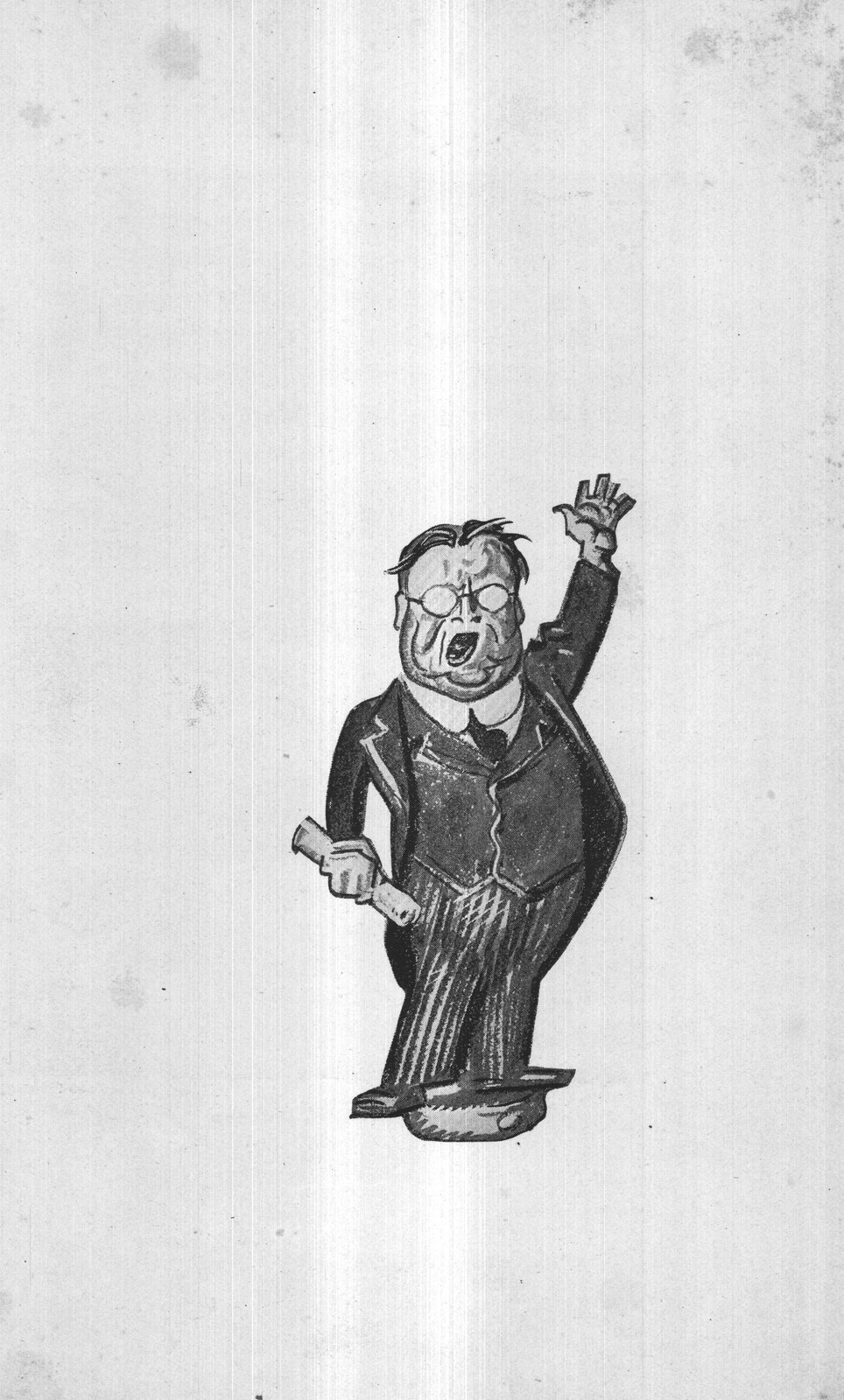
Moreover, his one chance lies that way. I have said that he is, by accident, radical. Let us imagine a great outburst of popular passion for reaction. And suppose that Johnson was, when it arrived, a political blank, as he was when Heney was shot. Johnson would have raised his angry voice against radicalism, just as readily as for it.
The essential thing with him is popular passion, not a political philosophy. He has no political philosophy. He has no real convictions. He does not reason or think deeply. His mentality is slight. He is the voice of many; instinctively he gives tongue to what the many feel; that is all. Suppose the strong-lunged Californian were a political blank, just reaching the national consciousness, when the reaction against Wilson began and when the public swung to conservatism.
You know those vast tin amplifiers employed in big convention halls, or in out-door meetings, to carry the voice of the speaker to the remotest depths of the audience; Johnson is a vast tin amplifier of the voice of the mass. When the people had become "docile" he would have thundered "docility" to the uttermost bounds of the universe, if he had not by earlier utterances been definitely placed on the side opposed to docility.
But he had been definitely placed in the battle of Armageddon. A thousand ennuies located him for all political time. No convictions hold him where he is in case there be profit in changing sides; other men habitually conservative would have the preference over him on the other side. In this sense he is accidently radical, accidently because he happened to emerge in politics at a radical moment. That takes into account only the mental background of his political position. There is an element that was not chance. Public passion is almost invariably radical, springing as it does from the resentment of inequality, and Johnson is the tongue of public passion. Is he dangerous? He is, only if public passion becomes dangerous and only up to the point where the speakers of revolution pass from the stage and the doers of it rig up their chopping blocks. At present he furnishes the words, the ugly words, which men throw instead of stones at the objects of their hate. He is the safety valve of gathering passion. Men listen to him and feel that they have done something to vindicate their rights. They applaud him to shake the roof, and vote for Mr. Harding.
It is customary to speak of his magnetism over crowds. He has no magnetism in personal contact. He walks toward you as if he were about to deliver a blow, an impression that is strengthened by his square menacing figure. His voice is unpleasant. His smile is wry. He not unusually has a complaint to make against the public, against the press, against fate, against you personally. He is not interested in people, as Roosevelt was to so an amazing degree, and as magnetic persons usually are. He is cold, hard, and selfish. His quarrels are numerous, with the campaign managers of the Armageddon fight, with his own campaign manager of 1920, with the newspaper correspondents. He is habitually pessimistic, and pessimism and magnetism do not go together.
His complaint that the people were docile and would not recover their confidence and self-assertion in his time, was a bit of his inevitable gloom. His dark habit of thought hung over his campaign for the presidential nomination of 1920, preventing his making a real effort in many states, and lay in the way of his success. He has few friends, love having been left out of his make-up. I do not speak of family affection--but love in its larger implications. Those who surround him--clerks and secretaries--have the air of repressed, starving personalities.
That which gathers the crowds and sets them shouting is not his magnetism but the perfect expression of their passion. For them and for it he is a sounding board. His voice with its hard angry tone, its mechanical rise and fall, has the ring of a hundred guillotines in operation. Having little culture, unintellectual, he is primitive as the mass before him. He talks their language and an instinct all his own gives him an exact sense of their emotions.
And what he says leaves the impression of tremendous sincerity. His sincerity does not arise from reasoned convictions but from hatred; deep and abiding hatred.
Senator Borah once said, "The difference between Johnson and me is that I regard questions from the point of view of principles while he regards them from the point of view of personalities. When a man opposes me I do not become angry at him. On the next issue he may agree with me. When a man opposes Johnson he hates him. He feels that the opposition is directed personally against him, not against the policy that separates them." Johnson's opponents are the elements of reaction, the malefactors of great wealth, the supporters of that social inequality which the crowd resents. They stood in his path in California. They made impossible his nomination at Chicago. When the bitter enders, during the treaty fight, planned to send him on a tour of the country, these monied men closed their pocketbooks, exclaiming to Senator Knox, "What do you mean to do? Advertise this man Johnson and make him the Republican candidate for President? Not with our money."