Home › George Harvey › George Harvey
George Harvey
THERE is something inscrutably ludicrous in the anxiety, bordering upon consternation, that lurks in the elongated and grotesque shadow that George Harvey casts upon Washington. The Republican fathers, who now feel a sense of responsibility, after a lapse of many years, for the future of party and country, do not yet know how to take him.
As a campaign asset his value could be expressed in intelligible terms. But as a party liability, or asset,--many a good Republican wishes he knew which,--he remains an enigma. There is not one of the array of elders of either political persuasion who, while laughing at his satirical sword-play, does not watch him covertly out of the corner of the eye, trembling at the potential ruin they consider him capable of accomplishing.
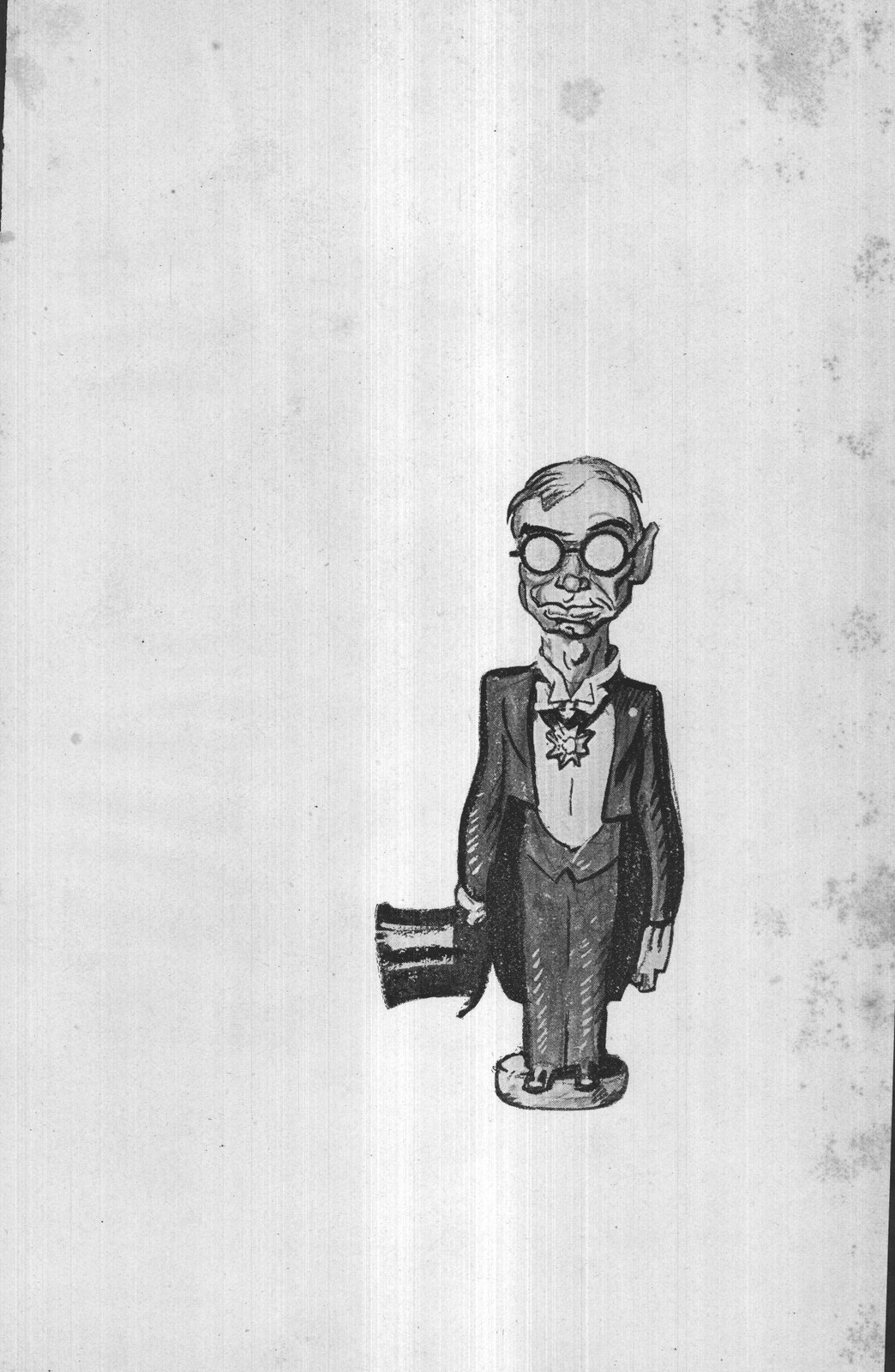
With all his weaknesses,--principally an almost hilarious political irregularity,--but two Republican hands were raised against him in the Senate when he was nominated for the Court of Saint James. When he rather unbecomingly filliped John Bull on the nose in his maiden speech as the premier ambassador, incidentally ridiculing some of his own countrymen's war ideals, President Harding and Secretary Hughes, gravely and with rather obvious emphasis, tried to set the matter aright as best they could. But there was no hint of reprimand; only a fervent hope that the mercurial Harvey would remain quiescent until the memory of the episode passed. The quondam editor, now the representative of his country on the Supreme Council, in which capacity he is even more important than as Ambassador, represents a new strain in American politics. His mental habits bewilder the President, shock the proper and somewhat conventional Secretary of State, and throw such repositories of national divinity as Senators Lodge and Knox into utter confusion.
Harvey plays the game of politics according to his own rules, the underlying principle of which is audacity. He knows very well that the weak spot in the armor of nearly all politicians of the old school is their assumption of superiority, a sort of mask of benignant political venerability. They dread satire. They shrink from ridicule. A well-directed critical outburst freezes them. Such has been the Harvey method of approach. Having reduced his subjects to a state of terror, he flatters them, cajoles them, and finally makes terms with them; but he always remains a more or less unstable and uncertain quantity, potentially explosive.
There is not much of the present Harvey to be gleaned from his earlier experiences, except the pertinacity that has had much to do with his irregular climb up the ladder. He was born in Peacham, Vermont, where as a boy after school hours he mounted a stool in his father's general store and kept books. At the end of the year his accounts were short a penny. Because of this he received no Christmas gift not, as he has said, because his father begrudged the copper more than any other Vermont storekeeper, but because he was meticulously careful himself and expected the younger generation to be likewise.
This experience must have been etched upon Harvey's memory; no one can be more meticulous when his interest is aroused. To money he is indifferent, but a misplaced word makes him shudder. Writing with him is an exhausting process, which probably accounts for the fact that his literary output has been small. But the same power of analysis and attention to detail have been most effective in his political activities. In these his divination has been prophetic and in his manipulation of contending elements he shows a dexterity that has baffled even the professional politicians.
Harvey began his journalistic career upon the Peacham Patriot. Thence, with a borrowed ten dollar bill, he went to Springfield, serving his apprenticeship on the Republican, the best school of journalism in the country at that time. Later, on the Chicago Evening News, on the staff of which were Victor Lawson, Eugene Field, and Melville Stone, he completed his training. When he joined the staff of the New York World at the age of twenty-one he was a competent, if not a brilliant newspaper man. His first important billet was the New Jersey editorship. This assignment across the river might very easily have been the first step toward a journalistic sepulcher, but not for Harvey. He made use of the post to garner an experience and knowledge of New Jersey politics that were to have an important bearing upon the career of Woodrow Wilson later. At the same time he attracted the attention of Joseph Pulitzer who appointed him managing editor of the World before he was thirty. While directing the World's policy during the second Cleveland campaign, Harvey met Thomas F. Ryan and William C. Whitney, the financial backers of the Democratic party. This prepared the way for his step from Park Row to Wall Street after his break with Pulitzer.
But the ways of Wall Street were not for Harvey. Nevertheless he was cautious enough to help himself to some of the profits that were forthcoming in those days of great amalgamations. With commendable foresight, however much he might have despised the methods then prevalent in the fields of high finance, he acquired enough to make him independent, to follow his own bent, and strangely enough, in the acquiring he came to the conclusion that the Republic could not survive if the plundering of the people by the "interests" continued as it was proceeding at that time.
He withdrew from the Street and eventually purchased The North American Review. In the meantime J. P. Morgan and Company had under-written the bonds of the Harper publishing house and the elder Morgan asked Harvey to take charge of the institution. This he agreed to do with the understanding that he should be permitted to direct the policy of Harper's Weekly, one of the assets of the firm, without interference from the bankers.
With his peculiar faculty for detecting the weaknesses of financiers and politicians, Harvey now had before him an opportunity which was not afforded by the sedate old North American Review and he promptly took advantage of it. He had seen enough of the union of finance and politics to place little faith in either of the old parties. One was corrupt and powerful; the other was weak and parasitical. In both organizations money was a compelling consideration. Not being accustomed to think in terms of party allegiance Harvey decided that the only remedy for a very bad situation was a militant Democracy. He had the organ; next he needed the leader.