Home › The Sleeping-Porch-As It Should Be › The Sleeping-Porch-As It Should Be
The Sleeping-Porch-As It Should Be
In every section of the country, from seaboard to seaboard, sleeping-porches have been built, but are they always successful? Ever since the sleeping-porch idea was first suggested, it has appealed to a constantly increasing number of householders -those building new as well as those living in old homes-but have they made their sleepingporches really practical, really useful, really delightfully healthful? Not always, it must be admitted, for often sleeping-porches are so slightingly considered, that they are inadequate and entirely inconvenient when built. Why the sleeping-porch? is frequently asked.
Why not open bedroom windows? So many think the sleeping-porch merely a fad; that fresh air is quite as plentiful in a well-ventilated bedroom, and the expense of building a sleeping-porch can be saved.
Open windows are beneficial, it is true, but they do not produce the same result as a wide-open sleeping-porch. In the first place, there is apt to be a draft in bedrooms where air entering one window blows through another. In such a room, unequally warmed, the current of air has fre- S quently been found conducive to colds. Then there are inconveniences; a bedroom with windows open is cold and uncomfortable to dress in during the winter. Then, too, if the radiator is turned on for warmth, there is danger it will freeze; danger, also, when it is turned off.
With a wide-open sleeping-porch the temperature is practically even throughout-not colder in one corner than another, as is frequently the case in a ventilated bedroom. Sleeping on a wideopen sleeping-porch is practically like sleeping out-ofdoors, and anyone who has slept outside knows how different it is from sleeping in a bedroom, no matter how wide the windows in the latter are opened.
That Americans have taken naturally to outof-door sleeping is very apparent when one considers how many new houses, no matter how small, have their sleeping-porches. Indeed, a large percentage of old houses are now equipped with sleeping-porches, usually by remodeling present porches, or adding second-story porches above existing porches on the first story.
Beginning with the first rough draft of the new house plans, one should embody in them some provision for a sleeping-porch. When carefully planned, such a porch is not expensive.
Usually some convenient way can be found to include it in the house with little difficulty.
There are several good ways to build a porch.
You may take one corner of the second story and build in it your sleeping-porch, reserving just enough space for the number of beds to be accommodated. Such a porch (like an ordinary bedroom, though smaller) can be fitted with wide openings, or with rows of casement windows.
When the latter are wide open, the room is, in fact, an out-of-doors porch, but one that can be closed up tight (by closing the casements) in bad weather.
Another convenient plan is to build a secondstory porch above the first-story veranda. This is known as a "double-deck" porch, and many have found it a very convenient and inexpensive way to get a successful sleeping-porch. Often such a porch, extending at the side of the house in the form of a wing, can be covered by the main roof of the house, making a pleasing appearance.
This method usually makes a small house look very much larger, and is, therefore, quite popular.
It solves the problem nicely.
It is not always possible, however, to have a sleeping-porch embodied in the house, nor is it always practicable to build a double-deck porch.
When conditions make necessary some other scheme, a second-story balcony can frequently be utilized.
This is nothing more nor less than a projecting porch supported on brackets, or built on top of any flat roof which may be available.
For instance, when (as is frequently the case) there is a flat roof over the kitchen, a balcony can be built; sometimes it can be located on top of the pantry. This balcony idea is usually quite practicable for old houses as well as for new.
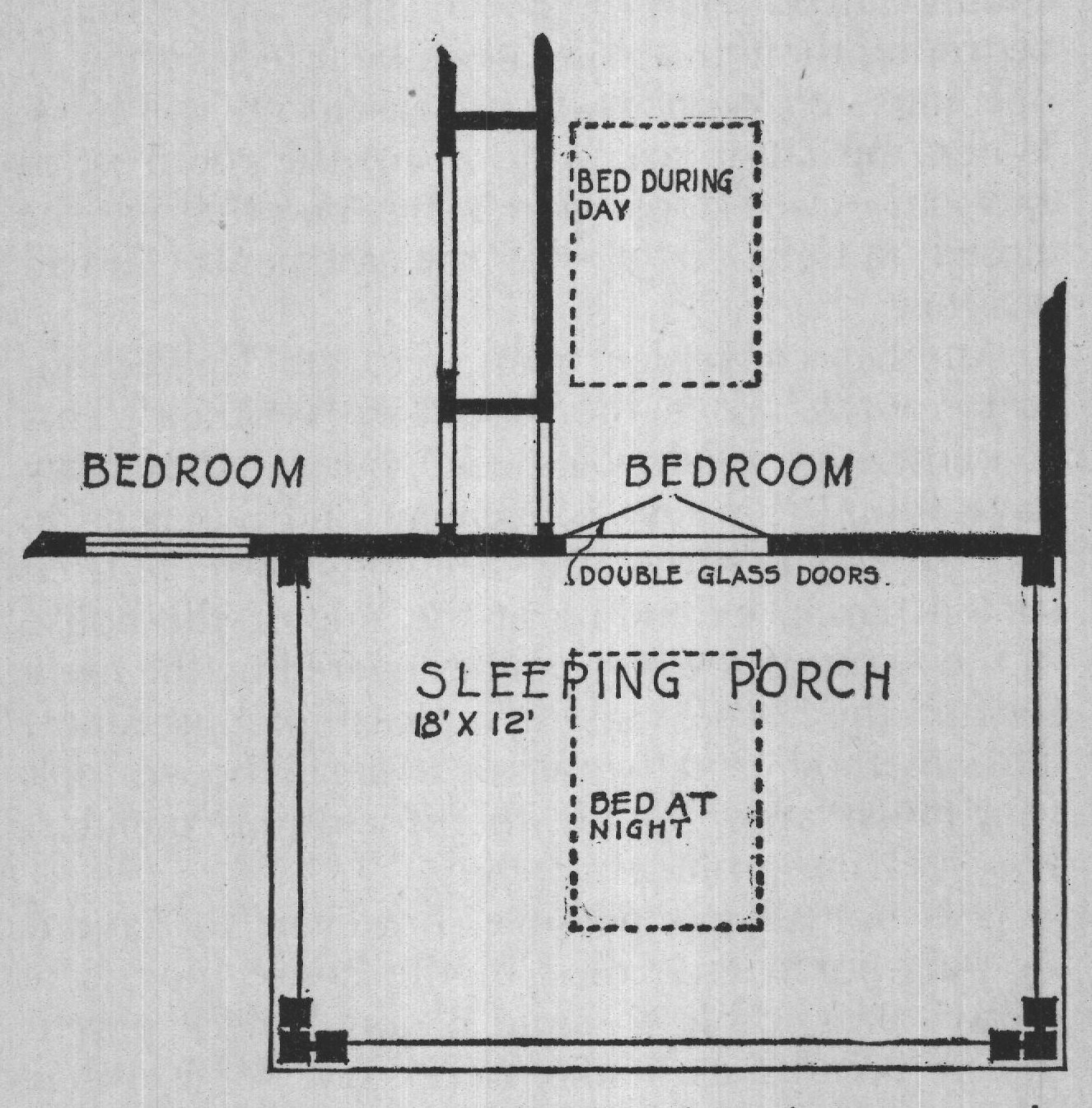
BEDROOM BED DURING DAY BEDROOM DOUBLE GLASS DOORS.
SLEEPING PORCH 18' X 12' BED AT NIGHT Good arrangement with double glass doors connecting porch with bedroom and permitting bed to be kept indoors during the day or in stormy weather.
In planning a sleeping-porch, after one has decided the type of porch wanted and its location on the house, the next step is to determine its size. Here is where so many make mistakes, frequently building a porch too large or too small, rarely of just the right size. To determine the correct size for a porch, one should first decide what kind of beds are to be used.
On a sleeping-porch for two, an ordinary double bed can be used if desired when, of course, the sleeping-porch problem becomes extremely simple. In one such case I recall that the sleeping-porch opens right off the bedroom by means of double glass doors, permitting the bed (on ball-bearing casters), to be trundled out through the doorway each night, to be returned in the morning. This eliminates one of the objections frequently brought against sleeping-porches that the bed is cold when one first enters it-because the bed can be kept in a warm room during the day. Another way to overcome a cold bed I will explain later.
After considerable experience and many experiments, I am of the opinion that an ordinary cot-bed is the most practicable stationary bed for a sleeping-porch. Cots are usually about 3 feet wide and 6 feet 3 inches long. The little white iron cots with woven-wire springs are best, and it is of distinct advantage to use those having a slight head- and foot-rail (which helps to hold the mattress securely).
Using cot-beds of this size, one is surprised how little room is required, and how many beds can be placed in a comparatively small space.
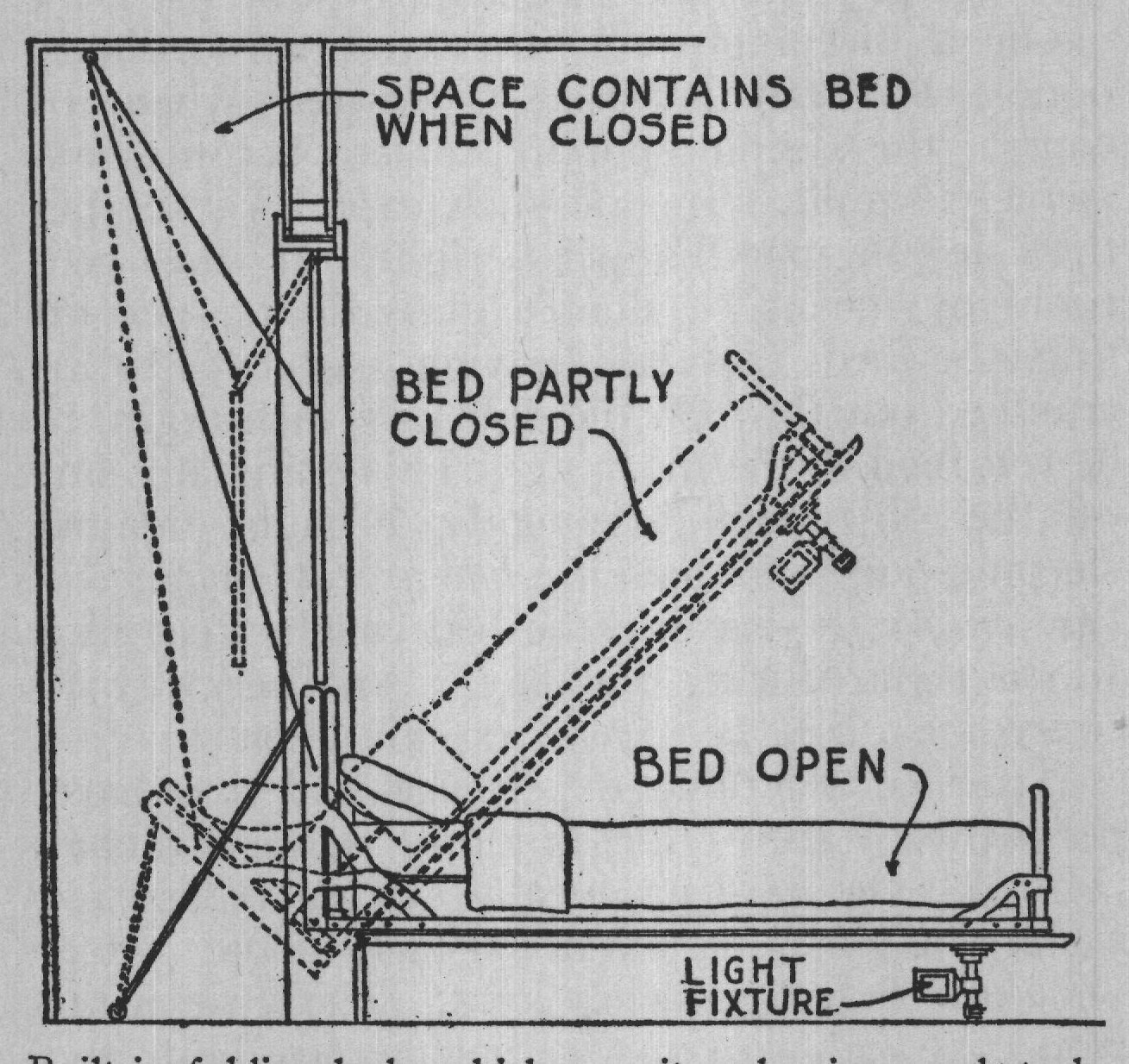
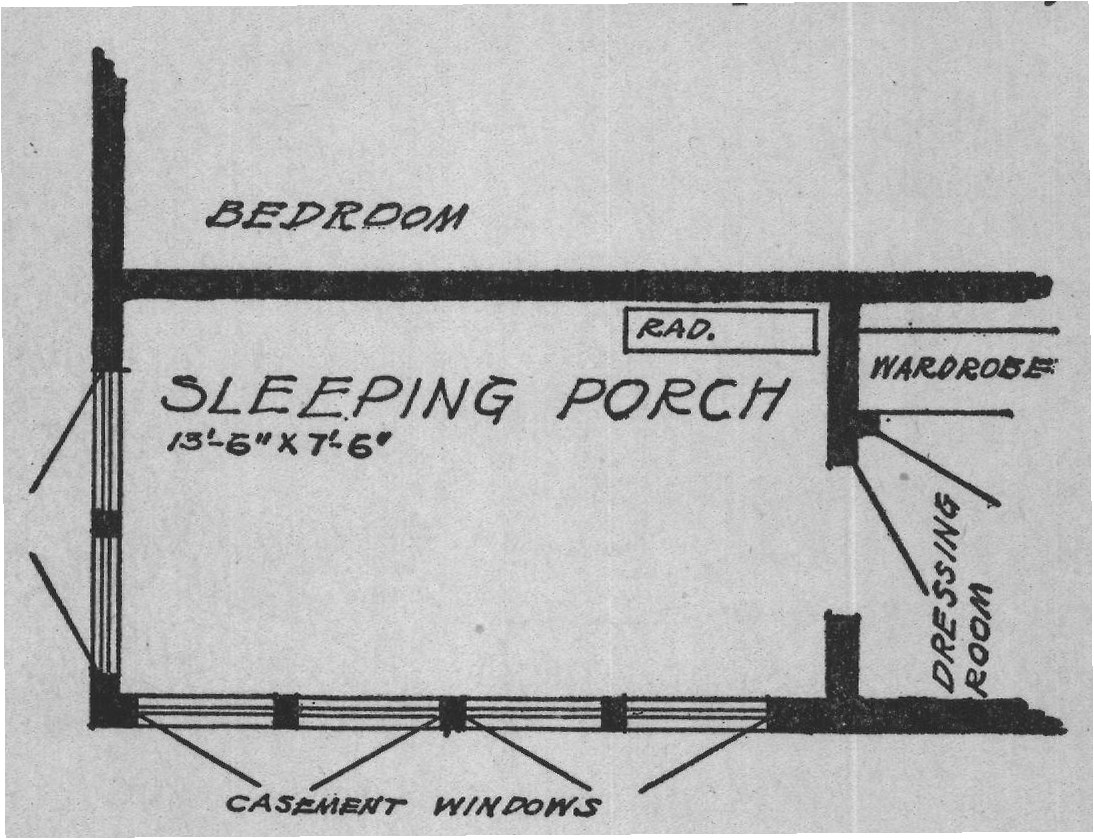
For instance, on a sleeping-porch 13 feet by 7 feet 6 inches, one can get three cots very comfortably with enough space about them for "making." Usually twelve inches or less between cots is SPACE CONTAINS BED WHEN CLOSED BED PARTLY CLOSED BED OPEN LIGHT FIXTURE- Built-in folding beds, which permit a sleeping-porch to be used twenty-four hours. With beds folded out of the way during daytime, a delightful veranda is possible for sewing or resting. quite sufficient, when it is impossible to get more room.
Ordinary folding canvas cots are also practicable for sleeping-porches, for they can be folded up out of the way during the day. As a general proposition, however, any method which requires removing bedding each day and bringing it out again at night is irksome. One should be able to jump right into bed on the sleeping-porch, as well as in a bedroom, without annoying preparation.
I have found that porches not conveniently equipped are usually soon discarded.
Two kinds of folding beds are obtainable for porches, both excellent, because they can be folded out of the way during the day. The first type is known as a "built-in" bed. A small recess in the wall is required (about 3 feet 6 inches wide and I foot 6 inches deep), in which to swing the bed (hinged on one end), when not in use. The under side of the iron bed has a wooden panel, which effectually conceals the bed when not in use. These beds are counterweighted to make easy their operation. Bed-clothes are strapped down, and when the beds are closed a small ventilating opening keeps bedding sweet and clean at all times.
Another good folding bed stands free from the wall, and folds up into a small space when closed.
One of the chief advantages of folding beds like these is that, during the day, folded up out of the way, one can use the porch for other purposes. Of course, when several ordinary cots are used, there is hardly room enough left to use the porch for anything but sleeping.
Every sleeping-porch, to be practicable the year IOI round should be fitted with screens in summer and storm-sash in winter, though the latter may be omitted by using heavy duck or khaki curtains.
Fixed storm-sash which entirely inclose the porch and cannot be opened are not practicable, for even in coldest weather one wants fresh air.
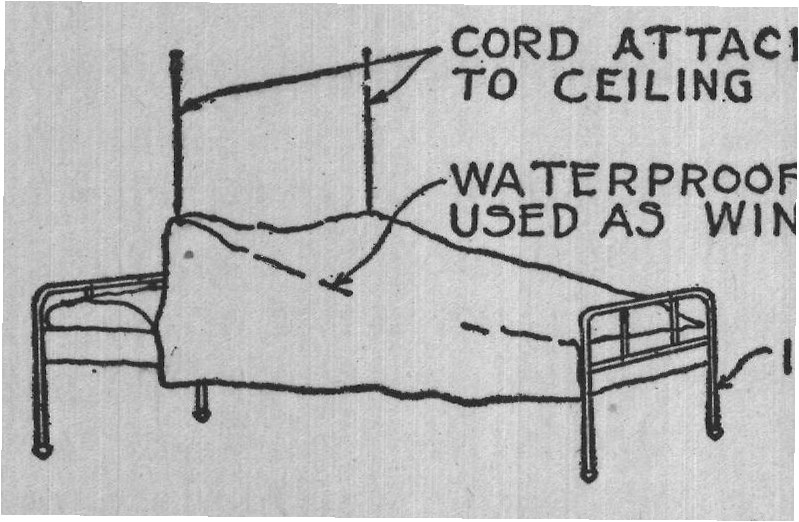
Many misunderstand this necessary feature of the sleeping-porch-fresh air; thinking that so long as the porch is cold there must be plenty of fresh CORD ATTACHED TO CEILING WATERPROOF COVER USED AS WIND SHIELD IRON COT Ordinary iron cots make good beds for sleeping-porches. Rigging the waterproof covering in the way illustrated makes a good wind-shield. air. Any porch, of course, which is not heated will be cold in winter, but fresh air will be lacking if storm-sashes are tightly closed. They should, therefore, be arranged to open.
Sleeping-porches having casement windows are well supplied with sash. In winter, all one needs to do is to open a sufficient number of them, to secure fresh air, but in stormy weather all, or nearly all of them, can be closed. In summer, casements can be left entirely open (screens being provided), or pins can be pulled out of the hinges and windows entirely removed, to be installed again in the fall.
For porches where casements are not used, detachable storm-sash should be provided. These can be fitted to bolt or screw in place, so they can BEDROOM SLEEPING PORCH 13-6"X7-6" RAD.
WARDROBE DRESSING ROOM CASEMENT WINDOWS One corner of the second floor made into a sleeping-porch. Rows of casement windows provide ample light and air.
Several be easily placed in position each season. sash should be hinged to open like casement windows, to secure fresh air. When canvas or khaki roller curtains are used in place of storm-sash, they are applied at the top or bottom of the porch openings. In cold or stormy weather they can be rolled up or down to close or nearly close the porch. Curtains have been found very satisfactory, and they are popular because cheaper than storm-sash. An advantage in them is that they may be left in place the year round, summer as well as winter. Screens, of course, should be detached in winter.
Many house-owners desire heat on their sleeping-porches. There is no objection to this except the liability a radiator has to freezing in very cold weather. To place a radiator on a sleepingporch is sometimes to invite catastrophe the first cold snap, for usually, hot water or steam in a radiator is not sufficiently hot to keep from freezing. Once frozen, a radiator is almost certain to crack and spring a leak.
When a radiator is used it should be at least twice as large as ordinarily needed. Then it should be placed in a protected corner. In extremely cold weather it should be turned off and drained. This is possible when a proper system of piping is installed, with the valve inside the house (often down in the basement). Turning off such a valve drains the water out of the radiator back into the house, without interfering with any other in the system.
Often, by arranging wide glass doors connecting a bedroom with the sleeping-porch, and placing an excessive amount of radiation in the bedroom, a porch can be made comfortable when doors are open without other means of heat, but this is not always satisfactory.
Another way to have the bed warm and inviting when first retiring is to use a soapstone bedwarmer. This is a disc of soapstone about 2 inches thick and 12 inches in diameter (similar to those used in fireless cookers). Heated a few minutes in the oven and then placed in bed it keeps the latter warm and dry for hours. A great many people use this method.
Not the least important factor is bedding, for no one can be comfortable on an outdoor porch when there is too much or too little bedding.
The amount required to keep warm on cold nights, of course, depends upon the season, and somewhat upon the individuals. Some persons require more and some less bedding to be comfortable. Sleeping-bags are excellent. With the proper amount of warm night-clothes one can sleep very comfortably in a sleeping-bag throughout the winter. There are several patterns of these, most of them being provided with strings to tie tightly around the neck.
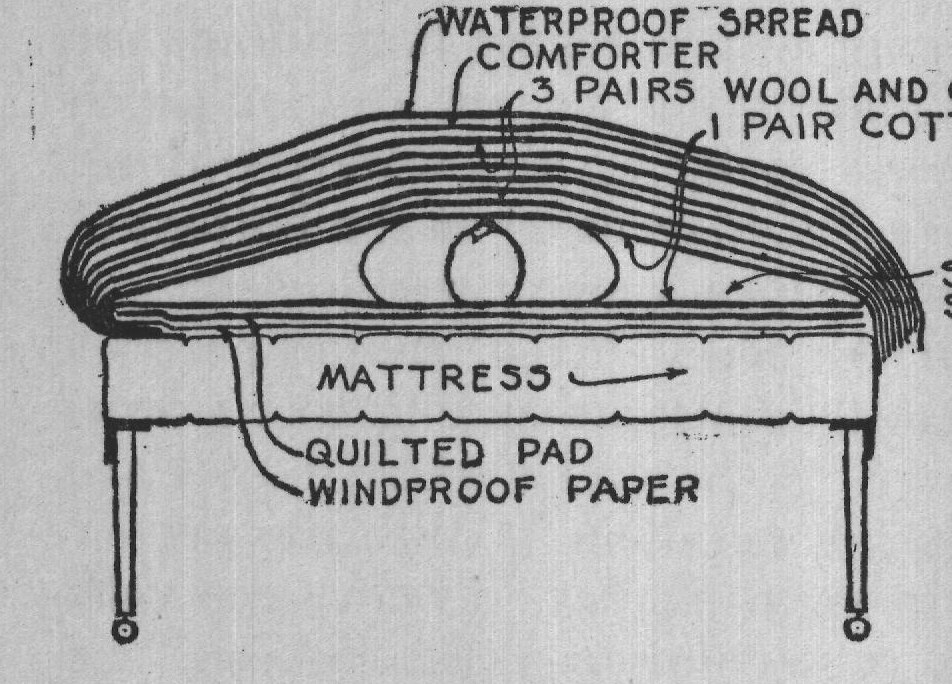
For those who prefer ordinary bed-clothes, the ! following have been found sufficient for very cold weather. First, on top of the mattress is placed a layer of newspaper or a sheet of heavy building-paper (such as is used on houses underneath the weather-boarding). This is to keep the cold wind from blowing through the mattress. Some such covering is absolutely essential in cold weather; many use a cowhide, rug, or rubber sheet for the same purpose. Next comes a pair of woolen blankets folded in the middle to make two thicknesses. On top of these place a quilted pad, topped with another pair of woolen blankets, folded. Between the folds of these last blankets is where the sleeper sleeps.
For covering, use three pairs of wool-and- WATERPROOF SRREAD COMFORTER 3 PAIRS WOOL AND COTTON BLANKETS I PAIR COTTON BLANKETS MATTRESS -QUILTED PAD WINDPROOF PAPER SLEEPING SPACE Graphic illustration of amount of bedclothing used during cold weather. Clothing can be varied to suit each sleeper, some preferring more comforters and less blankets. Adults usually need more bedclothes than children. All coverings should be tucked in firmly. cotton blankets, one comforter, and a tightly woven bedspread (or a waterproof covering, instead). Of course, one may use any coverings equivalent to these. When all-wool blankets are used, less in number are required than when cotton blankets are used, or more comforters can be used with less blankets and so on. For the topmost covering a waterproof cloth can be recommended, such as enamel cloth (that piano covers are made from). This will prove excellent in wet weather, both when the bed is occupied and during the day, to prevent dampness saturating the bed-clothes.
All bed coverings, of course, should be tucked in firmly at both sides so that the entire bed forms, in fact, a secure sleeping-bag into which the sleeper can crawl with little difficulty. One ingenious way for rigging up the waterproof top covering is to fasten it securely at the bottom of the bed and have hooks hung from the ceiling to suspend the other end. Thus it may be rigged up to hang slightly higher than the sleeper's head, effectually acting as a windbreak in stormy weather.
What should the sleeper wear? A man usually wears underclothes, flannel (or flannelette) pajamas, worsted stockings (or bed slippers), and a worsted hood tied tightly under the chin. Many women wear flannel pajamas, too, though some prefer flannel nightgowns. Children are dressed about the same, though they usually require less bed-clothes than grown-ups.
A little systematic experimenting will prove to anyone the advantage of a sleeping-porch and will demonstrate how comfortably one can sleep there even in the coldest weather. The quality of sleep one gets on a porch seems to be different from sleep indoors. Many sleeping-porchers state that less sleep is required outdoors than indoors.
Sleep outdoors seems to be more sound and more fraught with vigor-producing rest. One feels brighter in the morning after sleeping all night in the tonic air of out-of-doors.