Home › The Names of Rameses II › The Names of Rameses II: Sesostris
The Names of Rameses II: Sesostris
It is not the Sesostris of Herodotus that we meet with, then, at the twelfth dynasty; it was, indeed, a king who was victorious on the frontiers, but whose armies had never penetrated into Asia, and this false application of the legend of Sesostris may have been caused by the complete absence of that famous name from the real lists of Manetho. Since the British Museum published its fine collection of papyri, all Egyptian scholars have remarked in the historical texts of the nineteenth dynasty a singular royal monogram which Y reads Sesu, The same name is also found at Thebes on a mural inscription. It seemed impossible to find any particular place for this king Sesu, and the analogy of the name with Sesostris was so tempting, that it no doubt occurred to the mind of more than one archæologist; but the question was to find some decisive information so as to correctly place the king designated by the device. I believe that I have been so fortunate as to come across the proof desired, in the Egyptian collection in the imperial musuem at Vienna.
That museum possesses a small solid pyramid of calcareous stone; its four sides are covered with finely executed carvings. I have described, in the catalogue of the Louvre, the ordinary decoration of this small monument. It is, so to speak, turned so as to face eastwardly, and is always made up of invocations to the sun in his various positions. The Vienna pyramid does not fall short of this programme, and these repeated invocations have supplied opportunities to frequently mention the name of the person dedicating it. That personage was called, like the great king, Rameses Mei-Amoun, Excepting the border surrounding the royal name, the signs are exactly the same. Now, twice upon the pyramid, the same Egyptian is named APPENDIX. simply Ses, PΓ written without the vowel. A third time his MA in such manner as name is written Ses Mei-Amoun to make us perfectly understand that Ses is a popular abbreviation of Rameses. This royal name, in its most complete form, that which was particularly in use under Rameses I., reads thus :
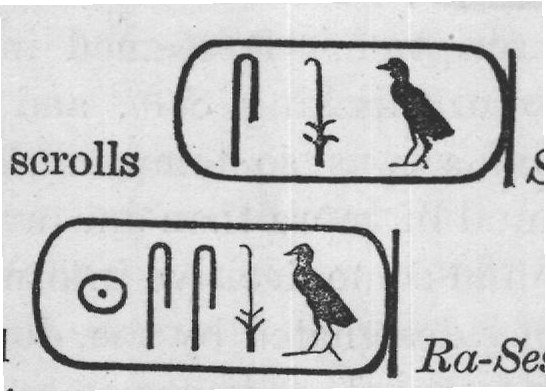
Ramesesu. From this form are derived several abbreviations. On the historical papyri we find the scrolls Sesesu, and M Sesu, Ra-Sesesu, all used indifferently to designate Rameses II. I have even found there the variation Sesu-Mei-Amoun, identical with that which is read once on the pyramid at Vienna, where the surname Mei-Amoun accompanies the abbreviation of the proper name. It is certain, then, that there did exist a popular abbreviation Sesu, so currently used to designate the great Rameses, that it could be employed indifferently to write the title of one of his namesakes. The form used in the papyri Sesesu is very exactly what Diodorus has transcribed in to Sesoosis. It is not that I regard the form Sesostris as less correct; it may be derived from the scroll Ra-Sesesu. The Egyptians had known a number of kings whose names ended in the word ra, or sun (pronounced ri by iotacism, according to all the Greek transcripts, in the terminations). Although the sign for the sun was traced at the commencement of the scroll as an honorary distinction, the APPENDIX. grammatical construction frequently brought it to the end of the name. It is thus that the name of king Menkeres, written invariably tion Men ke re Re-men-ke, became in the pronuncia.
U and it is in this way that I found it written ke re and it is in this way that I found it written for the proper name of a Saitic functionary. It seems to me very probable that, in consequence of this custom, the abbreviation became transformed in the mouth of the people to Sesesu-ri and that it was in this shape that they peated, in the presence of Herodotus, the name that produced the Greek from Sesostris. [Extract from the Atheneum français, 1856.] VI.