Working of the Fugitive Slave Law
The Fugitive Slave-Law now began to bear bitter fruit, and it soon became one of the most prolific causes of the continually increasing controversies between the upholders and opposers of the slave-labor system. It was made more offensive by the evident intention of the friends of the institution everywhere to nationalize slavery; and the perversion of the obvious meaning of the vital doctrine of the Declaration of Independence, by the judicial branch of the government, while the executive branch was ready to lend his tremendous power in giving practical effect to the system, awakened in the breasts of the people of the free-labor States a burning desire to wipe the stain of human bondage from the escutcheon of the Republic. Seizures under the Fugitive-Slave Law were becoming more and more frequent, with circumstances of increasing injustice and cruelty. The business of arresting, and remanding to hopeless slavery, men, women, and children, was carried on all over the free-labor States, and the people stood appalled. By that dreadful law, every man was compelled to become a slave-hunter, under certain conditions; and every kind-hearted woman who might give a cup of cold water or the shelter of a roof to a suffering sister fleeing from intolerable bondage, incurred the penalty of a felony!
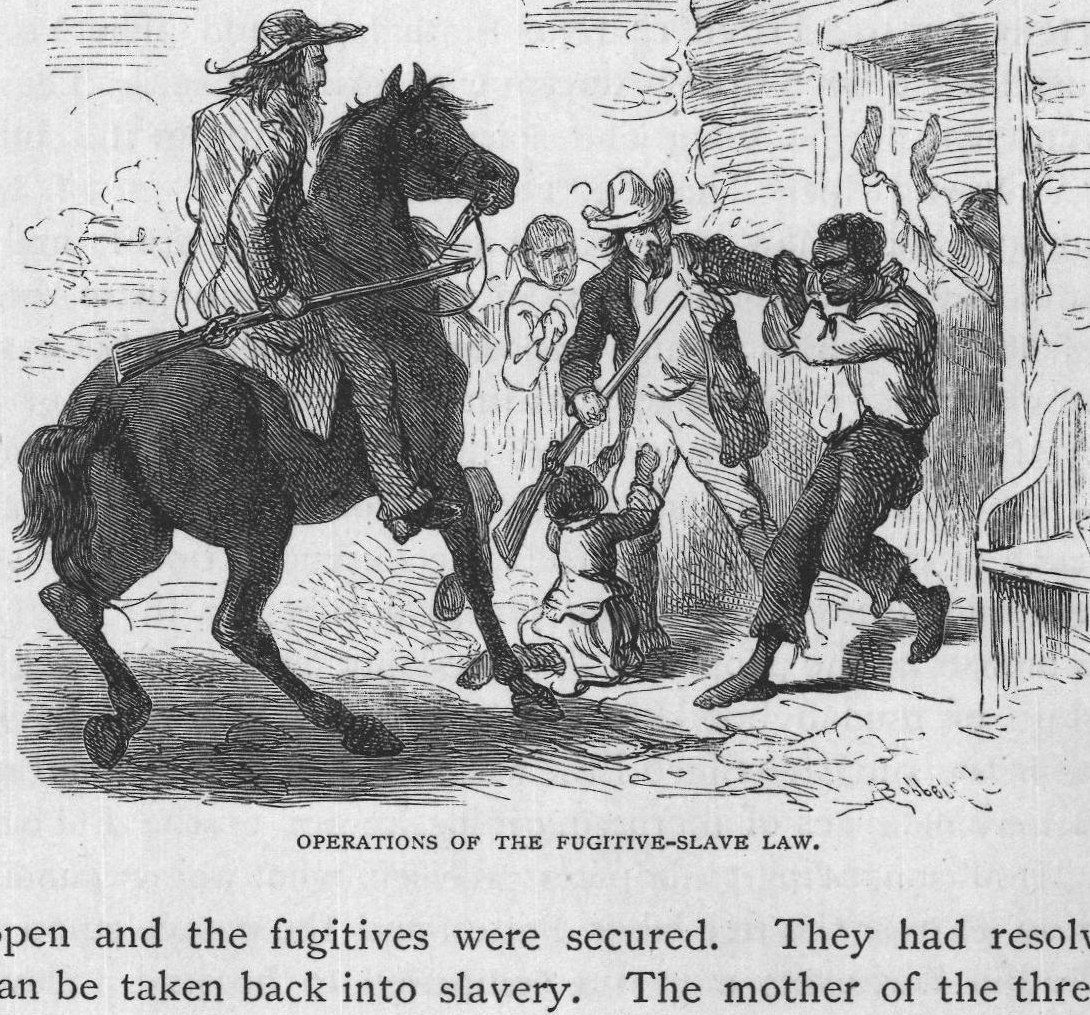
This law became a broad cover under which the kidnapping of free persons of color was extensively carried on; and scores of men, women, and children, born free, were dragged from their homes and consigned to hopeless bondage. Our public legal records are stained with the revolting details of the workings of the law; and the newspapers of the day contained accounts of many stirring events connected with the execution of it. The following facts will suffice as an illustration:
On a cold day in January, 1856, two slaves, with their wives and four children, all thinly clad, escaped from Kentucky into Ohio. They crossed the frozen river to Cincinnati, closely pursued by the master of three of them, on horseback. In Cincinnati, they were harbored by a colored man. Their retreat was discovered by the pursuing master, who repaired to the house with the United States marshal and his assistants, and demanded their surrender. They refused; and after a desperate struggle, the door was broken open and the fugitives were secured. They had resolved to die rather than be taken back into slavery. The mother of the three children, in despair, tried first to kill her offspring, and then herself. When she was seized, she had already slain one of her children with a knife--a beautiful little girl, nearly white in complexion--and had severely wounded the other two. A corner's jury was called, who decided that the frantic mother had killed her child, and it was proposed to hold her for trial under the laws of Ohio. But it was discovered that the Fugitive-Slave Law had been made so absolute by the terms of its enactment and the opinion of the Chief Justice of the United States, that a State law could not interfere with it; so the mother and her surviving companions were remanded into slavery. They were taken across the Ohio River, and all traces of them were lost.
When the hideous character of the Fugitive-Slave Law, in all its aspects, became fully manifest, the public conscience was aroused to action, and righteous men and women all over the slave-labor States, shocked by a spectacle that disgraced a free people pretending to be civilized, protested as loudly as they dared; and the legislatures of several of the free-labor States adopted measures for relieving their citizens from the penalties imposed upon those who should refuse to become slave-catchers.
By the terms of the Fugitive-Slave Law, the sacred right of trial by jury was denied to the man who was alleged to be a slave, and he had no redness. This was logical, for the Chief Justice of the United States had declared that the black man "had no rights which the white man was bound to respect." He had also declared that no State law could interfere with the operations of the Fugitive-Slave Act, or with slavery itself. This opinion was directly adverse to the letter and spirit of a statute in the code of the State of New York, which declared the immediate freedom of any slave when brought involuntarily within its borders. The Legislature of that State determined to sustain that statute, and boldly denounced the opinion of the Chief Justice, which denied citizenship to men of color who had descended from slaves. Ohio took similar action, and Maine, Massachusetts, Connecticut, Michigan, and Wisconsin took strong ground in favor of the freedom of the slaves within their borders, without assuming an attitude of actual resistance to the obnoxious act which every citizen was bound to obey so long as it remained unrepealed.
This movement in the Northern States naturally exasperated the slave-holders, and it was used by the politicians among them to create hot indignation in the hearts of the people in the slave-labor States. This, according to the testimony of a personal friend of the author of the Fugitive-Slave Act (James M. Mason, of Virginia,) was precisely what the peculiarly offensive features of that act were intended to effect. It was calculated that it would finally cause resistance to the measure on the part of the people of the free-labor States, and so give a plausible pretext for disunion, rebellion, and civil war, if necessary, on the part of the friends of the slave-labor system. This testimony was given to me orally, while standing among the ruins of Mr. Mason's house at Winchester, in 1866.