Vermont and Kentucky Enter the Union
Vermont, originally known as the New Hampshire Grants, had a long controversy with New York about territorial jurisdiction, which was not settled when the war for independence broke out. In 1777, the people of the province, in convention, declared it to be an independent State. In 1781, the Congress offered to admit it into the Confederacy then formed, but with a considerable curtailment of its area. The people refused the terms, and it remained an independent State ten years longer. Then New York agreed to relinquish all claim to the territory and political jurisdiction on the payment by Vermont of the sum of $30,000. This was done; and on the 4th of March, 1791, that State entered our Union as the fourteenth. The same year the first census or enumeration of the inhabitants was completed, with the result mentioned at the beginning of this Book. On the first of June the following year, Kentucky, with the consent of Virginia of which it formed a part, entered the Union as the fifteenth State.
We have seen with what an affluent stream emigration flowed into the Ohio region after the organization of the Northwestern Territory in 1787. General Arthur St. Clair, a worthy officer of the Continental Army, was appointed its governor. He soon found serious trouble brewing there. The British, in violation of the treaty of 1783, still held Detroit and other Western posts, and British traders were jealous of the hardy settlers who were gathering in communities north of the Ohio. British agents, instigated by Sir John Johnson, the former Indian agent in the Mohawk Valley, and Guy Carleton (then Lord Dorchester), again governor of Canada, were inciting the savages to make war on the settlers. These well-established facts gave reasons for a prevalent belief that the British government yet hoped for an opportunity to bring back the young republic to a state of colonial dependence. The fostered discontents of the Indians were developed into open hostilities, in the spring of 1790, and attempts at pacific arrangements were fruitless.
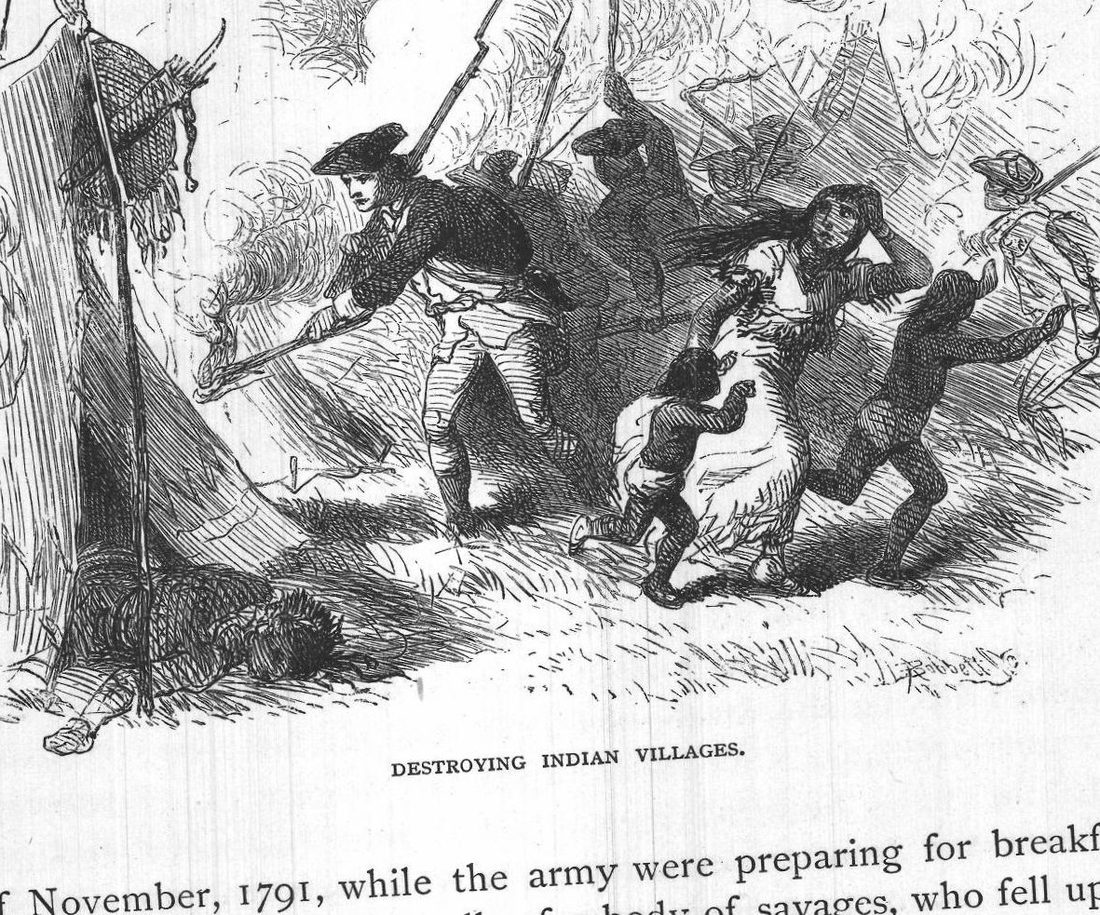
In September, 1790, General Harmer led more than a thousand troops, regulars and volunteers, from Fort Washington (now Cincinnati) into the Indian country around the headwaters of the Maumee River, to chastise the savages as Sullivan had scourged the Senecas in 1779. Instead of humbling them by spreading desolation over their fair land, Harmer, in two battles near the present village of Fort Wayne, Indiana, was defeated with considerable loss, and abandoned the enterprise. In May the following year, General Scott of Kentucky, with eight hundred men, penetrated the Wabash country almost to the site of the present town of Lafayette, Indiana, and destroyed several villages. At the beginning of August, General Wilkinson, with more than five hundred men, pushed into the same region, and pressing on to the Tippecanoe and the prairies, destroyed some Kickapoo villages, and then made his way to the Falls of the Ohio, near Louisville. But the Indians, instead of being humbled by these scourges, were urged thereby, and the false representations of British emissaries, to fight desperately for their country and lives.
Congress now prepared to plant fortifications in the heart of the Indian country; and in September, 1791, two thousand troops were gathered at Fort Washington and marched northward under the immediate command of General Butler, accompanied by General St. Clair as chief. Twenty miles from Fort Washington, they built Fort Hamilton, on the Miami River. Forty-two miles further on they built Fort Jefferson; and when they moved from there, late in October, there were evidences that dusky scouts were hovering on their flanks.
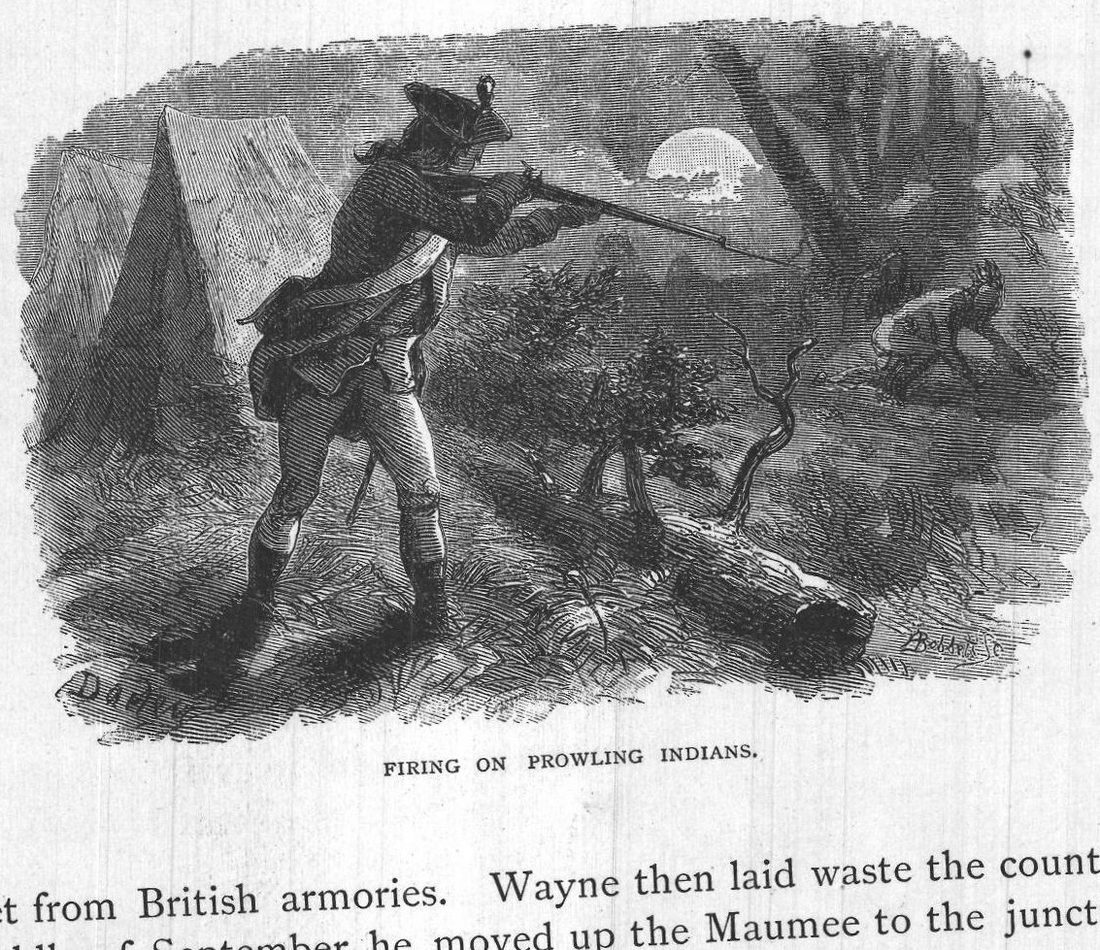
At length the little army of invaders halted and encamped on the borders of a tributary of the Upper Wabash, in Darke County, Ohio, near the Indiana line, a hundred miles from Cincinnati. The wearied soldiers went to rest early, unsuspicious of much danger near. All night long the sentinels fired upon prowling Indians; and before sunrise on the morning of the 4th of November, 1791, while the army were preparing for breakfast, they were surprised by the horrid yells of a body of savages, who fell upon them with great fury. The troops made a gallant defence, but the slaughter among them was dreadful. General Butler was killed, and most of his officers were slain or wounded. The smitten army fled in confusion. It was with great difficulty that St. Clair, who was tortured with gout, after having three horses killed under him, escaped on a pack-horse. That evening Adjutant-General Winthrop Sargent wrote in his diary: "The troops have all been defeated; and though it is impossible, at this time, to ascertain our loss, yet there can be no manner of doubt that more than half the army are either killed or wounded." Among the fugitives were more than a hundred feminine camp-followers--wives of the soldiers. One of them was so fleet of foot that she kept ahead of the flying army. Her long, red hair streaming behind her, was the oriflamme that the soldiers followed in their flight back to Fort Washington.