Unfortunate Movements: Scott and Heights
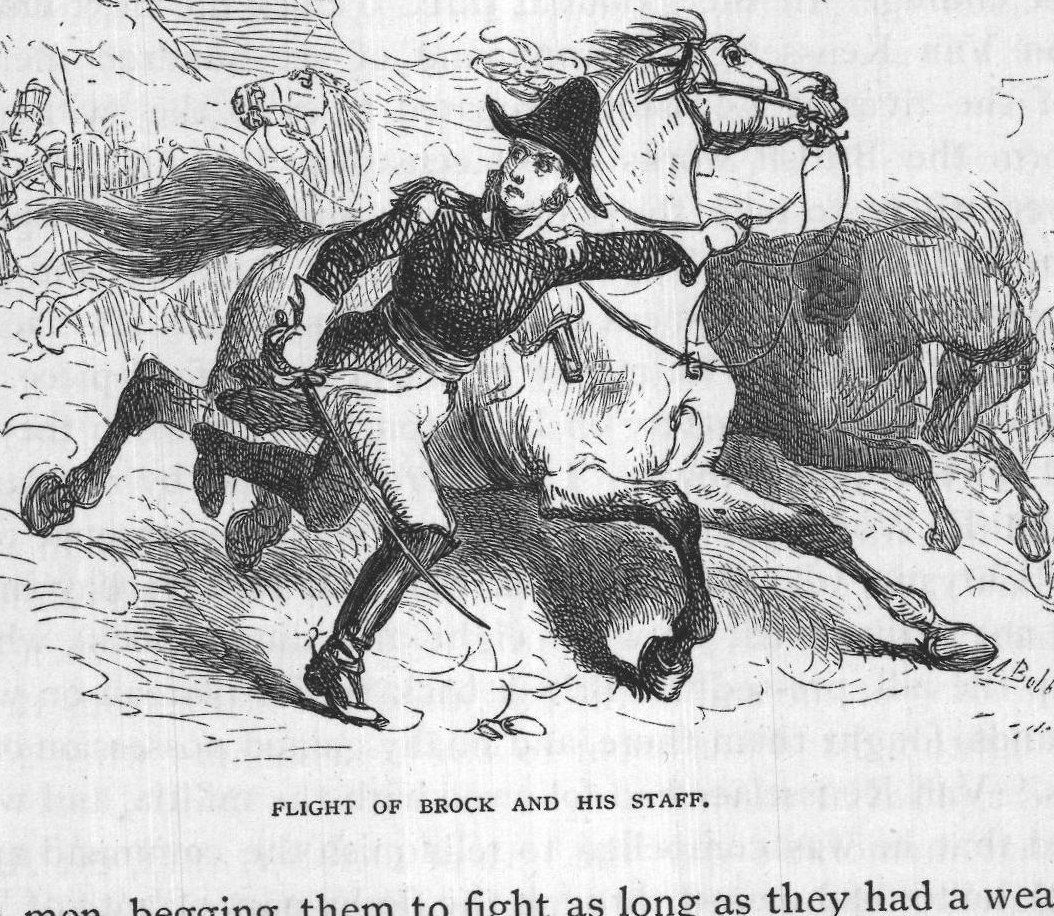
General Brock was at Fort George, seven miles below Queenstown, when the firing began. He hastened to the scene of action, and with his staff pressed up the Heights to a redan battery, where they dismounted. They were suddenly startled by the crack of musketry. Wool and his followers were close upon them. Brock and his aides had not time to remount, but fled down the hill, leading their horses at full gallop and followed by the dozen men who manned the battery. In a few minutes the American flag was waving over that little work. Brock at once placed himself at the head of some troops to drive Wool from the Heights, and at first the Americans were pressed back by overwhelming numbers, to the verge of the precipice that rises from the deep chasm of the river two hundred feet below. That little band were in great peril, when Captain Ogilvie, seeing men falling around him and the danger of being hurled into the flood below, raised a white handkerchief on the point of a bayonet in token of surrender. Wool sprang forward, snatched the token of submission, addressed a few stirring words to his men, begging them to fight as long as they had a weapon, and then waving his sword, so inspirited his comrades to a renewal of the fight that they soon made the British veterans break, and flee down the hill in confusion. These were rallied by General Brock, and were about to reascend the Heights, when their commander was mortally wounded at the foot of the declivity. After a short struggle, the British retreated a mile below Queenstown. The young commander (Wool was only twenty-four years of age), after three distinct battles, was left master of the Heights with two hundred and forty men. Not long afterward, Brigadier-General Wadsworth, of the New York militia, took the chief command.
General Sheaffe, who succeeded General Brock in command of the British, rallied the troops. Lieutenant-Colonel (afterward Major-General) Winfield Scott, had arrived at Lewiston, and crossing the river joined the troops as a volunteer. At the request of General Wadsworth, he took active command. Early in the afternoon a cloud of dusky warriors, led by John Brandt, painted and plumed, and with gleaming tomahawks, fell upon the pickets on the American left with great fury, uttering the horrid war-whoop. The militia were about to flee, when the towering form and trumpet-toned voice of Scott, commanded their attention. He inspired the troops, now about six hundred strong, militia and regulars, to fall upon the savage assailants with a shout. The Indians turned and fled to the woods in terror. Meanwhile General Sheaffe had pressed forward, when General Van Rensselaer, who stood by the side of Scott, hastened across the river to send over reinforcements of militia. About a thousand had gone over in the morning, but few had engaged in the fight. Others now refused to go, pleading, in the language of the opponents of the war, that they were not compelled to leave the soil of their country and invade that of another. The poltroons stood idly at Lewiston, while their comrades were mown down like grass at Queenstown. Overwhelming numbers compelled the Americans to surrender, when all the prisoners were marched to Newark. There Scott had an encounter with two Indian chiefs. He met them in a hall, and was unarmed. They demanded how many bullets had passed through his clothes, as they had both fired at him repeatedly. One of the Indians attempted to turn him round rudely, when Scott thrust him away, exclaiming: "Hands off! you shot like a squaw!" Both-Indians drew their knives and tomahawks, and were about to spring upon Scott, when he snatched a sword standing at the end of the hall, drew the blade from the scabbard as quick as lightning, and was about to slay his assailants, when a British officer interfered and saved them.
On that memorable day, the 13th of October, 1812, the Americans lost, in killed, wounded and prisoners, about eleven hundred men. General Van Rensselaer, disgusted with the inefficiency everywhere displayed, left the service, and was succeeded by General Alexander Smythe, of Virginia, who accomplished nothing of importance during the remainder of the season. The military situation of the Americans at the close of 1812, was this: The Army of the Northwest, as it had been named, first under Hull and then under General Harrison, was occupying a defensive position among the snows of the wilderness on the banks of the Maumee River; the Army of the Centre, under General Smythe, was resting on the defensive on the Niagara frontier; and the Army of the North, under General Bloomfield, was also resting on the defensive at Plattsburgh.