Ticonderoga Evacuated by the Americans
Meanwhile Burgoyne, on board the schooner Royal George, ordered his gunboats to pursue the bateaux. The bridge barrier was soon removed, and the British vessels gave chase. They overtook the bateaux at near the landing-place at Skenesborough, and destroyed them and their contents. Colonel Long and his men escaped; and after setting on fire everything combustible at Skenesborough, they fled to Fort Ann, a few miles in the interior, pursued by a British regiment. Near Fort Ann, he turned upon and routed his pursuers, when the latter was reinforced and Long was driven back. He burned Fort Ann, and fled to Fort Edward on the Hudson.
When the army of St. Clair reached Hubbardton, in Vermont, the main body marched through the woods toward Castleton, leaving the rear-guard, under Colonel Seth Warner, one of the brave "Green Mountain Boys," to gather up the stragglers. While awaiting their arrival, Warner was overtaken by the van of the pursuers, on the morning of the 7th, when a sharp engagement took place. Colonel Francis of New Hampshire, who commanded the rear-guard in the flight, was killed. The Americans were dispersed and fled, but about two hundred of them were made prisoners. The pursuers lost almost as many killed and wounded, and gave up the chase. St. Clair, with about two thousand troops, made his way in safety to Fort Edward.
A very large amount of provisions and military stores, and almost two hundred pieces of artillery, were lost by the Americans when they evacuated Ticonderoga. The news of the disaster went over the country, with wildest exaggerations. Generals Schuyler and St. Clair were condemned without stint and without reason. They had done all that it was possible for men to do under the circumstances. The States as individual communities and by their representatives in Congress had utterly failed to supply the Northern Department with sufficient men to defend it. The Congress had been practically deaf to the repeated calls of Schuyler for reinforcements. He had pointed out the dangers of an impending invasion while his force was too small to stay, or even impede it much. Washington, more wise than the Congress, saw the importance to his own army and the safety of the country in checking the progress of the invaders; and though he was sorely in want of reinforcements coming from New England, he directed that a part of them, when they should reach the Hudson River, should be sent up that stream to assist Schuyler against a powerful foe. The enemies of the commander of the Northern Department, in and out of Congress, took an ungenerous advantage of the public ignorance of the truth, and condemned him as an incompetent. Some went so far as to call him a traitor. After tedious endeavors he procured a trial by a court-martial, who, by their verdict, heartily approved by the Congress, fully vindicated his character in every respect.
Schuyler was at Saratoga when he heard of the disaster. He hastened to Fort Edward to gather there the scattered troops and oppose the further advance of Burgoyne, who, victorious, was boastful and arrogant. In a proclamation he peremptorily demanded the instant submission of the people. Schuyler immediately issued a counter-proclamation, with excellent effect; but with the remnant of St. Clair's army added to his own force at the middle of July, he had not more than four thousand effective men--a number totally inadequate to combat with the enemy. He employed it simply but effectually, in destroying bridges and felling trees in the pathway of the invader. So impeded, Burgoyne did not reach Fort Edward until the close of July. He was compelled to move cautiously, for Carleton had refused to garrison the lake-forts, and the lieutenant-general was compelled to "drain the life-blood" of his army to defend them. His Indians, too, were beginning to be restless, and some were leaving him.
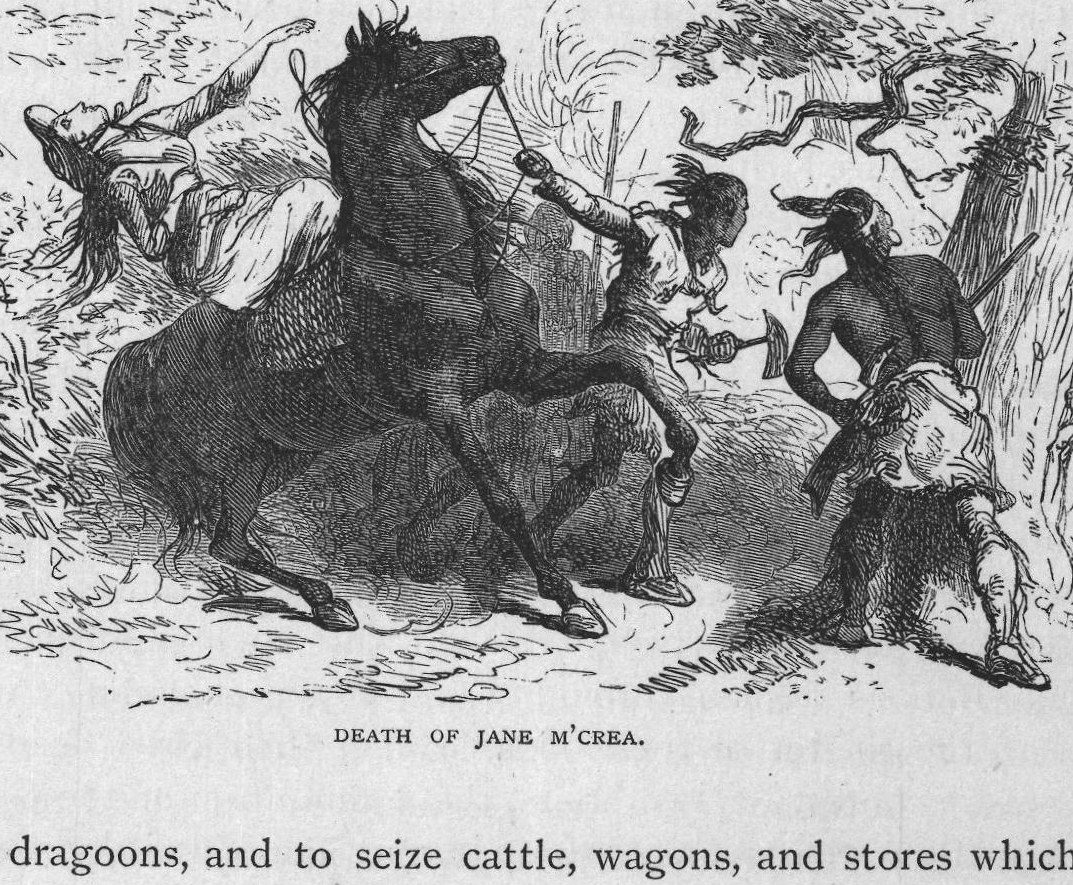
At Fort Edward occurred the death of Jane McCrea, the story of which, as set afloat at the time, is familiar to all, and was exploded years ago. Truth tells the story as follows: Miss McCrea was a handsome young girl, visiting friends at Fort Edward at the time of Burgoyne's invasion. She was betrothed to a young man living near there, who was then in Burgoyne's army. When that army approached Fort Edward, some prowling Indians seized Miss McCrea, and attempted to carry her to the British camp at Sandy Hill, on horseback. A detachment of Americans were sent to rescue her. One of a volley of bullets fired at her captors, pierced the maiden and she fell dead from the horse, when the Indians scalped her and carried her glossy locks as a trophy into the camp. Her lover, shocked by the event, left the army, went to Canada at the close of the war, and there lived a moody bachelor until he was an old man. He had purchased the scalp of his beloved, of the Indians, and cherished it as a precious treasure, upon which, at times, he would gaze with tearful eyes as he held the ever-shining locks in his hand. The body of Miss McCrea was recovered by her friends, and was buried at Fort Edward. A tale of romance and horror, concerning the manner of her death, went abroad. In September, a letter from Gates to Burgoyne, holding him responsible for her death, gave great currency to the story; and hundreds, perhaps thousands of young men, burning with indignation and a spirit of vengeance because of the outrage, flocked to the American camp.