The West
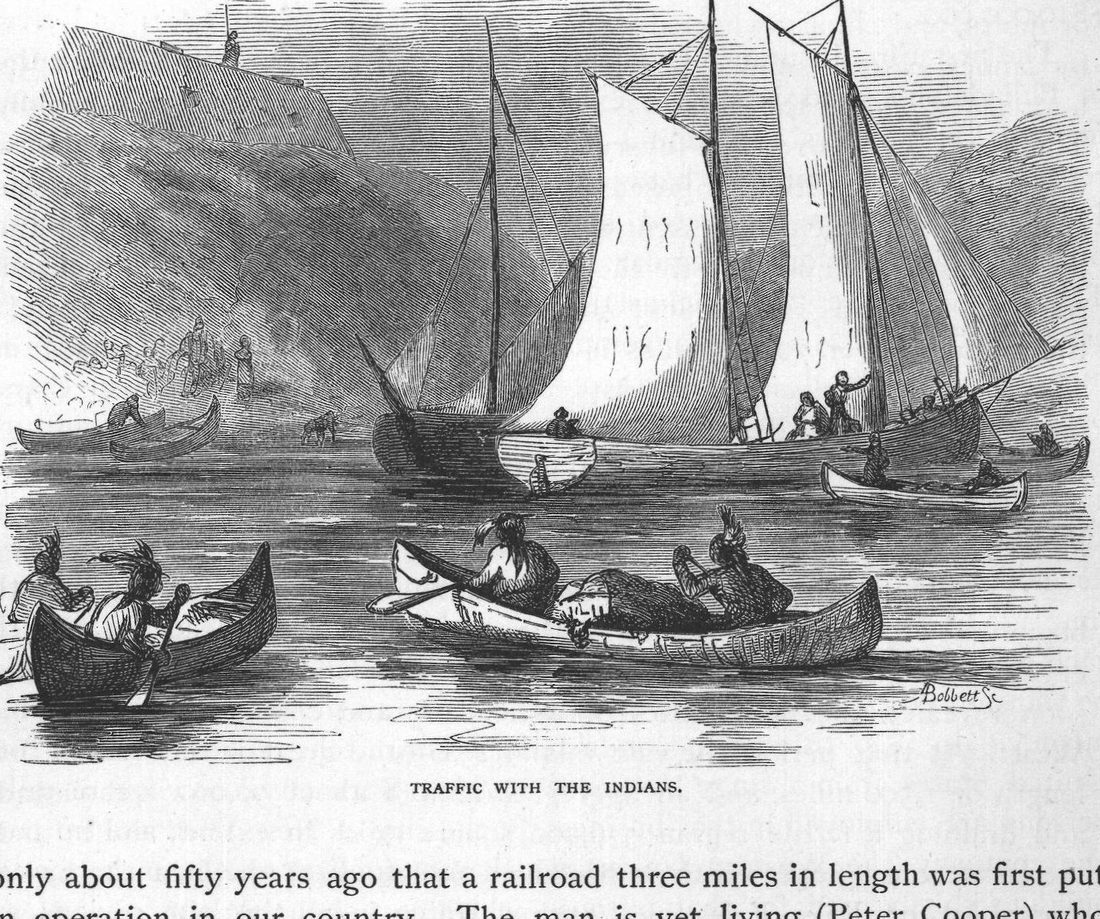
The first great improvement in our internal commercial facilities was the beginning of our canal system at the close of the last century; but the effects were small until the completion of the Erie Canal in 1825, which soon revealed the possibilities of agriculture and commerce in the Great West. At that period the vast inland seas--the great lakes--with a total length of 1,500 miles, and an aggregate area of about 90,000 square miles, and draining a fertile region 336,000 square miles in extent, had no commerce of consequence on their bosoms. So late as 1819, when there was a steamboat on Lake Erie, the principal traffic in all the lake regions was carried on with the Indians, who came to ports in canoes with peltry and furs to exchange for the products of the Eastern States, borne upon the bosom of the waters in sloops and schooners. Now the Indian has disappeared from our commerce; and the value of the products of "the West," transported on the land and water vehicles, may be estimated by hundreds of millions of dollars. The canal, the steamboat and the railway, have caused large cities to spring up in desolate places, and the wilderness to bud and "blossom as the rose." Chicago, which was composed of vacant village lots in a wild and almost unknown region of our continent forty-five years ago, is now a city of 300,000 inhabitants, and is the greatest grain market and centre of internal commerce in the world. Its entire trade amounts annually to $450,000,000.
When the Erie Canal was first conceived, the steamboat and the railway were unknown in our land. It is only seventy years since the first successful steamboat made a voyage between New York and Albany; and it is only about fifty years ago that a railroad three miles in length was first put in operation in our country. The man is yet living (Peter Cooper) who built the first American locomotive. Now the extent of our railways is 73,000 miles, and these represent a capital stock of $2,000,000,000. Full 20,000 miles of these roads were built and equipped between 1850 and 1860, at a cost of $720,000,000. For the benefit of the commerce of the United States and the world, we are now contemplating the construction of a ship-canal across the Isthmus of Darien, at a cost of more than $100,000,000.
In banking and insurance, commerce finds important auxiliaries. The Bank of North America, founded at Philadelphia in 1781, with a capital of $400,000, was the first one established in our country. After the National Government went into operation and commercial activity became very great, the number of banks rapidly increased; and when the civil war broke out in 1861, the number was 1,562. During that war a National system of banking was organized, and at the beginning of 1876, the number of banks formed under it was over two thousand, with an aggregate capital of more than $500,000,000. Savings banks were first established in the United States in 1816. These useful institutions have rapidly increased in numbers and importance, and now have an aggregate amount of deposits of about $810,000,000.
The first Fire Insurance Company in our country was organized in 1752, in Philadelphia, and is still in existence. Such companies have rapidly increased in numbers and capital within ten or fifteen years, and they now represent a stock capital of between $55,000,000 and $60,000,000. Marine Insurance had been conducted here by individuals. It was late in the present century before a regular Life Insurance Company was organized. The first was the "Massachusetts Hospital Life Insurance Company," established in 1825. These companies also have recently increased in numbers and capital. One of them--the New York Life Insurance Company--now has assets amounting to more than $30,000,000.
The Electro-Magnetic Telegraph, perfected by Professor S. F. B. Morse, an American, a little more than thirty years ago, is one of the most efficient aids of commerce now known. It is a perpetual wonder, as the astonishing developments of its capabilities for good are rapidly revealed. Only a short time ago, it was discovered that messages might be transmitted over a wire each way at the same moment; now audible words and musical sounds may be transmitted to any required distance. This invention seems to be in its infancy. In 1846, three men conducted the entire telegraph business in the United States, from a dingy basement in New York city; now a thousand persons are employed in that business, in the city of New York alone; and one company (the Western Union), which monopolizes the business, has a building chiefly used for that purpose, which cost about $2,000,000. Now there are nearly 80,000 miles of telegraphic communication over the surface of our Republic alone. The telegraph is aiding commerce and agriculture potentially by the operations of Weather Signals, a system of meteorological observations originated by General Albert J. Myer of our army, a few years ago. By it, knowledge of the state of the weather in various parts of our Union is transmitted by telegraph simultaneously to the Signal Bureau at Washington, and thence sent immediately by telegraph all over the land, with predictions concerning the state of the weather, in different sections of the Union, twenty-four hours afterward. Agriculture and commerce are greatly benefited by these forewarnings. This American system of weather signalling has been adopted in the eastern hemisphere.