The Last Combat
Accompanied by Governor George Clinton and other civil officers, and escorted by a detachment of troops from West Point under General Knox, Washington, with his staff, appeared near the city of New York (at the site of the Cooper Institute), on the morning appointed for the evacuation--the city from which he and his troops had been compelled to fly more than seven years before. At one o'clock in the afternoon, when the British had withdrawn to the water's edge for embarkation, the Americans marched into the city, the General and Governor at their head, the civil officers and a cavalcade of citizens following, with the regular troops. In compliment to the governor and the civil authority the procession was escorted by West-Chester Light Horsemen, the continental jurisdiction having ceased or was suspended. Before three o'clock General Knox had taken possession of Fort George, at the foot of Broadway, amid the acclamations of thousands of citizens and the roar of artillery; when Clinton formally re-established civil government there, and closed the important transactions of the day by a public dinner.
Before the British left Fort George, they nailed their colors to the top of the flag-staff, knocked off the cleats, and "slushed" the pole from top to bottom to prevent its being climbed. When Knox took possession of the fort, John Van Arsdale, a lively sailor boy sixteen years of age, climbed the flag-staff by nailing on the cleats, tore down the British flag, and in its place unfurled the American banner of Stars and Stripes. The British hoped to leave the harbor with their flag still floating over the spot they had occupied so long, but they did not. The last sail of the British fleet that bore away the army and the Loyalists, did not disappear beyond the Narrows, before the evening twilight.
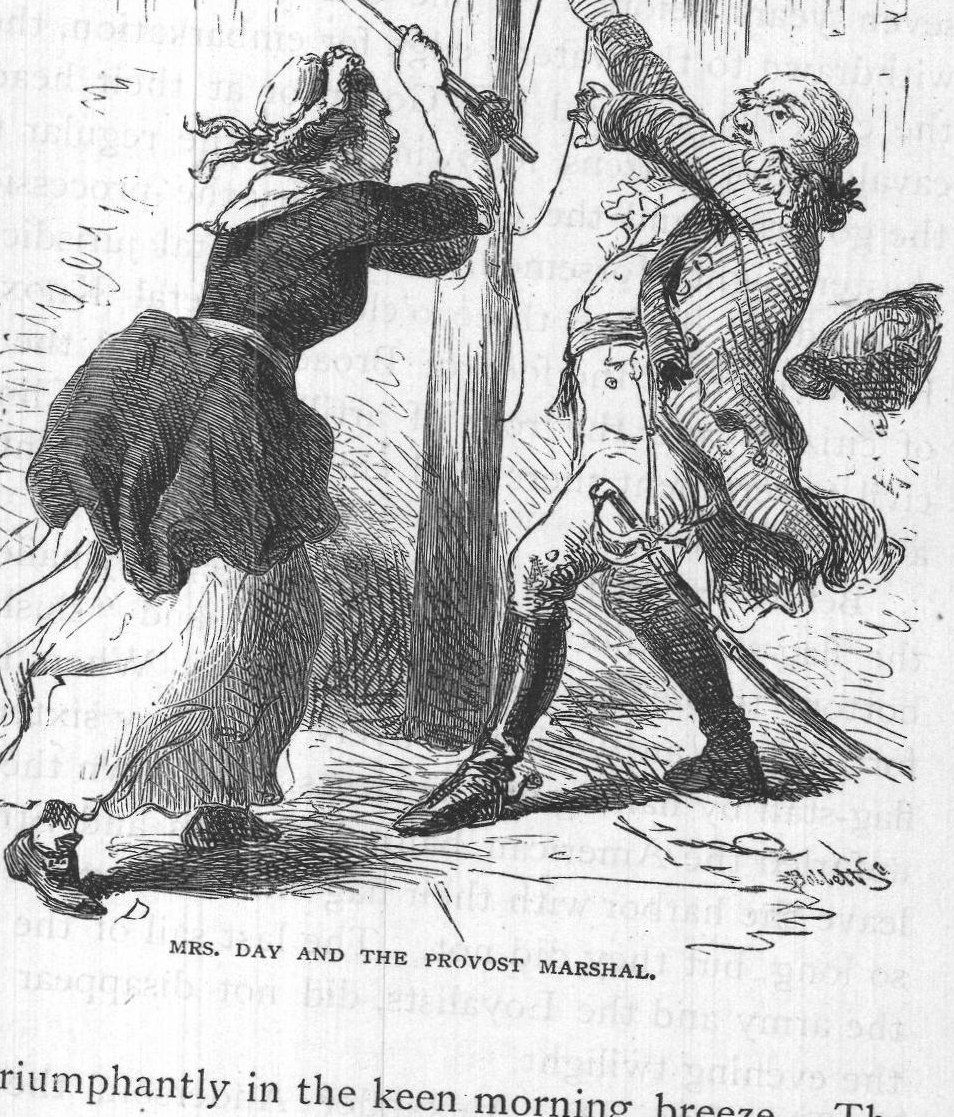
The late Dr. Alexander Anderson, the pioneer wood-engraver in America, related to me the following amusing incident of that evacuation-day. He was then a boy between eight and nine years of age, having been born three days after the skirmishes at Lexington and Concord. He was living with his parents in Murray street, near the Hudson River, then sparsely settled. Opposite his father's dwelling was a boarding-house kept by a man named Day, whose wife was a large, stout woman and zealous Whig. On the morning of evacuation-day, she ran up the American flag upon a pole in front of her house. The British claimed possession of the city until twelve o'clock at noon, and this act was offensive to them. Early in the forenoon, when young Anderson was on his father's stoop, he saw a burly red-faced British officer, in full uniform, coming down Murray street in great haste. Mrs. Day was sweeping in front of her door when the officer came up to her in a blustering manner, and in loud and angry tones ordered her to haul down the flag. She refused, when the officer seized the halyards to pull it down himself. Mrs. Day flew at him with her broomstick, and beat him so furiously over his head, that she made the powder fly from his wig. The officer stormed and swore, and tugged in vain at the halyards, which were entangled; and Mrs. Day applied her weapon so vigorously that he was soon compelled to retreat, and leave the flag of the valiant woman floating triumphantly in the keen morning breeze. The British officer was the infamous provost marshal of the army, William Cunningham, who, for seven years, had cruelly treated American prisoners under his charge in New York, and terribly oppressed some of the few Whig families who remained in that city. This inglorious attempt to capture the colors of Day Castle and the result, was the last fight between the British and Americans in the Old War for Independence.