The King and his Ministers the Real Revolutionists (Part 3)
The colonists now said: "We must fight." They repeated it from Maine to Georgia. They buckled on their armor and stood on the defensive determined not to give the first blow. We shall now see how their oppressors became the aggressors, and spilled the first blood that flowed in the war of that momentous revolution which King George the Third began. That revolution, as we have observed, was not the work of the people. They did not seek to overturn anything; they sought only to preserve the precious things that existed. They had never known hereditary titles, nor prerogatives, nor any of the forms of feudalism, in America, other than as temporary exotics. They had grown to greatness in plain, unostentatious ways, chiefly as tillers of the soil and moving on a social plane of almost absolute equality. They had all been born free. They were not called upon to fight for freedom, for they already possessed it; they were compelled to fight for its maintenance. Therefore, the American people in 1775 were not revolutionists. They, only, were revolutionists, who, by arbitrary methods, attempted to deprive the Americans of their rights. This aspect of the case I wish to impress upon the minds of my countrymen. I shall not dwell long upon the sanguinary features of that war. An eminent author, in a deprecatory spirit, wrote :-- "They Muse of History has been so much in love with Mars, that she has seldom conversed with Minerva." Acting upon that hint, I shall, in telling the story of that war, touch as lightly upon the terrible details of battles as faithfulness to the task before me will allow. With that governing thought, I have traced the course of the colonies through the several phases of their growth from feeble, scattered settlements to powerful commonwealths, endued with a pervading love of freedom, and possessing large liberties. I have endeavored to unfold the causes which gradually made them gravitate toward a common center of nationality, in the form of a colonial Union. We will now consider their tremendous struggle during seven years for the maintenance of their liberties, and the establishment of a new and independent nation on the earth.
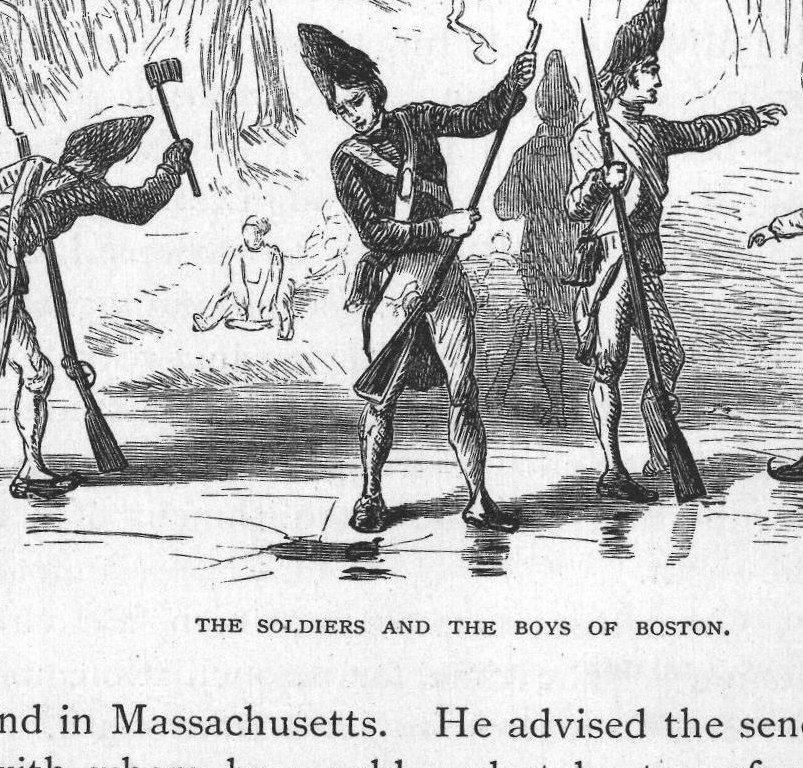
In February, 1775, Great Britain, as we have seen, had virtually declared war against the colonies. "The time for reconciliation, moderation, and reasoning is over," General Gage wrote to Lord Dartmouth. Even the boys of Boston asserted their rights in the presence of the military governor. They had built some snow-hills on the Common, down which they slid on to a pond. The soldiers, to annoy them, frequently demolished these hills. They complained to the captain, but could not obtain redress. At length a large deputation of older boys called upon General Gage. He received them courteously, and said: "Why have so many children waited upon me?" "We have come, sir," said the tallest boy, "to demand satisfaction." "What!" said the general with surprise, "have your fathers been teaching you rebellion, and sent you here to exhibit it?" "Nobody sent us here, sir," replied the boy, while his eyes flashed, and his cheeks reddened with indignation at the imputation of being a rebel. "We have never injured nor insulted your troops," he continued, "but they have trodden down our snow-hills, and have broken the ice on our skating-ground. We complained, and they called us young rebels, and told us to help ourselves if we could. We told the captain of this, and he laughed at us. Yesterday our works were destroyed for the third time, and we will bear it no longer." The good-natured general felt touched with admiration for the spirit of these boys, and turning to an officer near him, he said: "The very children here draw in a love of liberty with the air they breathe." To the boys he said: "Be assured that if my troops trouble you again, they shall be punished."