The First Work of Congress
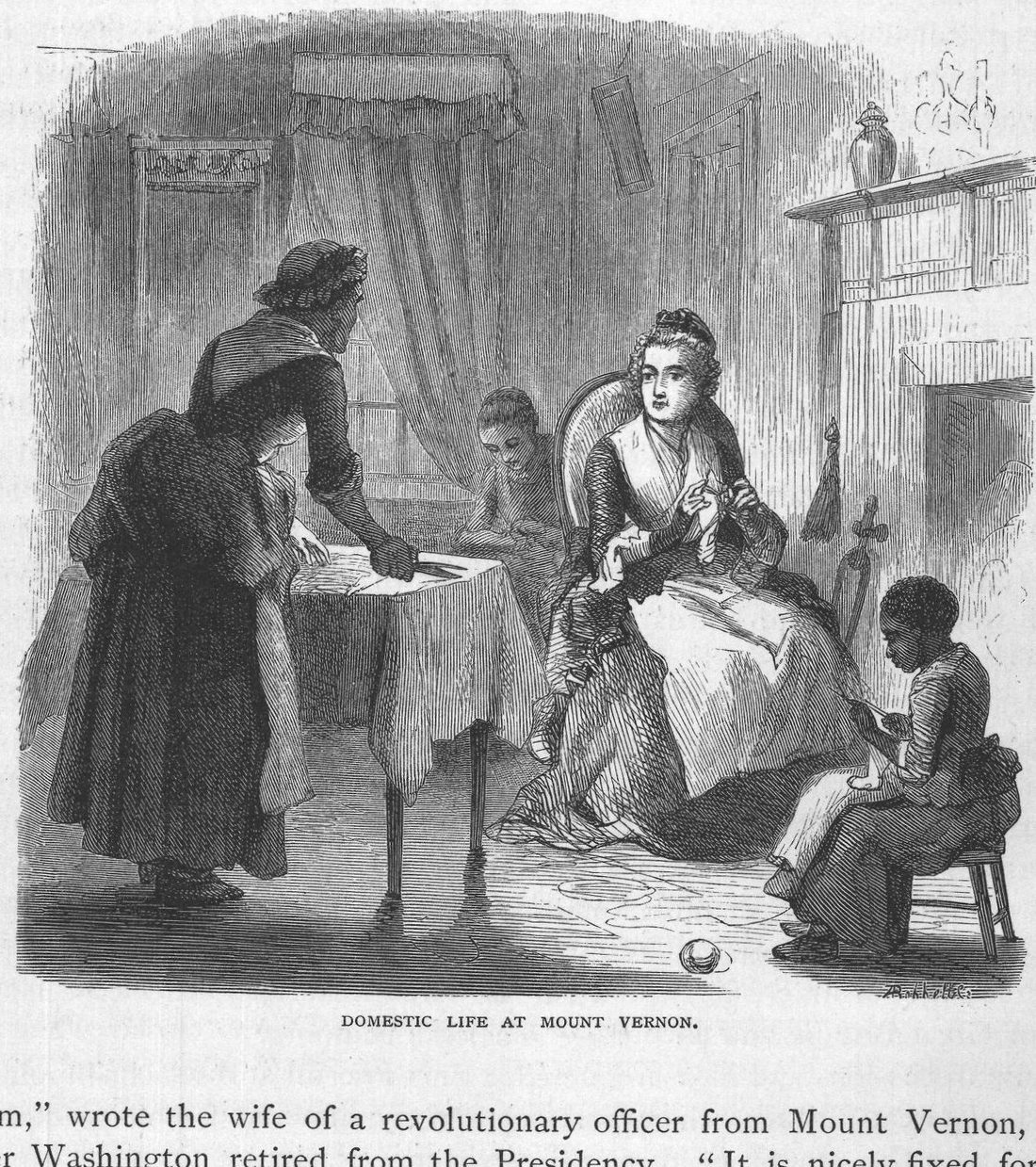
This "court-life" was very distasteful to Mrs. Washington. She wrote to a friend: "I live a very dull life here, and know nothing that passes in the town. I never go to any public place-indeed I think I am more like a state-prisoner than anything else. There are certain bounds set for me which I must not depart from; and as I cannot do as I like, I am obstinate and stay at home a great deal." She was a careful, bustling, industrious little housewife, more fond of her home than promiscuous society, and a noble exemplar for American women. "Let us repair to the old lady's room," wrote the wife of a revolutionary officer from Mount Vernon, just after Washington retired from the Presidency. "It is nicely fixed for all sorts of work. On one side sits the chambermaid, with her knitting; on the other, a little colored pet learning to sew. An old, decent woman is there, with her table and shears, cutting out the negroes' winter-clothing, while the good old lady directs them all, incessantly knitting herself. She points out to me several pair of nice colored stockings and gloves she had just finished, and presents me with a pair, half done, which she begs me to finish and wear for her sake. It is wonderful, after a life spent as these good people have necessarily spent theirs, to see them in retirement assume those domestic habits that prevail in our country."
Even before the inauguration of the President, Congress began in earnest the great work of putting the machinery of the new government into harmonious and vigorous action. The first and most important duties to which they were called were the devising of a revenue system--for the public treasury was empty--and establishing a national judiciary as a co-ordinate branch of the national government. Two days after the votes of the Presidential electors were counted, Mr. Madison, to whom the leadership in the House of Representatives was conceded, brought forward a plan for a temporary system of imports, to be based upon one proposed by the Continental Congress. He was decidedly favorable to free trade; but the wants of the public treasury and the impossibility to obtain reciprocal action on the part of other governments, made him consent to and propose a tariff upon spirituous liquors, wines, tea, coffee, sugar, molasses and pepper, as subjects for special duties; also an ad valorem duty upon all other articles imported, and a tonnage duty upon all vessels, with a discrimination in favor of vessels owned wholly in the United States, and an additional discrimination between foreign vessels, favorable to those belonging to countries having commercial treaties with the United States. The debates that arose on these propositions took a scope so wide and general that nearly every principle of tariff regulations, which have occupied the attention of our national legislature since, was fully discussed. It was finally agreed to lay duties upon certain specified articles that were imported into the United States until the the year 1796; also to impose higher duties on foreign than on American bottoms; and goods imported in vessels belonging to citizens of the United States were to pay ten per cent. less duty than the same goods brought in those owned by foreigners. These discriminating duties were intended to counteract the commercial regulations of foreign nations, and especially those of Great Britain, and encourage American shipping.
These discussions and measures startled the powerful and selfish shipping interest of Great Britain, which had persistently opposed fair commercial relations with the Americans during the existence of the old Confederation. British merchants and British statesmen now perceived that American commerce was no longer regulated by thirteen separate legislatures representing clashing interests, nor subject to the control of the king and council, but that its interests were guarded by a central power of great energy. The British government hastened to secure commercial advantages, and it became a supplicant instead of a haughty master. Soon after the passage of the revenue laws, a committee of Parliament proposed to ask the United States to consent to an arrangement precisely like the one proposed by Mr. Adams in 1785, but then rejected with scorn by the British ministry. The proposition was made to our government, and was met by generous courtesy on the part of the United States; but it was not until 1816, when the second war for independence--the war of 1812-'15--had been some time closed, that reciprocity treaties fairly regulated the commerce between the two countries.