The Creek Indians: Lord Gambier and Ghent
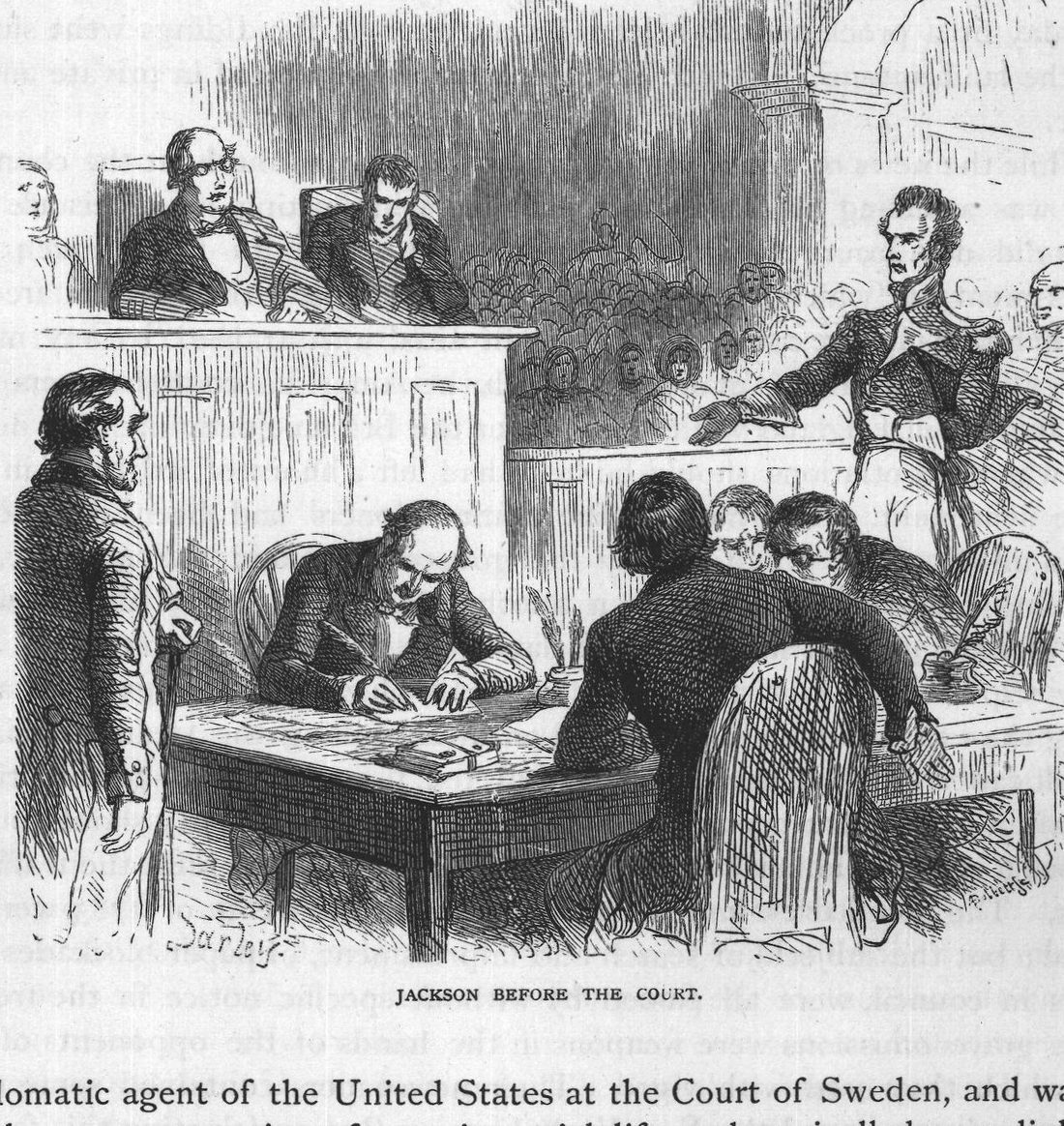
The general was vigilant as well as brave, and he exercised martial law until official tidings of peace reached him. Martial and civil law clashed. An irate judge, whom the general had caused to be arrested and banished beyond the military jurisdiction, summoned Jackson before him to show cause why the general should not be punished for contempt of court. The hero obeyed. The court-room was crowded with citizens indignant at such treatment of the man who had saved their State from invasion and their city from plunder. The judge was alarmed in the presence of the public wrath. "Go on; I will protect you in your duty," said the brave general to the trembling judge. The latter fined the hero a thousand dollars, for which amount the general drew a check before leaving the room. The populace bore him on their shoulders to a carriage in the street, and the citizens soon made up the amount of the fine and tendered it to Jackson. He ordered it to be distributed among the families of the soldiers who had fallen in the battle. Thirteen years afterward the people of the United States elected Andrew Jackson President of the Republic.
We have observed that Great Britain refused to treat for peace under Russian mediation, but the government offered to open negotiations in London or in Gottenburg, Sweden. President Madison, anxious for peace, accepted the proposition, and chose the last-named place for the meeting; but the ancient city of Ghent in the Netherlands (now Belgium) was afterward substituted. There commissioners appointed by the two governments met in August, 1814. The United States was represented by John Quincy Adams, James A. Bayard, Henry Clay, Jonathan Russell and Albert Gallatin. The British representatives in the commission were Lord Gambier, Henry Goulbourn and William Adams. Christopher Hughes, Jr., of Baltimore, was appointed secretary to the American commissioners. He was then the diplomatic agent of the United States at the Court of Sweden, and was one of the most attractive of men in social life, and unrivalled as a diplomat. When negotiations for peace were opened, a wide difference in the views of the commissioners of the respective nations appeared. Discussions continued several months. A result was not reached until the 24th of December, when a treaty was signed by the respective commissioners and was immediately sent to London, where it was ratified on the 28th by the Prince Regent. It had been borne there by Mr. Baker, secretary of Lord Gambier, and Mr. Carroll, one of the secretaries of the American commission. The same messengers took it to America in the sloop-of-war Favorite, which arrived at New York on the 11th of February. Mr. Hughes, who left Ghent with a copy of the treaty, and embarked for America from the Texel, arrived at Annapolis tow days after the Favorite reached New York, and he put a copy of the treaty into the hands of the President before the ratified copy arrived in Washington. The treaty was ratified by the Senate of the United States on the 17th of February, and it was promulgated the next day by a proclamation of the President. As the tidings went slowly over the land, intense joy and satisfaction were manifested in private and in public.
While the news of peace was spreading great joy throughout the country, there was a feeling of disappointment among reflecting men because the treaty did not secure to the Americans that immunity from search and impressment for which they had made war. It left Great Britain free to pursue her haughty course on the high seas, unrestrained by any moral force. The supercilious manner in which the American commissioners had been treated in England while waiting for the British government to determine where negotiations should be held, had left a thorn of irritation in the public sentiment. For months the commissioners had been suffered to remain in England unnoticed by the government; and the ministry, by proposing first one place and then another for the meeting, had shown a spirit of undignified trifling which delayed the result full six months. The treaty stipulated a mutual restoration of all places and possessions taken during the war, or which might be taken after signing the treaty; declared that all captures at sea should be relinquished, if made within specified times thereafter, in different parts of the world; and that each party should mutually put a stop to Indian hostilities, and endeavor to extinguish the traffic in slaves. The boundaries, imperfectly adjusted by the treaty of 1783, were all settled; but the subjects of search and impressment, of paper blockades and orders in council, were all passed by without specific notice in the treaty. These grave omissions were weapons in the hands of the opponents of the war, which they used with vigor. Their newspapers contained some well-pointed epigrams; and the New York Evening Post, anticipating this failure, had printed in its "New Year's Address," several weeks before the arrival of the treaty, the following stanza:
Your treasures are wasted and gone;
You've fought to no end, but with millions of cost
And for rivers of blood you've nothing to boast,
But credit and nation undone."