The Congress Returns to Philadelphia
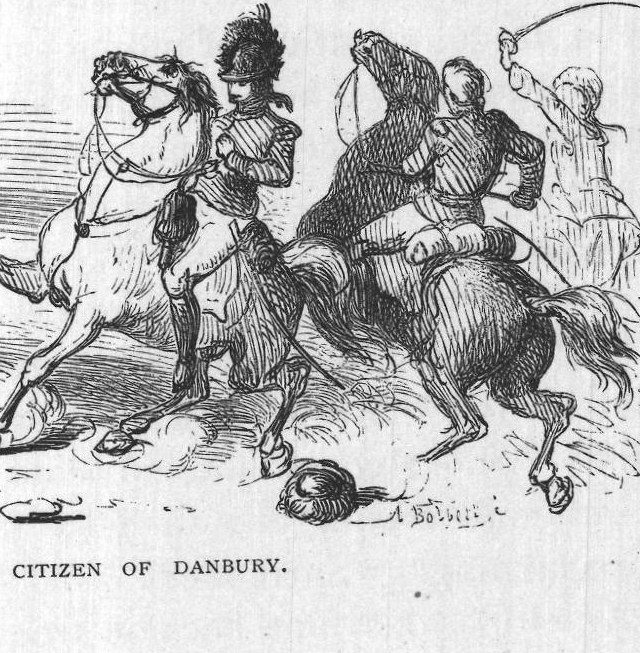
It is related that when the British approached Danbury, an old citizen resolved to save a piece of cloth which was at a clothier's at the south end of the village. He had just mounted his horse with it, when the British advanced-guard approached. Three light-horsemen started in pursuit. The old man's animal was not so fleet as theirs. Drawing near to him, one of the troopers cried out, "Stop, old Daddy, stop! We'll have you!" "Not yet!" cried the citizen. At that moment his roll of cloth unfolded, and fluttering like a streamer behind him, so frightened the pursuing horses that he got several rods ahead, and escaped.
The Americans, also, spurred by resentment, took similar aggressive action. Late in May, Colonel Meigs crossed Long Island Sound from Guilford, Connecticut, with one hundred and seventy men in whale-boats, and at two o'clock in the morning of the 23d, attacked a British provision-post at Sagg Harbor, at the eastern end of Long Island. They burned a dozen vessels; also stores and their contents; made ninety men prisoners, and with these reached Guilford the next day at a little past noon, without losing a man. For this exploit, the Congress voted thanks to Colonel Meigs and his men, and a sword to the commander.
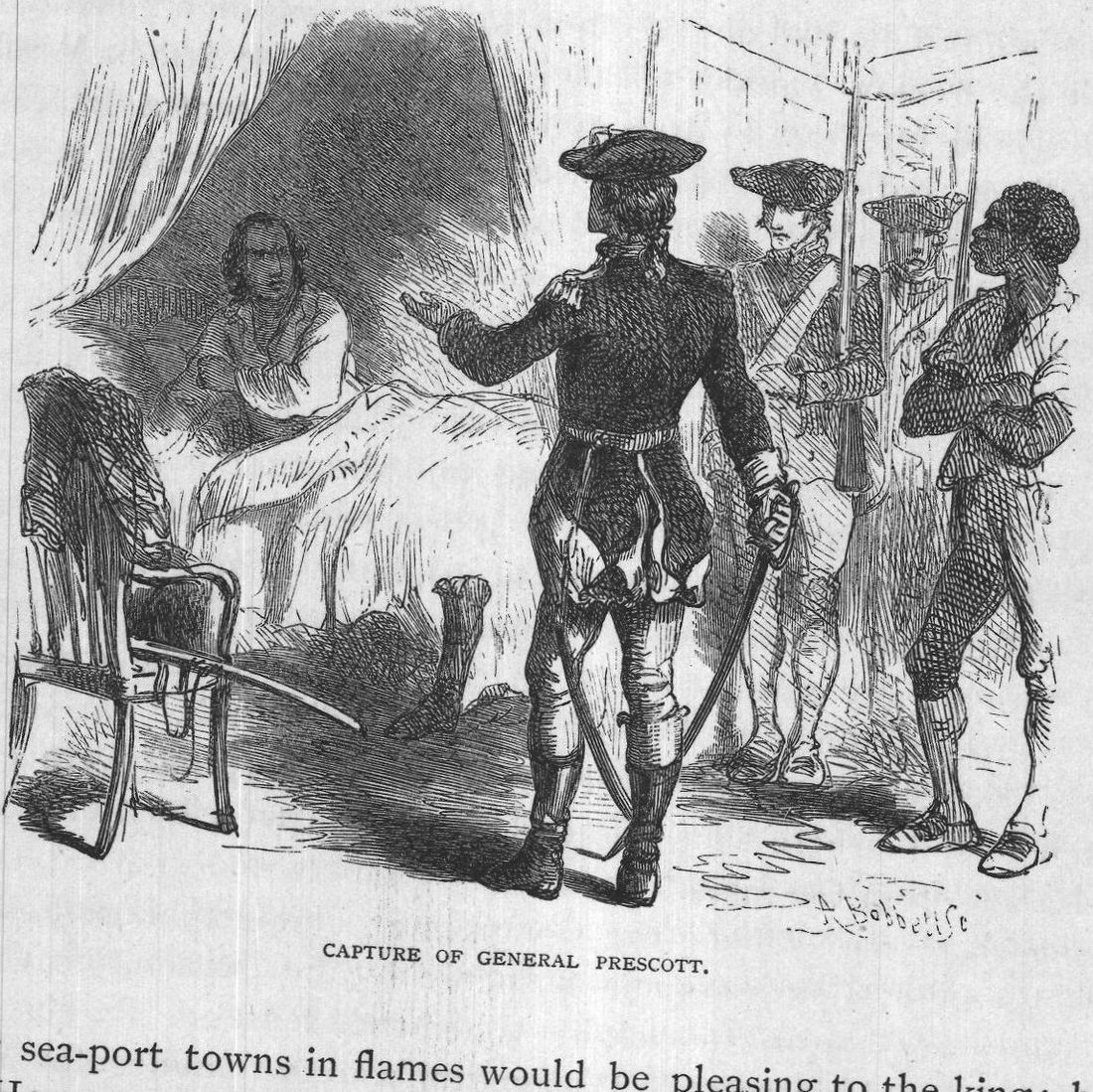
A little later a bolder exploit was performed in Rhode Island. General Prescott, the officer who so cruelly treated Ethan Allen at Montreal, was in command of the British troops there. He was a petty tyrant, and was detested by the people. His headquarters were at a farm-house a few miles from Newport, that belonged to a Friend. It was near the shore of Narraganset Bay. Many of the inhabitants had earnestly desired his removal, and Lieutenant-Colonel Barton of Providence resolved to attempt the perilous task of carrying him away. With a few picked men, he crossed the Bay from Warwick Point, in four whale-boats, passed unobserved through the British guard-boats with muffled oars on a warm night (the 10th of July), and landed near the general's quarters without discovery. The colonel and a part of his men walked silently up to the house, seized the musket of a sentinel at the gate and threatened him with death if he should make any noise, and entered the dwelling. The owner sat reading. It was late, and all others of the household had retired. To Barton's inquiry for Prescott's room, the Friend pointed upward. Barton went up the stairs silently, followed by a powerful negro. The general's bedroom door was locked. The negro, making a battering-ram of his head, burst it open at the first effort. Prescott sprang from his bed to find himself a prisoner. Without allowing him to dress, his captors took him to a boat, his perfect silence being his guarantee of personal safety. At midnight they landed on the Warwick shore. The general was taken in a close carriage to Providence, and was sent to the headquarters of Washington, in New Jersey, where he was afterward exchanged for General Charles Lee. For this exploit, Congress voted an elegant sword for Barton, and commissioned him a colonel in the Continental Army.
During the winter and spring of 1777, Washington's mind was filled with anxiety concerning the future. The Congress was weak, for the jealousy of the States paralyzed their executive power. Faction was disturbing their councils. There was discontent in the army because inefficient foreign officers were, it was supposed, about to be put in high military positions; also because few a like Gates could not bear to serve in subordinate stations. That intriguing officer, like Lee, exerted a baneful influence continually. Aided by the New England delegation, with Samuel Adams at the head of the faction, he had supplanted General Schuyler, the most trusted and best beloved by Washington of all his generals. But his triumph was short. The baseness of his insinuations against the character of Schuyler were exposed by a committee of the Congress and, superseded in April, the latter was reinstated in May with larger discretionary powers. Gates, angry and insubordinate, refused to serve under Schuyler; and, without leave, he left the army and hastened to Philadelphia to demand redress. By falsehood he obtained admission to the floor of Congress, and the privilege of making a verbal communication. There he made an exhibition of impertinence, malice, folly and unmanliness, that disgusted all but his New England friends, who supported him in further intrigues, as we shall observe presently. Samuel Adams and some others had resolved to make Gates the commander-in-chief of the Northern Department, and worked assiduously for that purpose; and while they were swaying Congress in favor of this weak man, who was doing nothing but boasting, they were unjustly demanding of Washington vigorous aggressive movements against the enemy, with so few troops that failure would have been a certain result. They reproached him with slowness; and intimations were thrown out that Gates was "the life and soul of the army." Washington bore this injustice with patience and obedience, for he was an unselfish patriot.