The Brave Express Geiger
Marion now hastened to attack a British post at Georgetown; and Lee pushed forward toward the Savannah to aid Pickens and Clarke in holding the country between Ninety-Six and Augusta, to prevent the garrison at either place joining the other. In this they were successful. Rawdon's order to Cruger to evacuate Ninety-Six reached him when the pathway between that post and Augusta was closed by the partisan rangers; and Rawdon, alarmed by the rapid and successful movements of these partisans, fled toward the sea-coast, and did not halt until he reached Monks' Corners, well down toward Charleston. Pickens and Clarke had kept watch over the British at Augusta, and when, on the 20th of May, they were joined by Lee, they proceeded to invest the fort there. Fort Galphin, twelve miles below Augusta, was taken on the 21st of May, and then an officer was sent to demand the surrender of the main fort. Lieutenant-Colonel Brown, one of the most cruel of the Tories of that region, who was in command, refused to surrender, when a regular siege began. A general assault was about to be made on the 4th of June, when Brown proposed to surrender, and on the following day this important post passed into the hands of the Americans. In that siege the Americans lost fifty-one killed and wounded, and the British parted with fifty-two in the same way, and over three hundred made prisoners. At the close of the siege, Lee and Pickens hastened to Ninety-Six, then beleagured by the forces of Greene.
Kosciuszko was Greene's chief engineer, and with that skillful officer he began the siege of Ninety-Six on the 22d of May, with about a thousand men. The garrison numbered five hundred and fifty. The post was well fortified, and Cruger was a brave soldier. Some troops having arrived from Ireland early in June, Lord Rawdon, thus reinforced, hastened to the relief of the beleaguered fort, with about two thousand men. His approach was heralded by a horseman in the garb of a planter, who rode along the American lines at twilight one evening, and talked freely with the officers. It was a common occurrence, and attracted no special attention. When he reached the road leading directly to the fort, he put spurs to his horse and dashed toward the gate of the fortress followed by a score of bullets. He reached the portal unharmed, bearing in his upraised hand a large letter. It was a despatch to Cruger from Rawdon, announcing his approach. The former had not heard from the writer since he fled from Camden; and he was so hard pressed by the besiegers, who had cut off his water supply, that he was contemplating a surrender. The news encouraged the garrison to endure a little longer. When, on the 18th of June, Rawdon was drawing nigh, Greene attempted to take the fort by storm. It was a disastrous failure. Only one of every six of the assailants escaped unhurt; one-third of them were killed. On the following day Greene raised the siege and fled beyond the Saluda, pursued some distance by the garrison.
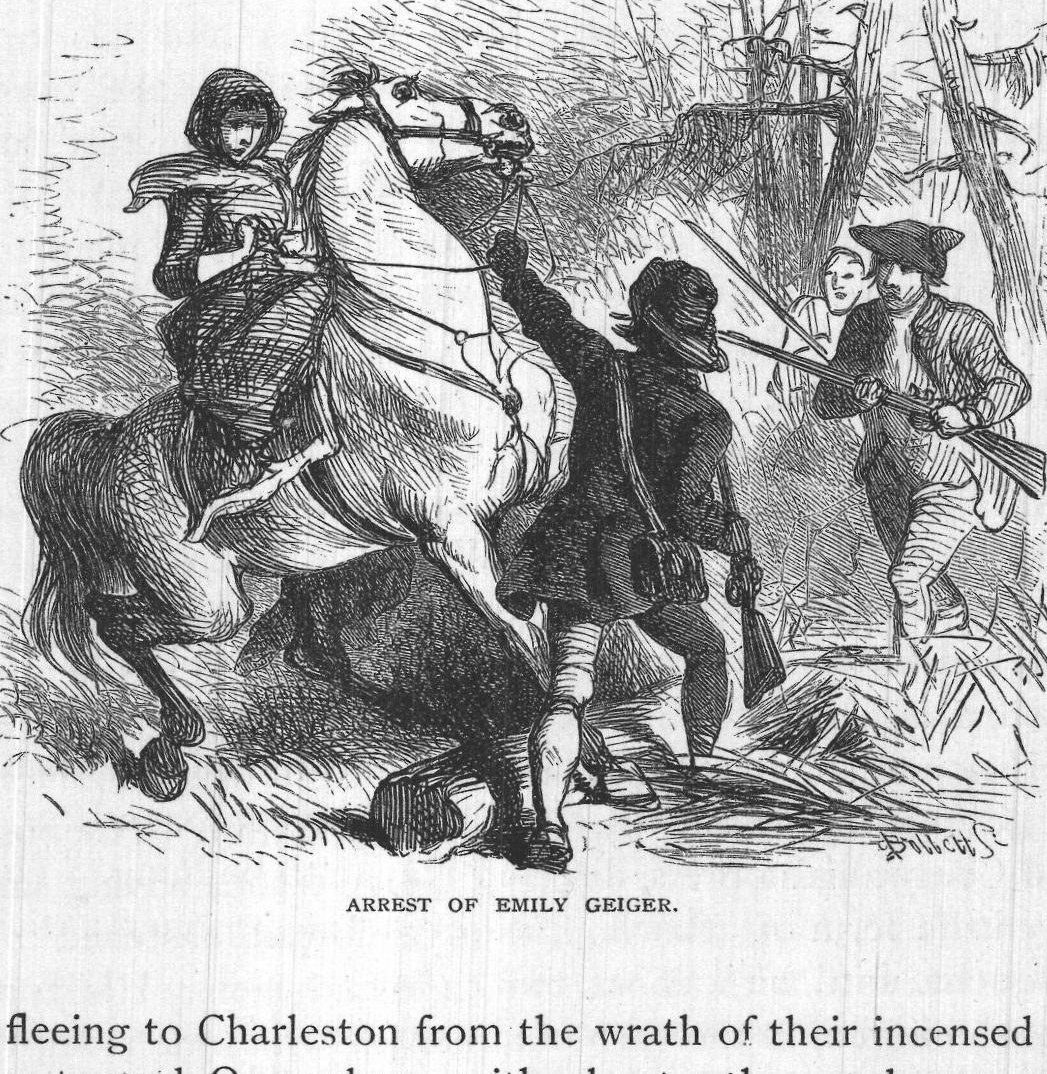
The chief commanders of the contending armies now changed their relative positions. As the post of Ninety-Six could not be held, Rawdon ordered its abandonment. Leaving Cruger and the garrison to assist the loyalists in fleeing to Charleston from the wrath of their incensed neighbors, he pushed on toward Orangeburg, with about a thousand men, pursued by Greene, but avoiding a contest with him. Greene sent a message to Marion and Sumter, then on the Santee, to take a position in front of the enemy and impede his progress. His messenger was Emily Geiger, daughter of a German planter. No man in the army was willing to attempt the hazardous service, for the Tories were on the alert. The brave young girl was not more than eighteen years of age. She volunteered to carry a letter to Sumter. With his usual caution Greene told her its contents, so that, in case she might find occasion to destroy it, she could still bear the message to the partisan. The brave maiden mounted a fleet horse, crossed the Wateree at the Camden Ferry, and while passing through a dry swamp on the second day of her journey, she was arrested by some Tory scouts. As she came from the direction of Greene's army, she was suspected of being a messenger. They took her to a house on the edge of the swamp, and with proper delicacy employed a woman to search her person. No sooner was she left alone than she ate up Greene's letter, piece by piece. The matron who was sent for searched in vain for any scrap of paper. Her captors made many apologies for detaining her, and Emily passed on to Sumter's camp. Very soon he and Marion were co-operating with Greene in sorely pressing the troops of Rawdon. Emily Geiger afterward married a rich planter on the Congaree.