The American and British Squadrons
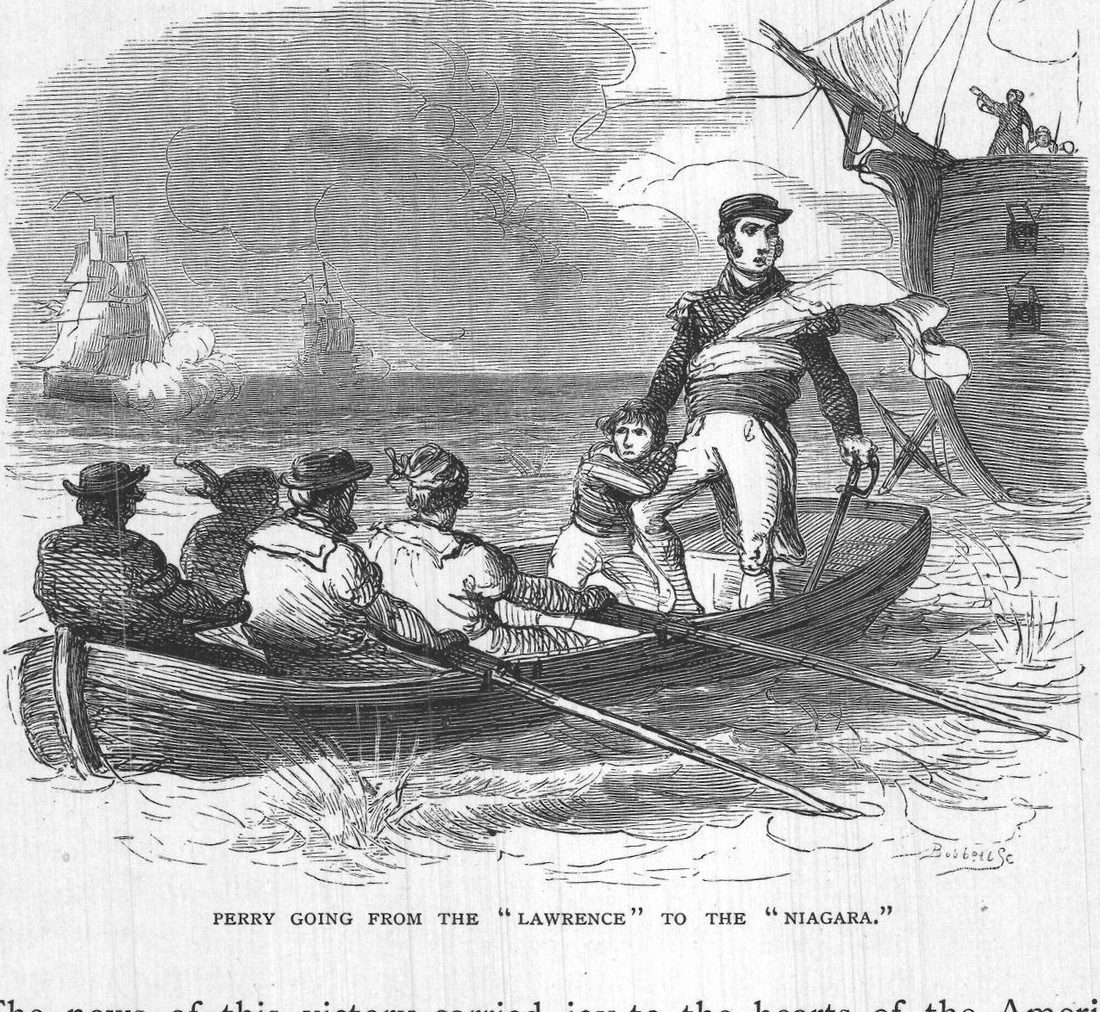
The two squadrons slowly approached each other, and at noon the battle began at long range-the Scorpion, commanded by young Champlin, then less than twenty-four years of age, firing the first shot on the American side. Nearer and nearer the vessels approached each other; hotter and hotter waxed the fight. For two hours the Lawrence bore the brunt of battle, with twice her force, until, like the Guerriere, she lay upon the waters an almost total wreck. Her rigging was all shot away; her sails were cut into shreds, her spars were battered into splinters, and her guns were dismounted. One mast remained, and from it the Stars and Stripes were streaming. A less hopeful man than Perry would have pulled them down and surrendered, for his deck was a scene of dreadful carnage. Meanwhile most of the other vessels had been fighting gallantly, excepting the stanch Niagara, Captain Elliot, which kept outside and was unhurt. As this lagging brig drew near, Perry determined to fly to her, and renewing the fight, gain a victory. In token of his faith he put on the uniform of his rank, as if conscious he should receive Barclay as a prisoner. Then taking down his broad pennant and the banner with the stirring words, he entered his boat with his little brother, fourteen years of age, and four stout seamen for the oars, and started on his perilous voyage, anxiously watched by Lieutenant Yarnell and a few others, who had been left in charge of the battered Lawrence. Perry stood upright in his boat with the pennant and banner partly wrapped around him, a conspicuous mark for the guns of the enemy. Barclay, who was badly wounded, knew that if Perry, who had fought the Lawrence so gallantly, should tread the decks of the stanch Niagara as commander, the British would be in danger of defeat; so he ordered big and little guns to be brought to bear upon the boat that bore the young hero. The voyage lasted fifteen minutes. The oars were splintered, bullets traversed the little vessel, and round and grape-shot falling in the water near, covered his oarsmen with spray. But he reached the Niagara in safety. Hoisting his pennant over that vessel, he dashed through the British line, and eight minutes afterward the colors of the enemy's flag-ship were struck, and all but two of the fleet surrendered. These attempted to escape. They were pursued and brought back by the brave young Champlin in the Scorpion late in the evening. He had fired the first gun at the opening of the battle, and now he had fired the last one in securing the conquered vessels. The victory was complete. Assured of triumph, Perry sat down, and resting his naval cap on his knee, wrote with a lead-pencil, on the back of a letter, this famous despatch to General Harrison: "We have met the enemy, and they are ours; two ships, two brigs, one schooner, and one sloop.
"O. H. PERRY."
The news of this victory carried joy to the hearts of the Americans. The lakes had echoed the triumphs of the ocean. The name of Perry was made immortal. His government, in the name of the people, thanked him, and gave him and Elliott each a gold medal. States and cities honored him. The legislature of Pennsylvania voted him thanks and a gold medal; and they gave the thanks of the Commonwealth and a silver medal to each man who was engaged in the battle. The loss of the Americans in the conflict on Lake Erie, considering the small number engaged, was very severe-twenty-seven killed and ninety-six wounded. The British lost about two hundred in killed and wounded, and six hundred made prisoners. Perry's humane conduct toward the captives was such that Barclay declared it was sufficient to immortalize him.
This victory was followed by energetic action on the part of Harrison. The veteran Governor Shelby, the hero of King's Mountain, had joined him with four thousand Kentucky volunteers. The command of Lake Erie was secured, and he proceeded to attack Fort Malden and attempt the recovery of Detroit. The fleet took a part of his troops across the lake and landed them below Fort Malden, but no enemy was there. The cowardly Proctor, taking counsel of his fears, and in spite of the indignant remonstrances of Tecumtha, had fled with his motley host into the interior of Canada, setting fire to Fort Malden and the many buildings and store-houses at Amherstberg when he left. As the Americans approached the smoking ruins, they were met by a troop of modest, well-dressed women, who came to implore mercy and protection. Harrison calmed their fears and took possession of the fort while the bands played Yankee Doodle. Proctor's rear-guard had been gone only about an hour when the Americans arrived.