Society of the Cincinnati
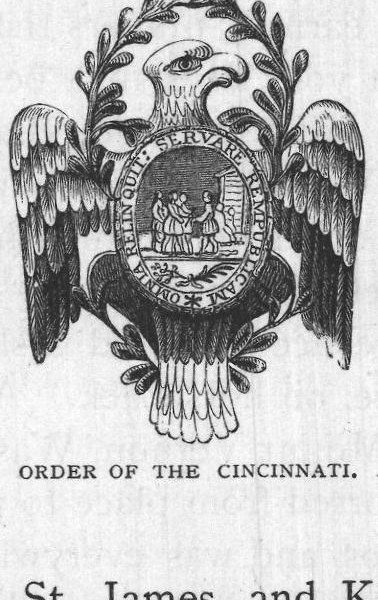
A few months before the disbanding of the army a tie of friendship had been formed among the officers, at the suggestion of General Knox, by the organization at the cantonment of the troops, near Newburgh, New York, of an association known as The Society of the Cincinnati. Its chief objects were to promote a cordial friendship and indissoluble union among themselves, and to extend benevolent aid to such of its members as might need assistance. Washington was made its President-General, and remained so until his death. General Knox was its Secretary-General. To perpetuate the association, it was provided in the constitution of the society, that the eldest masculine descendant of an original member should be entitled to wear the Order and enjoy the privileges of the society. That society is yet in existence. The Order or badge consists of a gold eagle, suspended upon a ribbon, on the breast of which is a medallion with a device, representing Cincinnatus receiving the Roman Senator.
The Americans were now free but not independent. Why not? Because they had not established a nation endowed with the functions of absolute sovereignty. The British statesmen were wise enough to see this, and sagacious enough to take advantage of the situation. They saw that the Americans were without a government sufficiently powerful to command the fulfillment of treaty stipulations, or an untrammeled commerce sufficiently important to attract the cupidity or interested sympathies of other nations. John Adams was received with courtesy as the ambassador of an independent nation at the court of St. James, and King George had said to him: "I was the last man in the kingdom, Sir, to consent to the independence of America; but now it is granted, I will be the last man in the world to sanction a violation of it."
These courtesies and fair words were only the velvet that covered the mailed hand of power. The British ministry, misled by the Loyalists that swarmed in the metropolis, believed that the weak confederacy would soon crumble, and that each part would be suing for restoration to the privileges of subjects to the crown. It was prepared to seize with merciless grasp the inchoate nation and destroy its sovereignty. The trade, commerce, manufactures, arts, literature, science, religion and laws were yet largely subservient to the parent country, without a well-grounded hope for speedy deliverance from the thrall. These facts gave Dr. Franklin good reason for saying to a compatriot who remarked that the war for independence was successfully closed: "Say, rather, the war of the Revolution. The war for Independence is yet to be fought." That struggle occurred, and that independence was won by the Americans in the war of 1812.
We have already observed that wise men deplored the weakness of the government under the Articles of Confederation ratified in 1781. The powers of that government were soon tested by its efforts to employ the functions of sovereignty. A debt of $70,000,000 lay upon the shoulders of a wasted people, besides the promises of the dead "Continental money" to pay more than $200,000,000 more. About $44,000,000 of this live debt was owing by the general government, $10,000,000 in Europe, and the remainder by the individual States. The debt had been contracted in carrying on the war, which, for a long time, was sustained only by money borrowed for the purpose. By this means the public credit had sunk very low. The restoration of that credit or the downfall of the infant republic was the alternative presented to the Americans at the close of the war.
With a determination to restore the public credit, the General Congress put forth all their strength, which was only absolute weakness. They asked the several States to vest that body with power to levy, for the term of twenty-five years, duties on certain imported articles, the revenue therefrom to be appropriated to the sole purpose of paying the interest and principal of the public debt. It was also proposed that the States should establish, for the same time and for the same object, substantial revenues for supplying each its proportion of $1,500,000 annually, exclusive of duties on imports. This financial system, which was approved by the leading men of the country, was not to go into effect without the consent of every State in the league. For three years the proposition was before the people. All the States but two were willing to raise the required amount; but they would not consent to vest the Congress with the asked-for power. "It is money, not power," they said, "that ought to be the object. The former will pay our debts, the latter may destroy our liberties." So ended in failure the first important effort of the general government to assume the functions of sovereignty. It was the beginning of a series of failures, and was mischievous because it excited the jealousy of the respective States. It also exposed the impotency of a so-called national government, whose very vitality, as well as the right to exercise governing functions, depended upon the will of thirteen distinct legislative bodies, each tenacious of its own peculiar rights and interests, and miserly in its delegation of power. It was perceived that the public credit must inevitably be destroyed by a repudiation of the public debt.