Signing the Ordinance
Charleston harbor now became the theatre of stirring events. John B. Floyd of Virginia, one of the leading conspirators, was then Secretary of War, and was secretly weakening the physical power of the Government by stripping the arsenals of the North of their arms and ammunition, and strengthening the Secessionists by filling the arsenals of the South with an abundance of weapons. Of course he paid no attention to the words of General Winfield Scott, the chief of the army, when, so early as the close of October, he observed signs of incipient insurrection in South Carolina, and recommended the strengthening of the forts near Charleston. And when, at the close of the same month, Colonel Gardiner, in command of the fortifications near that city, attempted to increase his supply of ammunition, Floyd removed him, and in November placed Major Robert Anderson, a meritorious officer in the war with Mexico, in his place. That loyal Kentuckian at once perceived, by various acts, the designs of the Secessionists to seize the fortifications in the harbor, and he urged his Government to strengthen them with men and munitions of war, especially Fort Moultrie, in which he was placed with a feeble garrison. But his constant warnings were unheeded, even when he wrote: "The clouds are threatening, and the storm may burst at any moment. I need not say to you how anxious I am, indeed determined, as far as honor will permit, to avoid collision with the people of South Carolina. Nothing will, however, be better calculated to prevent bloodshed, than our being found in such an attitude that it would be madness and folly to attack us." He continually begged the War Department to give him more strength, and send him explicit instructions; and when he found his warnings treated with contemptuous silence, he wrote: "Unless otherwise directed, I shall make future communications through the regular channel-the General-in-Chief."
Anderson did not know that he was addressing an enemy and not a protector of his Government, who was working with all his might to destroy the Republic. On the very day when the patriotic Major wrote to Floyd, the treacherous Secretary sold ten thousand Government muskets to an agent of the Secessionists of Georgia. Eight days before he had sold five thousand to the State of Virginia; and vast numbers were sent to other slave-labor States. The Mobile Advertiser, the organ of the Secessionists in Alabama, exultingly declared that within twelve months one hundred and thirty-five thousand muskets had been quietly transferred from the Northern Arsenal at Springfield (Mass.) alone, to those in the Southern States. "We are much obliged to Mr. Floyd," said the Advertiser, "for the foresight he has thus displayed in disarming the North and equipping the South for this emergency. There is no telling the quantity of arms and munitions which were sent South from other arsenals. There is no doubt but that every man in the South who can carry a gun can now be supplied from private or public sources." Floyd also attempted to supply the Secessionists with heavy guns, but loyal men prevented the outrage.
Secretary Floyd found Anderson too loyal for his purpose, but it was too late to displace him, so he left him to his own feeble resources, satisfied that the military companies then in process of organization in South Carolina, would be able to seize the forts in Charleston harbor in good time. Moultrie was weak, and many of the little garrison in Sumter were known to be disloyal. The latter fort was by far the stronger and more important work; and as evidence hourly increased, especially after the passage of the Ordinance of Secession, that the South Carolinians intended to seize Fort Sumter, Anderson, being commander of all the forts in the harbor, resolved to transfer the garrison in Fort Moultrie into that of Sumter, and abandon the former. It was a delicate undertaking, for the Secessionists had watchboats out upon the waters.
Anderson revealed his secret to only three or four of his most trusted officers. Then he resorted to stratagem to get the women and children first into Fort Sumter. They were taken in a vessel, with ample provisions, to Fort Johnson on James Island, where, under pretext of difficulty in finding quarters for them, they were detained on board until evening. Three guns fired at Fort Moultire was to be the signal for consigning them immediately to Fort Sumter. The movement was regarded by the people of Charleston as a natural and prudent measure of Anderson, who, they knew, believed they were about to attack Fort Moultrie, and so all suspicion was allayed.
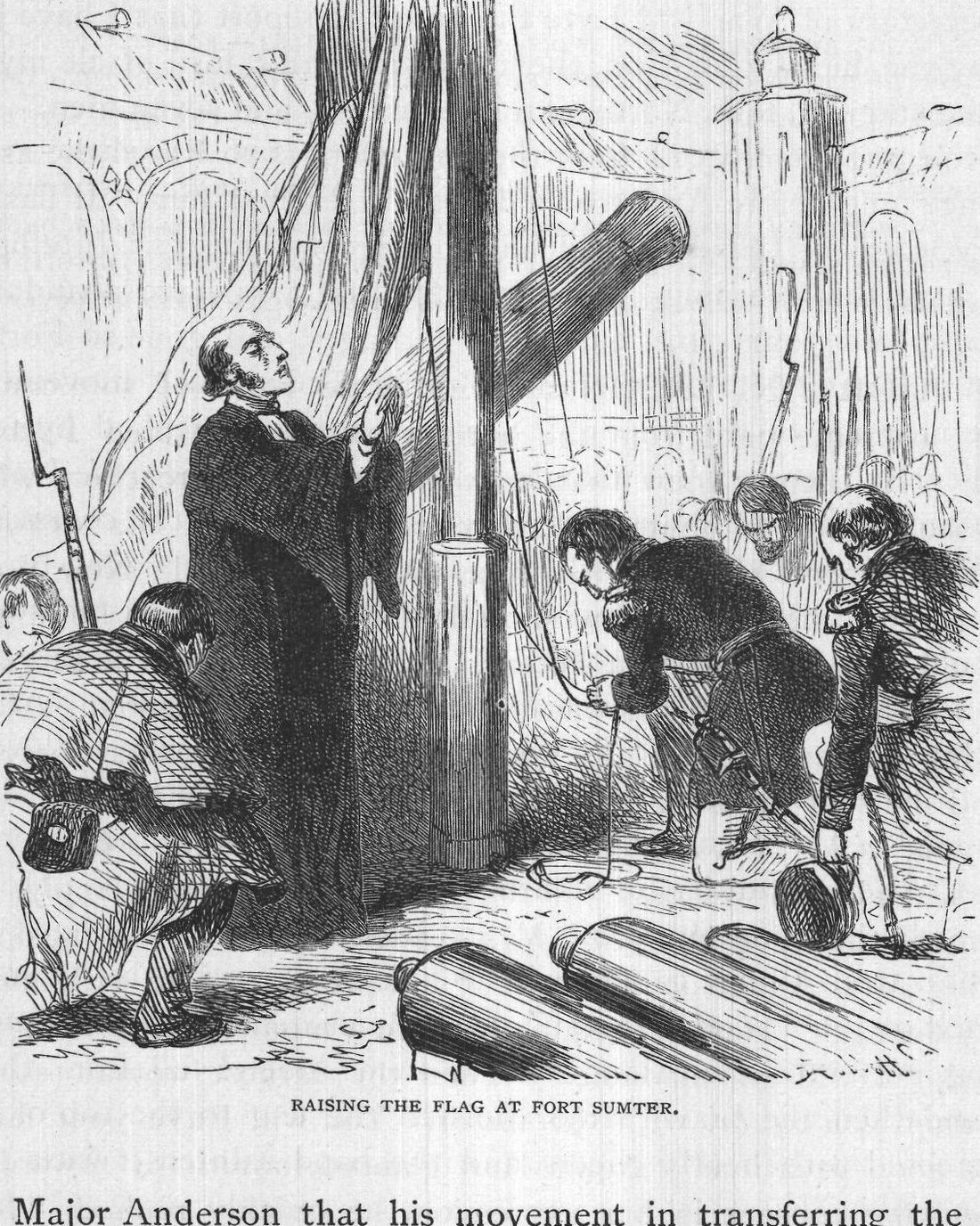
At the close of that evening, while the almost full-orbed moon was shining brightly, the greater portion of the little garrison at Moultrie embarked for Sumter. The three guns were fired; the women and children were quickly taken from before Fort Johnson to Sumter, and the movement was successful. Two or three officers remained at Fort Moultrie to spike the cannon, to destroy the gun-carriages, and to cut down the flag-staff, that no secession banner might float from the peak from which the National flag had so long fluttered. When the soldiers and their families and many weeks' provision were safely within the granite walls of Fort Sumter, Major Anderson wrote to the Secretary of War-"I have the honor to report that I have just completed, by the blessing of God, the removal to this fort, of all my garrison except the surgeon, four North Carolina officers, and seven men."