Rupture Between France and England
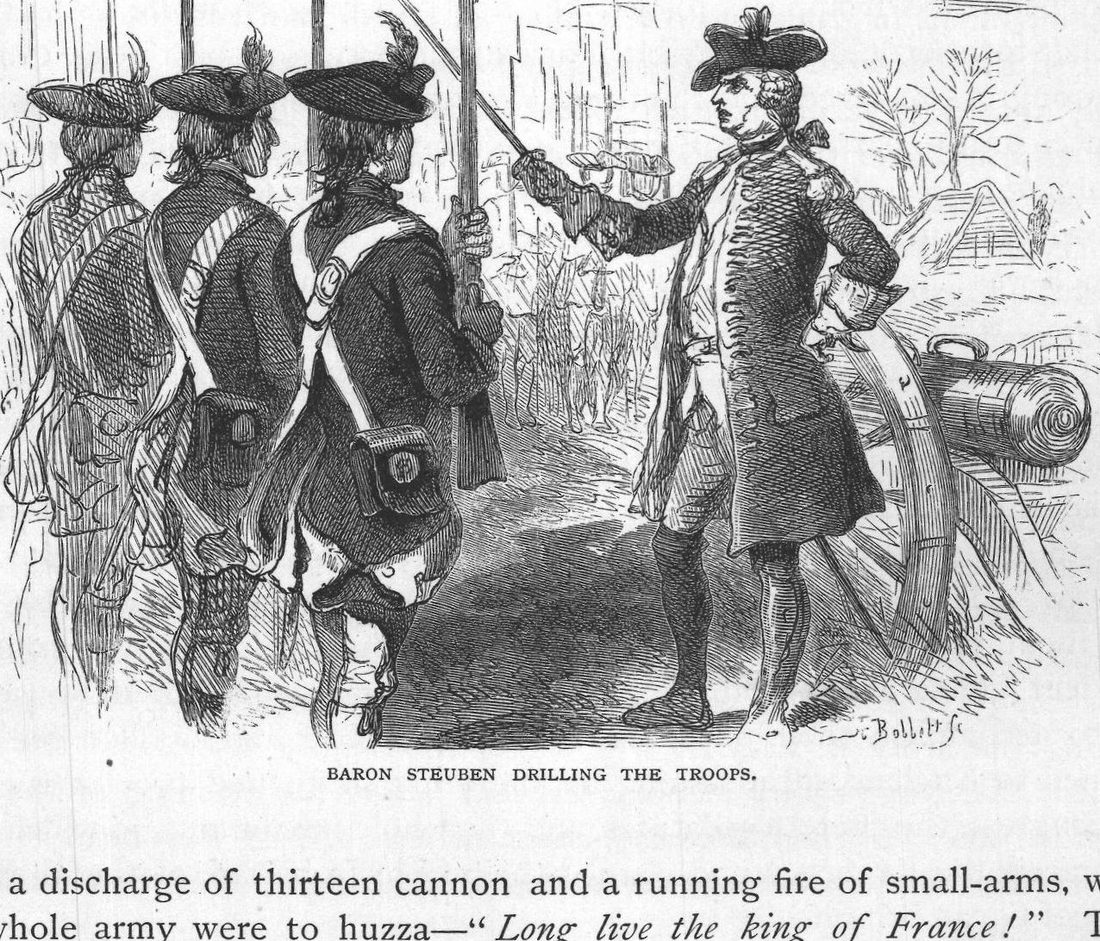
Meanwhile the service had been strengthened by the appointment of General Greene quartermaster-general, in place of General Mifflin, and the Baron de Steuben as inspector-general of the Continental Army, in place of General Conway. Steuben was a skillful Prussian officer, who had served on the staff of Frederick the Great. He arrived in America at the beginning of December, 1777, and presenting himself to the Congress at York, offered his services. His certificates of character were so ample, that they were accepted; and at the urgent solicitation of Washington he was appointed inspector-general of the armies, with the rank and pay of major-general. Joining the army at Valley Forge, he so thoroughly disciplined the crude soldiery there, in military manaeuvres, that before the opening of the campaign in June, they had acquired much of the skill of European veterans. Our regular soldiers were never beaten in a fair fight, after their drilling at Valley Forge.
As the spring advanced and warm weather prevailed, the comforts of the soldiers were increased and their daily wants were more bountifully supplied. Their shattered regiments were filled, and a more hopeful feeling prevailed throughout the country, when, on the night of the 3d of May, a despatch reached Washington, from the President of Congress, announcing the alliance between France and the United States. Washington communicated the important news in general orders on the 6th, and great joy was thereby produced. He set apart the following day to be devoted to a grateful acknowledgement of the Divine goodness in raising up a powerful friend in "one of the princes of the earth, to establish liberty and independence upon a solid foundation," and to celebrate the great event by tokens of delight. He directed the several brigades of the army to be assembled at nine o'clock in the morning to hear prayers and appropriate discourses from their respective chaplains. At a given signal the men were to be under arms for inspection and parade, when they were to be led to a specified position to fire a feu de joie with cannon and small guns. At a given signal, there was to be a discharge of thirteen cannon and a running fire of small-arms, when the whole army were to huzza--"Long live the king of France!" Then another discharge of thirteen cannon and all the muskets was to be given, followed by a shout of the army--"Long live the friendly European powers!" Then a third discharge of cannon and musketry in like manner, and a shout--"The American States."
These orders were faithfully obeyed. Washington, with his wife and suite and other general officers with their wives, attended the religious services of the New Jersey brigade. The army made a brilliant appearance in their new suits of clothing and polished arms. After the soldiers had retired, the commander-in-chief dined in public with all his officers, attended by a band of music; and the entertainment ended with a number of patriotic toasts, and loud huzzas for Washington, when he left the table.
The "Conciliatory Bills" had arrived in America a fortnight before the news of the treaty was received by the Congress, and attracted much attention in and out of that body. Governor Tryon, at New York, caused them to be printed and widely circulated, to produce disaffection among the Americans. As they did not propose independence as a basis for negotiations, they were regarded by the patriots with suspicion, and were denominated "deceptionary bills." Washington and the Congress rejected them as inadequate, in scope, to form a foundation for discussion. "Nothing short of independence, it appears to me, will do," Washington wrote. "A peace on other terms would, if I may be allowed the expression, be a peace of war." The Congress resolved that the terms were totally inadequate, and that no advances on the part of the British government would be met, unless, as a preliminary step, they should either withdraw their fleets and armies, or acknowledge, unequivocally, the independence of the United States.
Such was the temper of the Americans, when, on the 4th of June, three commissioners--the Earl of Carlisle, George Johnstone, and William Eden--sent to negotiate for peace, arrived at Philadelphia. They were accompanied by Adam Ferguson, the eminent professor in the University of Edinburgh. Directions were sent for General Howe to join them, but as he had left the country, and the army was commanded by Sir Henry Clinton, the latter took his place. The commissioners sent their credentials to the Congress by a flat. For reasons above given, the Congress refused to treat with them, and the papers were returned to them, with a letter from the President giving reasons for the act. The commissioners tried by various arts to accomplish their purposes, but were foiled; and in October they returned to England, after issuing an angry manifesto and proclamation to the Congress, the State legislatures, and the whole inhabitants, in which they denounced the "rebels" and warned the people to beware of the righteous wrath of Great Britain.