Reorganization of the Union: Confederates and Republic
When Andrew Johnson was inaugurated President, there were painful apprehensions among men who knew him most intimately, that he would not be faithful to the trust reposed in him by the loyal people of the land. Notwithstanding the strength of our government had been made manifest by the shock of Civil War which it had survived, it was equally manifest that it was surrounded with great perils. A pilot was needed at the helm of the ship of state possessed of a combination of moral and intellectual forces of a rare order--sound morality, strong and unwavering convictions, firmness of will, sobriety of conduct, calmness of temper, a thorough knowledge of men, an accurate and impartial judgment, a willingness to take counsel, a clear perception of righteousness, and the acuteness of a true statesman. Circumstances had occurred which justly created a doubt in the public mind whether the new President possessed all these qualities, so requisite at that critical time, and these doubts soon became settled convictions. His total disregard of the highest interests of the freedmen, and the fact that the President was making haste to pardon a large number of those who had been active in the service of the Confederates and would exercise a controlling influence in the States which he was equally in haste to reorganize on his own plan, startled the loyal men of the country, and made them doubt the sincerity of his vehement declaration of intentions to punish the leading enemies of our Government. To a delegation from New Hampshire, who waited upon him soon after his inauguration, he said: "Treason is a crime, and must be punished as a crime. It must not be regarded as a mere difference of political opinion. It must not be excused as an unsuccessful rebellion, to be overlooked and forgiven. It is a crime before which all other crimes sink into insignificance." Such, and even more severe language was used by the President when speaking of the leading Confederates; and, as we have seen, he charged Jefferson Davis and others with being accessories in the murder of Mr. Lincoln, and offered large rewards for their arrest. It was feared by some that the President would deal too harshly with the offenders; but events soon dispelled the illusion.
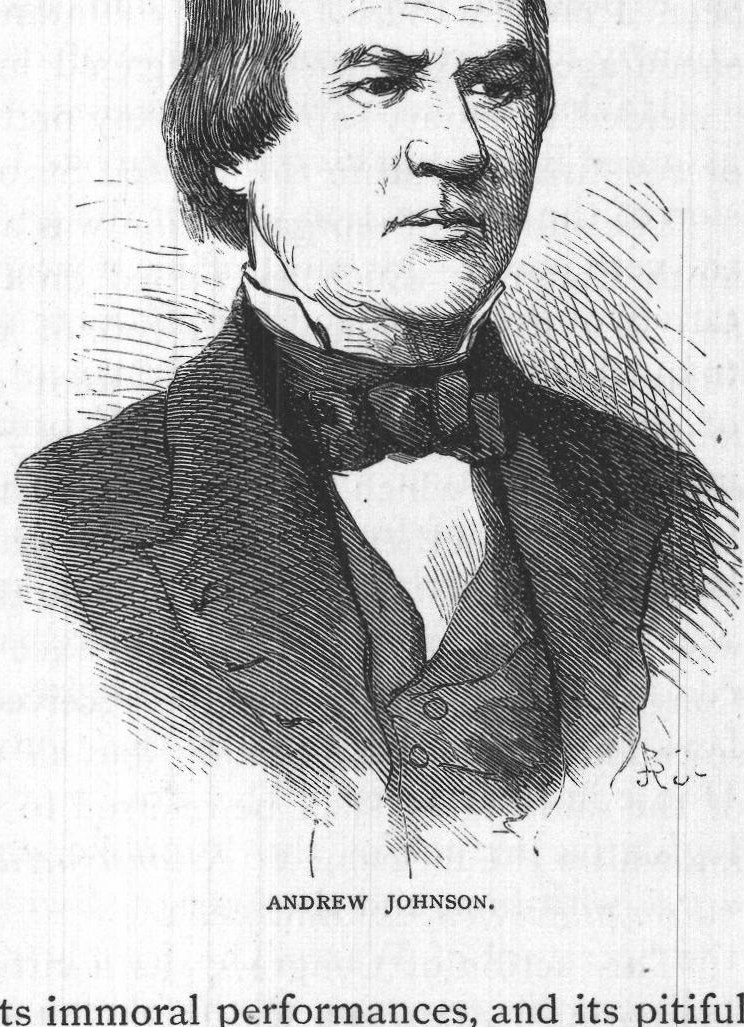
The poor freedmen relied with bright hopes upon the President's promise to be their "Moses" in leading them completely out of bondage; but they soon found that he was unwilling to do more than secure their personal freedom. He was unwilling to invest them with civil rights, which deprivation he knew would virtually remand them to slavery. The political party which had emancipated them and elevated Mr. Johnson to his high position, felt that justice, not expediency, should be the rule in the readjustment of the affairs of the Republic; and it was demanded, as an act of National honor, that the freedman when made a citizen by the Constitution, should have equal civil and political rights and privileges with other citizens, such as the elective franchise. In the spring of 1864, President Lincoln suggested to the governor of Louisiana, the propriety of giving that franchise to the colored people. "They would probably keep," he said, almost prophetically, "in some trying time to come, the jewel of Liberty in the family of freedom." For an ignoble purpose, President Johnson proposed to his provisional governor of Mississippi, to give the franchise to such of the freedmen as could read the National Constitution and possessed property worth two hundred and fifty dollars. He well knew that an extremely small number could avail themselves of the privilege, as the laws of Mississippi made it a punishable offence to teach a colored person to read; and in the condition of slavery, not one could hold property. It was a pitiful trick, which he was not ashamed to avow. In his letter to the governor, he said: "Do this, and, as a consequence, the radicals (in other words the most earnest Republicans), who are wild upon negro suffrage, will be completely foiled in their attempt to keep the Southern States from renewing their relations with the Union."
Within a hundred days after his inauguration, President Johnson took issue with the Republican party upon vital points of principle and policy; and at the close of 1865, it was plain to the comprehension of sagacious observers, that the Chief Magistrate was more friendly to the late enemies of his country than consistency with his professions, or the safety of the Republic, would allow. It was soon perceived that politicians in the North who had sympathized with the Confederates during the war, and the newspapers in their interest which had advocated the cause of the insurgents, had assumed a belligerent tone toward Congress and the loyal people, which greatly disturbed the latter by unpleasant forebodings.
In the meantime measures had been taken for perfecting peaceful relations among the whole people of the Republic, by a revival of industrial pursuits and a restoration of harmony of interests. The order for a blockade of the Southern ports was rescinded late in June (1865); most of the restrictions upon inter-State commerce were removed in August; State prisoners were paroled in October; and on the first day of December, the first important measure adopted, after the assembling of Congress, was the repeal of the act suspending the privilege of the writ of habeas corpus.