President Polk: Santa Anna and Taylor
Just as General Taylor was preparing to enter upon a vigorous winter campaign, he was compelled to endure a severe trial of his patience, temper, and patriotism. In accordance with his recommendation, his government had sent General Scott, with a considerable force, to attempt the capture of Vera Cruz, and from that point to penetrate to the Mexican capital. Scott arrived off Vera Cruz in January, 1847, and being the senior officer of the army, he assumed the chief command of the American armies in Mexico. To effect the work which his government had ordered him to do, he felt compelled to draw from General Taylor's army a large number of his best officers, and a greater portion of his regular troops, leaving him with only about five thousand effective men, including the division of General Wool; and of them only five hundred were regulars. Like a true soldier, Taylor, though greatly mortified, instantly obeyed the chief's order to that effect. At that time Santa Anna had gathered an army of twenty thousand men at San Luis Potosi. He had also been elected Provisional President of Mexico in December, and his followers were full of enthusiasm when, on the first of February, he began a march toward Saltillo, with the avowed intention of drawing the Americans beyond the Rio Grande. General Wool, at Saltillo, had kept his commander advised of the movements of Santa Anna; and when Taylor was assured that the Mexicans were really moving against him, he resolved, weak as he was in numbers, to fight them. On the 31st of January he left Monterey with all his troops, and reached Saltillo on the 2d of February. He pushed on to Aqua Nueva, twenty miles south of Saltillo, on the San Luis road, and encamped until the 21st, when he fell back to Augustina, a narrow defile in the mountains facing the estate of Buena Vista, and there encamped in battle order to await the approach of Santa Anna. His position was well chosen. It was near a narrow gorge in the mountains, through which the approaching Mexican army must pass-a sort of Thermopylae.
On the morning of the 22d of February (1847), Santa Anna and his army were within two miles of Taylor's line of battle, when the Mexican chief sent the following note to the American leader:
"You are surrounded by 20,000 men, and cannot, in any human probability, avoid suffering a rout, and being cut to pieces, with your troops; but as you deserve consideration and particular esteem, I wish to save you from such a catastrophe, and for that purpose give you this notice in order that you may surrender at discretion, under the assurance that you will be treated with the consideration belonging to the Mexican character; to which end you will be granted an hour's time to make up your mind, to commence from the moment that my flag of truce arrives at your camp. With this view, I assure you of my particular consideration. God and Liberty!
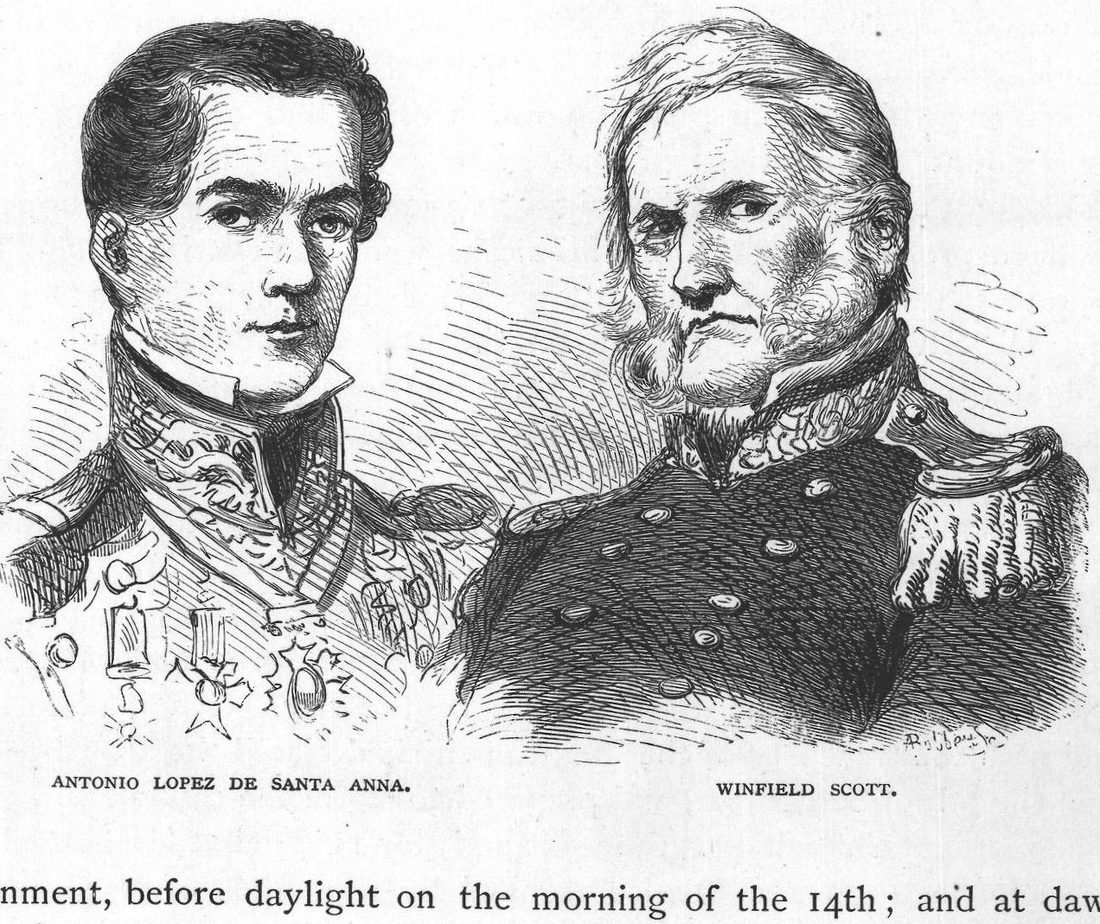
Antonio Lopez De Santa Anna."
General Taylor, who was always "ready," did not take an hour to consider the matter, but immediately replied:
"SIR--In reply to your note of this date, summoning me to surrender my forcess at discretion, I beg leave to say that I decline acceding to your request. With high respect, I am, Sir, your obedient servant,
Z. Taylor."
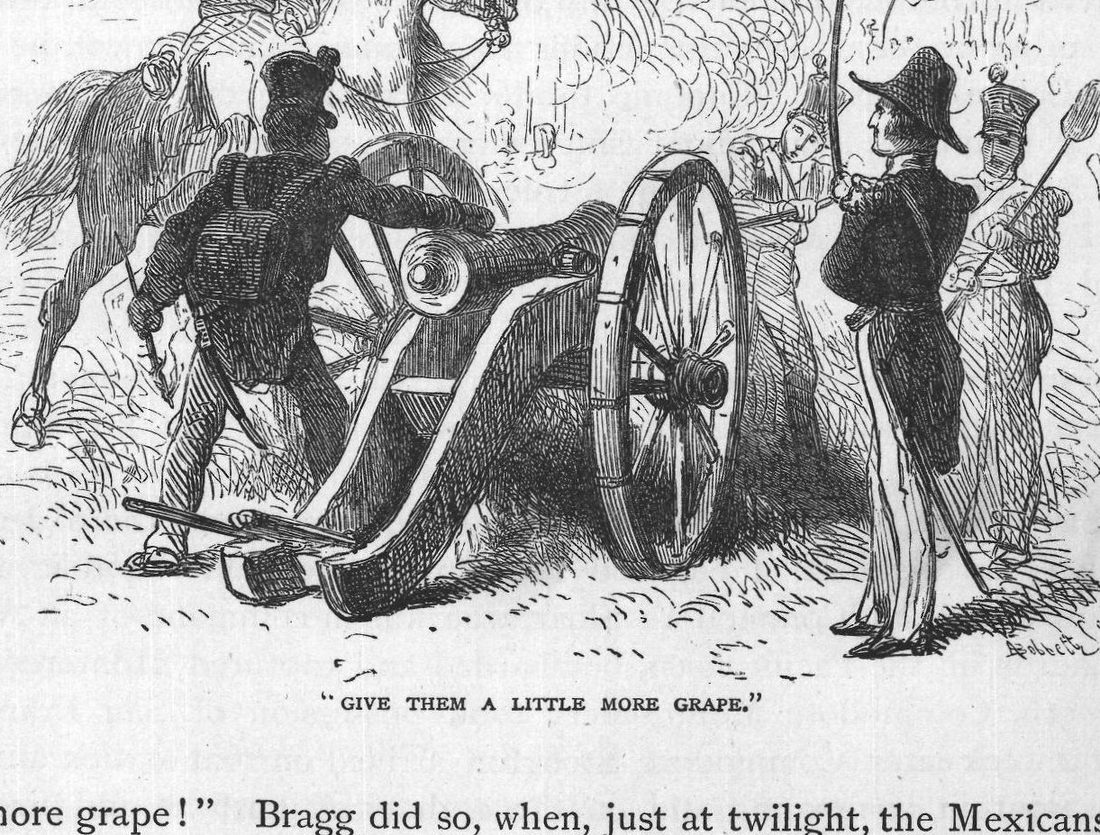
Both armies now prepared to fight. The Americans waited for the Mexicans to take the initiative. It was deferred until evening excepting some skirmishing that afternoon and all that night. While the American troops were bivouacked without fire and slept on their arms, the Mexicans were in detachments in the mountains above them, trying to form a cordon of soldiers around the little army of Taylor and Wool, then less than five thousand in number. Early in the morning of the 23d the battle began and continued all day. The struggle was terribly severe, and the slaughter was fearful. Until almost sunset it was doubtful who would triumph. Then the Mexican leader, after performing the pitiful trick of displaying a flag in token of surrender, to throw Taylor off his guard, made a desperate assault on the American centre, where that officer was in command in person. That centre stood like a rock against the billow. The batteries of Bragg, Washington and Sherman, rolled back the martial wave, and it was not long before the Mexican lines began to waver. General Taylor, standing near the battery of Captain Bragg, saw the signs of weakness and coolly said: "Give them a little more grape!" Bragg did so, when, just at twilight, the Mexicans gave way and fled in considerable confusion. Night closed the battle; but expecting it to be resumed in the morning, the Americans again slept on their arms; but when the day dawned, no enemy was to be seen. Santa Anna had fallen back to Aqua Nueva, and, in the course of a few days, his large but utterly amazed and dispirited army was almost dissolved. In the flight they had left five hundred of their comrades dead or dying on the field. They had lost in the battle almost two thousand men; the loss of the Americans in killed, wounded and missing, was seven hundred and forty-six. A son of Henry Clay was among the slain.