President John Quincy Adams
JOHN QUINCY ADAMS, son of the second President of the United States, entered upon the duties of that high office on the 4th of March, 1825. He was small in stature, a thorough republican in principles, and with political views consonant with those held by Mr. Monroe. The Senate was in session at the time of his inauguration, and that body, by unanimous vote, immediately confirmed Mr. Adams's nominations for cabinet ministers, excepting Henry Clay, against whose confirmation fourteen votes were cast. It had been charged that Mr. Clay, seeing little chance for his own election to the Presidency, had used his influence in favor of Adams and against Jackson with the understanding that he was to be appointed Secretary of State. This alleged "bargain" was the cause of opposition to Clay's confirmation. He was appointed Secretary of State; Richard Rush, Secretary of the Treasury; James Barbour, Secretary of War; Samuel L. Southard, Secretary of the Navy, and William Wirt, Attorney-General.
Mr. Adams's administration began under the most pleasant auspices. The country was at peace with all nations, and no serious domestic trouble appeared, while general prosperity reigned in the land and there seemed to be nothing that would disturb the serenity of public affairs. This quietude prevailed, in a degree, during the whole of Mr. Adams's administration of four years, which were the least conspicuous for stirring events in the history of the republic. The discords engendered by the late exciting election had produced healthful agitation, but measures were adopted that caused stormy times in the administration that followed.
A threatening cloud appeared in the firmament at the beginning of Adams's administration. When Georgia relinquished her claim to a considerable portion of the Mississippi Territory, the national government agreed to purchase for that State the Indian lands within its borders "whenever it could be peaceably done upon reasonable terms." The Creeks and the Cherokees, who were practising the arts of civilized life, refused to sell their lands and remove into an uncultivated wilderness. The Georgians were impatient, and their governor demanded of the United States the instant fulfillment of the contract, by a removal of the Indians. He ordered a survey of their lands to be made, and he prepared to distribute their possessions among the citizens of Georgia; and because the national government seemed tardy, he assumed the right to remove the Indians himself. Our government took the just position of defenders of the Indians, and for awhile the matter bore a serious aspect. The difficulties were finally settled, and in the course of a few years the Creeks and Cherokees were settled on lands beyond the Mississippi River.
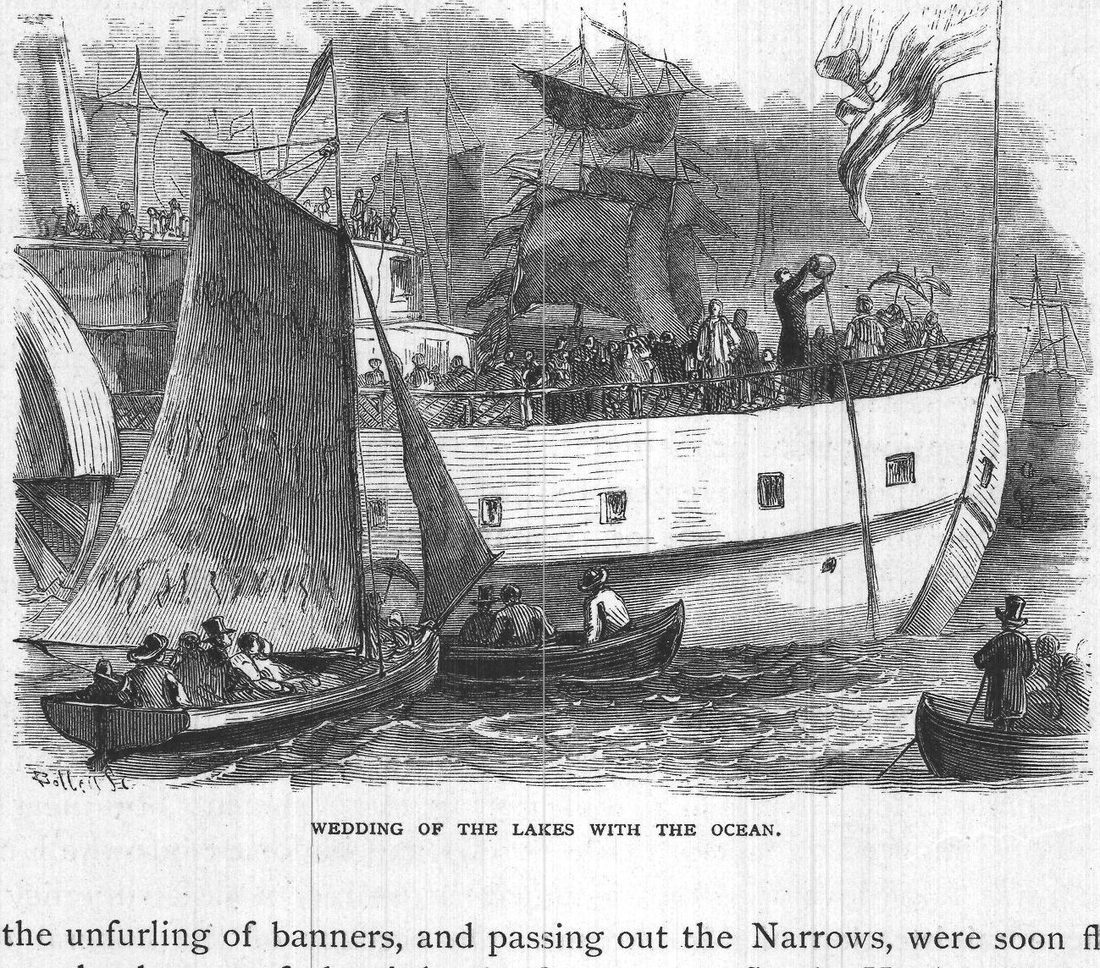
It was at the beginning of Mr. Adams's administration that the greatest work of internal improvement ever undertaken in our country, in the interest of commerce, was completed. It was the Erie Canal, which traverses the States of New York in an east and west line three hundred and sixty-three miles, between Buffalo and Albany, and connects the water of the great upper lakes and those of the Hudson River by a navigable stream. It was constructed by the State of New York at a cost of $7,600,000; and it was the consummation of scheme which General Philip Schuyler (the father of the American canal system), Elkanah Watson, Gouverneur Morris, Jesse Hawley, De Witt Clinton and others had cherished for years. It was the grand result of a suggestion made by Gouverneur Morris twenty-five years before. When the canal was completed in 1825, it was formally opened to commerce after a grand "celebration," which consisted of an aquatic procession from Albany to the sea, in November of that year. The flotilla, led by the steamboat Chancellor Livingston, with De Witt Clinton (then governor of New York) and State officers on board, was composed of steamers and canal-boats. It halted at the city of New York; and on a cool and brilliant November morning, the whole fleet, accompanied by other vessels, went down the bay, everywhere greeted by the roar of cannon and the unfurling of banners, and passing out the Narrows, were soon floating on the bosom of the Atlantic Ocean near Sandy Hook. There the Chancellor Livingston was anchored, with a swarm of other vessels around her, which were gayly decorated with flags and crowded with people. At a proper time Governor Clinton advanced to the taffrail of the Chancellor Livingston, and holding up a keg containing water of Lake Erie, which had been brought from Buffalo in a canal-boat, and pouring the liquid into the sea, completed the nuptials of the Ocean and the Great Lakes--nuptial ceremonies more important and significant than were ever performed in the wedding of the wedding of the Doge of Venice and the Adriatic. That great work of internal improvement gave rise to similar ones elsewhere, and was of vast benefit to the whole country. The Erie Canal continues to be the channel of a wonderful outflow of the agricultural products of the West to the sea-board, and of the inflow of the merchandise from the Atlantic ports to the interior. During the year 1872 (the year before the great depression in the business of the country began), the value of the property that was transported on that canal was $168,000,000; notwithstanding a three-track railway, carrying an immense amount of freight, is laid parallel to it in its entire length.