Popular Excitement
This amendment was immediately submitted to the authorities of the several States for action, and was ratified by the requisite number. Before the close of that session, an important financial bill was adopted, of which the following was the chief provision: "The faith of the United States is solemnly pledged to the payment, in coin, or its equivalent, of all interest-bearing obligations of the United States, except in cases where the law authorizing the issue of any such obligations has expressly provided that the same may be paid in lawful money or other currency than gold and silver." This act was not only just, but expedient. It was intended to strengthen the credit of the Government at home and abroad, and that was accomplished.
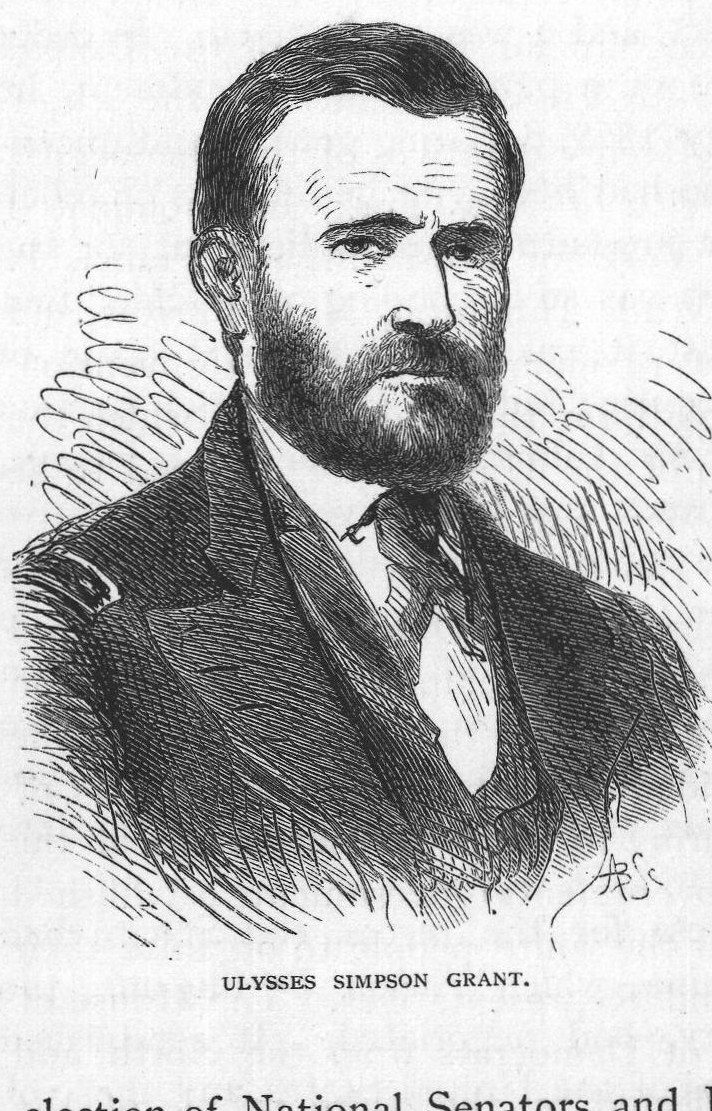
The turbulent administration of Mr. Johnson closed on the 4th of March, 1869, when Ulysses Simpson Grant was inaugurated the eighteenth President of the United States. The oath of office was administered by Chief-Justice Chase, and the Senate confirmed his cabinet appointments, after some necessary changes, as follows: Hamilton Fish, Secretary of State; George S. Boutwell, Secretary of the Treasury; John A. Rawlins, Secretary of War; Adolph E. Borie, Secretary of the Navy; Jacob D. Coxe, Secretary of the Interior; A. J. Creswell, as Postmaster-General; and E. Rockwood Hoar, as Attorney-General.
On the day when Johnson retired from the chair of state, he issued a long address to his countrymen in vindication of his course as Chief Magistrate. He recited his most prominent acts, declaring the necessity for them; and having done this he assailed the majority of the Congress with his usual vehemence of tone, accusing them of acting in "utter disregard of the Constitution." "Since the close of the war," he said, "they have persistently sought to influence the prejudices engendered between the sections, to retard the restoration of peace and harmony, and by every means to keep open and exposed to the poisonous breath of party passion the terrible wounds of a four years' war. They have prevented the return of peace and the restoration of the Union: in every way rendered delusive the purposes, promises and pledges, by which the army was marshalled, treason rebuked, and rebellion crushed, and made the liberties of the people and the rights and powers of the President objects of constant attack." He charged them with the commission of nearly every act of oppression enumerated in the indictment against George the Third, contained in the Declaration of Independence, and said, "This catalogue of crimes, long as it is, is not yet complete."
This public exhibition of the retiring President's weakness; his inaccuracy of statements; his unjust and untrue accusations, and his manifestation of blind anger, mortified his real friends and elicited a smile of pity from those who were assailed. In his whole career as President, Mr. Johnson seemed to feel, like Louis the Fourteenth, "I am the state." He seemed to forget that he was the executive and not the legislative or judicial branch of the Government; that it was the duty of Congress to make laws, and his to see that they were executed; that after he had expressed his reasons for the disapproval of an act, in a veto message, and that act became a law by a constitutional vote, it was his solemn duty to enforce that law; and that the Supreme Court, and not the Executive, was the sole judge of the constitutionality of an enactment.
The career of Andrew Johnson exhibits a peculiar phase in our social system--the possibilities that wait upon citizens of the most humble origin. Mr. Johnson was born in Raleigh, North Carolina, late in 1808. His parents were poor and lowly; and at the age of four years he was bereft of his father. Without an hour's schooling, he was apprenticed to a tailor at the age of ten years; and during that service he taught himself to read. With his own hands he supported his mother, and with her he moved to Greenville, East Tennessee, when he was eighteen years of age. There he soon married an excellent girl, who taught him to write. The energy of his character, his sobriety and strength of mind, commended him to the citizens, and he was elected alderman of Greenville at the age of twenty, and mayor when he was twenty-one.
Mr. Johnson was possessed of a certain kind of rugged and ready oratory that made him very popular; also the elements and aspirations of an adroit politician; and he made his way upward in the path of distinction by his own indomitable will, passing successively through the offices of alderman, mayor, member of both houses of the Legislature of Tennessee, presidential elector, member of Congress, governor of Tennessee, national Senator, Vice-President, and Acting-President of the United States. His moral nature was more feeble than his ambition, and yielded to it; and in his career as President that weakness prevented his achieving most enviable fame as a patriot and a benefactor of his race.