Perils of the British in Boston: Dunmore and Robert Howe
Early in the autumn Dunmore proceeded to execute his threat concerning the slaves. He unfurled the royal standard over the Fowey at Norfolk, and proclaimed freedom to all slaves who should rally under it. He also proclaimed martial-law over all Virginia. He sent a party ashore to destroy the printing-office of John Holt, an ardent Whig journalist; and at the head of a motley band of Tories and negroes, he committed depredations in southeastern Virginia. With the aid of some British vessels he attacked Hampton, near Old Point Comfort, late in October, when he was repulsed by the militia. Exasperated by his defeat, he openly declared war against the people. The militia of Lower Virginia flew to arms; and under Colonel Woodford, who had been sent there with a body of Minute-men, they prepared to drive the traitor governor from their soil. He became alarmed, and after fortifying Norfolk, he caused some works to be thrown up at the Great Bridge over the Elizabeth River, near the Dismal Swamp, by which he expected the approach of Woodford. There a short but severe battle was fought on the morning of the 9th of December, 1775, between the Virginia militia and a band of Tories and negroes under Captains Leslie and Fordyce. The latter were routed and fled back to Norfolk in confusion, where Dunmore, covered as he was, had remained in safety. In his rage he threatened to hang the boy who had brought him the first news of the disaster.
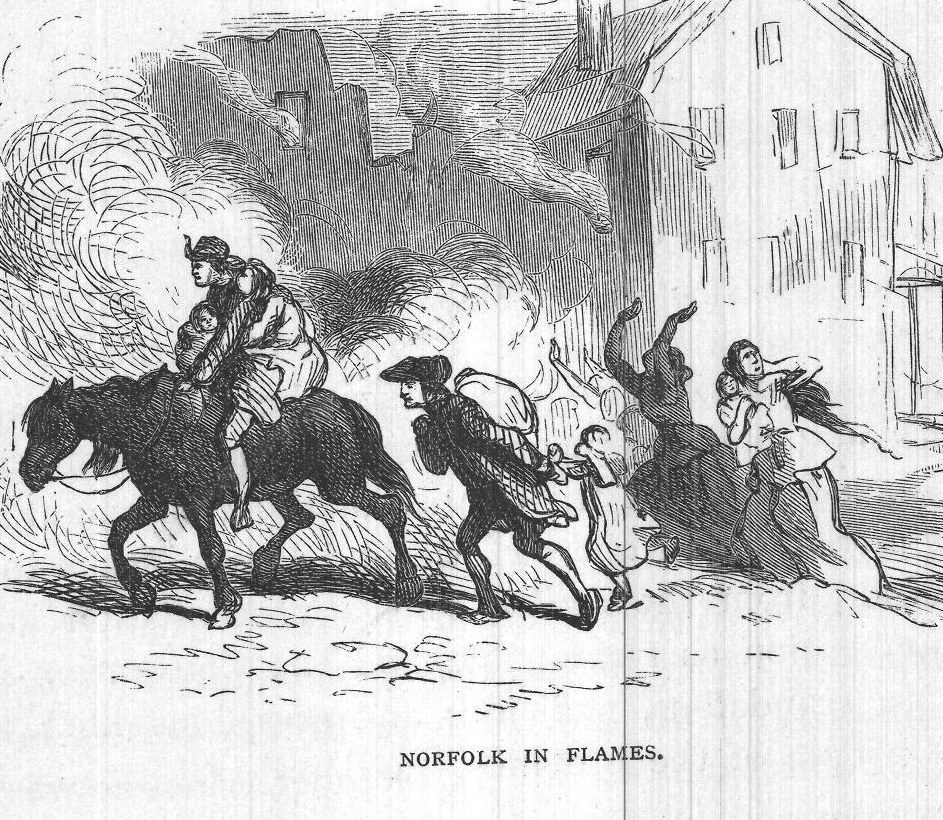
Woodford pushed on toward Norfolk, drove Dunmore to the small vessels-of-war, and entered the city in triumph, where he was joined by Colonel (afterward General) Robert Howe, with a North Carolina regiment, who took the chief command. That spirited officer annoyed Dunmore exceedingly by desultory cannon-shots, attacks upon British foraging parties, and the discharge of musketry from the houses in Norfolk. At length the British frigate Liverpool came up the river from Hampton Roads, when the governor sent a message to Howe demanding the instant cessation of the firing, and also a supply of food, and threatening to cannonade the town in case of a refusal. A prompt refusal was sent back, when the governor executed his threat, and more. On the morning of the first of January, 1776, his vessels-of-war opened a cannonade upon Norfolk, and he sent a party of marines and sailors to set the city on fire. The conflagration raged for fifty hours, during which time the cannonade was kept up. The distress occasioned by this wicked act at that inclement season was terrible; and the remembrance of it nerved the arms of the Virginia soldiers and the hearts of the Virginia people all through the struggle for independence.
After prowling along the Virginia sea-coasts and up its rivers with his ships and motley horde of followers for several months, Dunmore established a fortified camp on Gwyn's Island in Chesapeake Bay, from which he was dislodged by Virginia militia under General Andrew Lewis. Then he went up the Potomac with the evident intention of seizing Mrs. Washington to hold her as a hostage, and to lay waste the Mount Vernon estate; but heavy storms and the Prince William militia at Occoquan frustrated his designs. He finally sailed to the West Indies, taking with him about a thousand negroes whom he had collected by promises of freedom or by violence during his marauding expeditions, and sold them for slaves to the planters there. Thence he returned to England.
In North Carolina resistance to oppression began early, as we have seen. The Mecklenberg Declaration of Independence in May, 1775, was but a culmination in action of the patriotic sentiments of the province. Governor Martin, who succeeded Tryon, alarmed by the threatening aspect of the popular will, first fortified his "palace" at New Berne, and then took refuge in Fort Johnson, near the mouth of the Cape Fear River. From that stronghold he was driven by the patriots in arms in July, to the Pallas sloop-of-war in the Cape Fear. The fort was destroyed, and the governor fulminated menacing proclamations from his floating quarters. His political friends were numerous; but under the wise leadership of Cornelius Harnett, John Ashe and a few others, the Whigs were so well organized that they silenced the Tories, and kept the most obnoxious ones prisoners on their own plantations. The Continental Congress voted to furnish supplies for a thousand men in that province to counteract the influence of Governor Martin and his friends; and a popular convention that assembled at Hills-borough in August, and assumed the control of the colony, authorized the raising of two regiments, with Robert Howe and James Moore to command them. The governor, from the Pallas, sent a proclamation in which he denounced the Convention as treasonable, and the Convention denounced his manifesto as "a scandalous, malicious and scurrilous libel, tending to disunite the good people of the province," and ordered it to be burned by the common hangman.