Partisan Warfare
This annihilation of Ferguson's corps crushed the spirits of the loyalists, destroyed the hopes of Cornwallis of aid from those of South Carolina, and weakened, beyond recovery, the royal power in the South. King's Mountain was to Cornwallis what Bennington was to Burgoyne. When the earl heard of the disaster, he retreated from North Carolina and took position at Winnsboro' in Fairfield district, between the Broad and Catawba rivers-a station between Ninety-Six and Camden. The loyalists of North Carolina were repulsed, and the Whigs, everywhere, were strengthened. There was a general revolt against Cornwallis, who had expected to subdue the whole region south of the Susquehanna by easy conquests. In his retreat he was greatly annoyed by the uprising of republicans, who hung on his rear; and his whole army suffered much from exposure in almost incessant rains, and for want of food for man and forage for horses, during the retrograde march of fifteen days.
Nearer the seaboard the patriots were gaining strength. Marion and his men were striking the banding Tories, and annoying British outposts continually; while Colonels Pickens and Clarke were hourly increasing their forces in Georgia and southwestern Carolina. Sumter, too, undismayed by his recent defeat, had rallied the patriots above Camden; and men were in the field here and there between the Yadkin and the Catawba, ready to swell the ranks of any good leader, or strike a British foraging party. Sumter's men were all mounted, and cut off many supplies for Cornwallis's army at Winnsboro'. The earl sent Major Wemyss, with some mounted infantry, after him. These fell upon Sumter's camp at Fish Dam Ford on the Broad River, on the night of the 11th of November, but were repulsed. Wemyss was made prisoner, and on his person were found memoranda that revealed his cruelty toward the inhabitants. Cornwallis, on hearing of his defeat, recalled Tarleton from the pursuit of Marion in the lower country, and sent him after Sumter, who, with reinforcements, was pushing on to the British post of Ninety-Six. Tarleton overtook the partisan at Blackstock's plantation on the banks of the Tyer River, in Union district, and attacked him there on the night of the 20th of November. The assailants were repulsed, with heavy loss, leaving their wounded in the hands of Sumter. The latter was disabled by a severe wound, but his loss in men was inconsiderable.
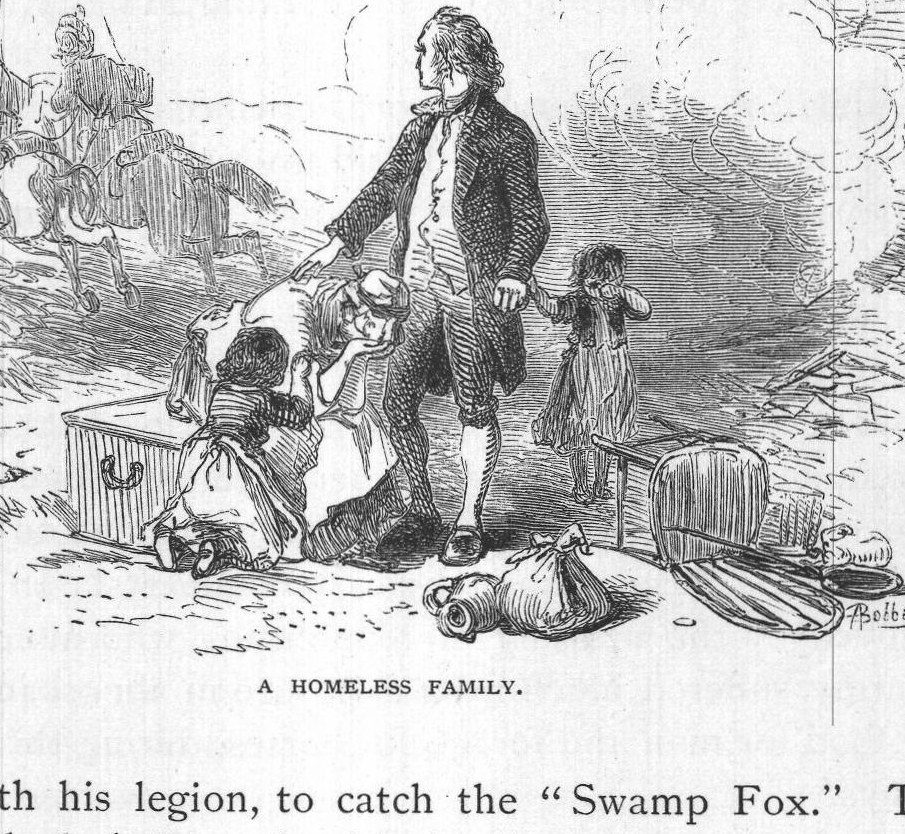
Meanwhile Marion had won victory after victory in forays against British and Tories in the vicinity of the Pedee and Santee rivers. Cornwallis had sent Tarleton, with his legion, to catch the "Swamp Fox." That officer and his men marked their track with desolation and woe. It might have been traced by burning dwellings, and groups of homeless women and children. On the banks of the Santee he beat the widow of a republican officer because she would not tell him where Marion was encamped. He robbed her of all her clothing excepting what she had on; burned her house and devastated her plantation. While pursuing this wicked career, he was recalled to go in pursuit of Sumter. Now Marion attempted a bolder stroke, by assailing the British post at Georgetown, on Winyaw Bay, to procure needed supplies for his men. He was beaten in a skirmish near the town, and retired to Snow's Island at the confluence of the Pedee and Lynch's Creek, which was a high river swamp, dry, and covered with a heavy forest filled with game. At that skirmish, Marion's nephew was murdered after he had surrendered. From that time the battle cry of Marion's men was "No quarter for Tories!"
On Snow's Island, surrounded by vast swamps, Marion had a secure retreat. To his camp, there, a young British officer was sent to treat concerning prisoners. He was led, blindfolded, to the camp, where he saw in the person of the famous partisan leader, a diminutive man, with large, sunken, lustrous eyes, and very coarsely clad, surrounded by rough-looking men with tattered garments. When the business of his mission was closed, Marion invited him to dine at his table. The invitation was accepted. Some roasted sweet potatoes were brought into the tent on a piece of bark, of which the general partook freely, and invited his guest to do the same. "Surely, general," said the astonished Briton, "this cannot be your ordinary fare." "Indeed it is," Marion replied; "and it is a fortunate circumstance that, on this occasion, entertaining company, we have more than our usual allowance." The young officer threw up his commission on returning to his commander, saying, "Such a people cannot, and ought not to be subdued."