M'clellan's Campaign
The gravity of the occasion was so little appreciated, that when it was known at Washington that McDowell was to attack Beauregard on Sunday, the 21st, scores of men, and even women--Congressmen, officials of every grade, and plain citizens--went out in carriages as to a spectacular show for amusement. Passes from military commanders were like tickets to a Roman gladiatorial combat in the circus; and the vicinity of the battle-field was gay, on Sunday morning, with civilians, who indulged in wine and cigars at the headquarters of Colonel Miles at Centreville. The heights there were crowded with spectators; and as the battle went on, and bombs "bursted in air," their cheeks were made to glow with delicious excitement. Before night those cheeks were made pale by terror as the crowd of spectators rushed back, pell-mell, toward places of safety, pursued by the Confederates. Soldiers and citizens and well-dressed women were mingled in picturesque confusion in the line of fugitives who crowded the highways. In several places the roads were blocked with overturned vehicles or abandoned cannon; and horses and human kind seemed equally eager to escape from the whirlwind of destruction that followed in fury behind them for awhile. But the pursuit of the Confederates was soon stayed by misinformation. Had they pressed on, their coveted prize, the National capital, might have been in their possession before Monday morning.
The battle at Bull's Run depressed the loyal people only for a moment, and there was a quick rebound from despair to hope. Another uprising by the loyalists in favor of the Union took place, and the gaps in the National armies were more than filled within a fortnight by new recruits. The Confederates were weakened by their victory, for it gave them undue confidence in their strength and prowess, and made them neglect to profit by it. But circumstances soon afterward caused a "solid South" to be arrayed against the National Government, and the Confederate armies were wonderfully sustained by their people.
General Patterson was unjustly censured for his failure to hold Johnston at Winchester or to reinforce McDowell. When the truth was made known by positive testimony, it appeared clear that he did all an obedient soldier, bound by instructions, could do under the circumstances, and the public mind was satisfied.
While the events we have just considered were occurring in the East, the war was making rapid progress in the West, especially in Missouri, where General Lyon, as we have seen, had taken vigorous measures to quell the rebellion. The disloyal governor of Missouri, who raised the standard of revolt at Jefferson City, fled westward with troops who were led by General Price, and took a stand at near Booneville. There they were attacked by Lyon and defeated, when they retreated toward the southwestern portion of Missouri, and halted not far from the Arkansas border. Lyon now held military control over the whole region northward of the Missouri River, and east of a line from Booneville to the Arkansas border, thus giving to the Government the important points of St. Louis, Hannibal, St. Joseph, and Bird's Point on the Mississippi, as bases of operations, with railways and rivers for transportation. General Lyon remained about a fortnight at Booneville preparing for a vigorous campaign against the insurgents whom Jackson was gathering around him in southwestern Missouri. He issued a proclamation which quieted the people and strengthened the Union cause, for he assured them that his Government had no other end in view than the maintenance of its authority over the persons and property of the whole people of the State.
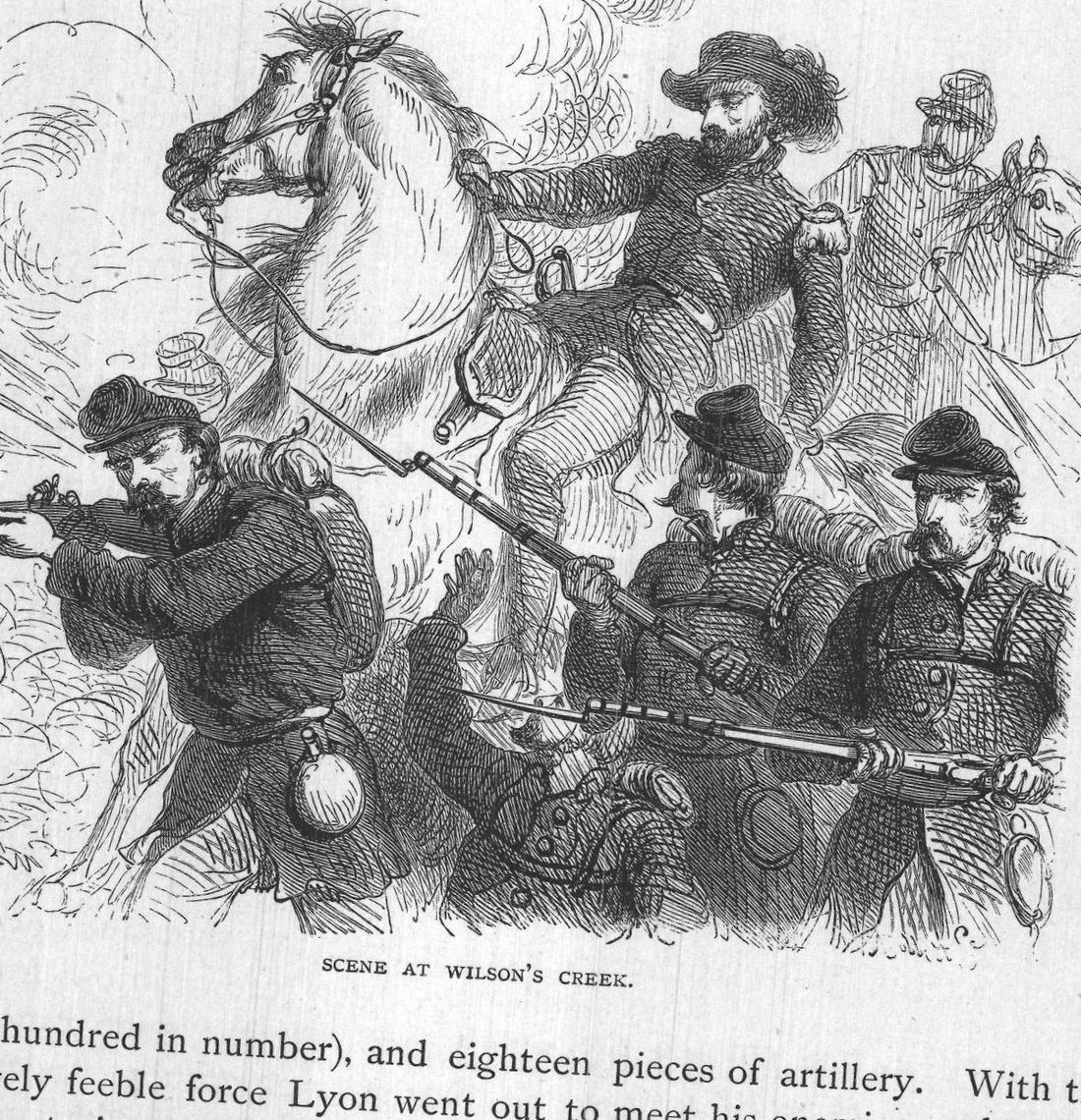
On the 1st of July (1861) there were at least ten thousand loyal troops in Missouri, and as many more might have been thrown into it from camps in Illinois, in the space of forty-eight hours. At the same time, Colonel Franz Sigel, a German soldier and patriot, was pushing eager soldiers toward insurgent camps on the borders of Kansas and Arkansas. On the 5th of July he encountered a considerable force under Jackson and Brigadier-General Rains, near Carthage. Their force was much greater in number than his own, and after a sharp fight he was pressed back and retreated in good order to Sprngfield. Lyon, who was then at the head of a small force, eighty miles from Springfield, satisfied of Sigel's peril, hastened forward to his relief, by forced marches, and encamped not far from him on the 13th of July and took command of the combined forces. In the meantime troops from Texas under Generals McCulloch, Rains, Pearce and McBride, had joined Price, making his whole force about twenty thousand men. They were now marching on Springfield. To confront them Lyon had not more than six thousand men, horse and foot (the former about five hundred in number), and eighteen pieces of artillery. With this comparatively feeble force Lyon went out to meet his enemies, and at Dug Springs, about nineteen miles west from Springfield, they met and fought a desperate battle on the 2d of August. The Confederates were led by General Rains. So furious was the charge of Lyon's cavalry, in the engagement led by Captain Stanley, that Confederate prisoners seriously inquired: "Are they men or devils?" The Confederates were beaten and fled to Wilson's Creek, about ten miles south of Springfield, where they encamped on the evening of the 9th wearied and half-starved.