Lord Chatham and Franklin
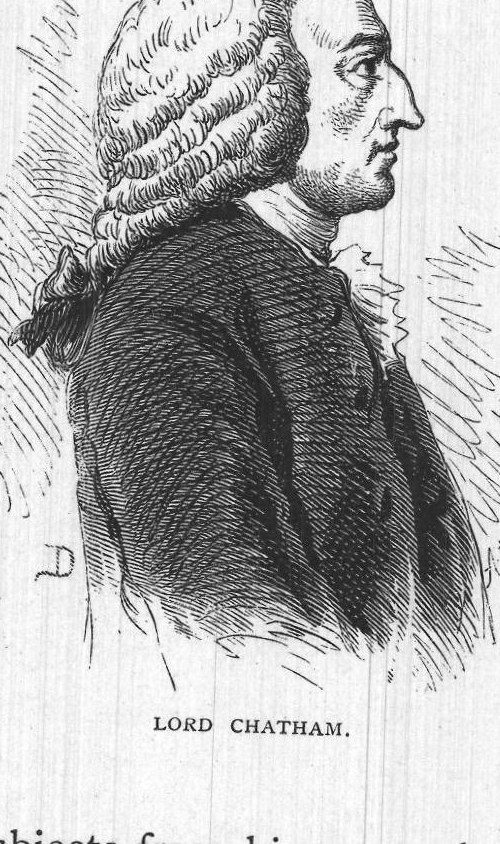
The agents were not permitted to lay the petition of Congress to the king "into his majesty's hands." Franklin presented it to Lord Dartmouth. His lordship laid it before the king, who promised it should be submitted to Parliament, and so the matter rested for awhile. Franklin, meanwhile, had borne a copy of the petition to Hayes, where he was courteously received by Lord Chatham. Among other pointed remarks made by Franklin to Pitt, on that occasion, none seemed to strike his lordship more forcibly than these words: "The army cannot possibly answer any good purpose in Boston, but may do infinite mischief; and no accommodation can properly be proposed and entered into by the Americans, while the bayonet is at their breasts. To have an agreement binding, all force should be withdrawn." Chatham was deeply impressed with the justice of the remark, and he promised Franklin that if his malady would allow, he would be in his place in the House of Lords at the reopening of Parliament, and move the immediate and unconditional withdrawal of the troops from Boston. In this measure he thought were involved the hopes of liberty for England.
The scruples of Lord North annoyed the king, and the monarch often rebuked his minister. These scruples had created much opposition to him in the Cabinet, and a clique had determined to procure his dismissal, if he should propose any more lenient measures toward the Americans. North was advised of this conspiracy. The Parliament was to reassemble on the 20th of January; and at a meeting of the Cabinet on the 12th, he saw unmistakable evidence that he must yield his conscience to the king, or throw up the seals of office. A majority of the Cabinet were firm supporters of the royal prerogative, and champions for the supremacy of Parliament. North loved place and its emoluments; so, quieting his conscience, by considering the sacredness of his pledge to the king, he reinstated himself with his fellow-ministers by unbounded good nature on that occasion, and a promise to take the tremendous responsibility of a leader in measures which his judgement assured him would create a civil war. At that meeting it was decided to interdict all commerce with America; and to declare all persons in the colonies, not actively loyal to the crown, to be rebels. By so drawing the line of separation sharply, they hoped to create a permanent antagonism among the people here; but union rather than discord was effected.
Parliament reassembled on the 20th January, 1775. The rumor had gone abroad that Chatham would appear in his place. It was vehemently asserted by the court party that he would not be there; that he had washed his hands of American affairs, and would never more appear as their advocate. This assertion disturbed Lady Chatham, who was in London. She had informed her husband of the day appointed for the assembling of Parliament, but she feared there might be some trick by which Lord Chatham would be prevented from being present at the opening, as he desired to be. In a letter to him she expressed some doubts about the propriety of her appearing at court, while the rumors of his remaining at Hayes were so rife. He wrote to her, most earnestly, saying: "For God's sake, sweet life, don't disquiet yourself about the impertinent and ridiculous lie of the hour. The plot does not lie very deep. It is only a pitiful device of fear, court fear, and faction fear. If gout does not put in a veto, which I trust in Heaven it will not, I will be in the House of Lords on Friday, then and there to make a motion relative to America. Be of good cheer, noble love.
Men not afraid of God, afraid of me."
To Lord Stanhope he wrote: "I greatly wish Dr. Franklin may be in the House."
His lordship communicated this wish to Franklin, and offered to lend him assistance in gaining admission. On the morning of the 20th, Lord Stanhope sent another message to Franklin, letting him know that if he should be in the lobby of the House at two o'clock that day, Chatham would be there and introduce him himself. Franklin was there. On mentioning to the great orator what Stanhope had said, Chatham replied: "Certainly, and I shall do it with the more pleasure, as I am sure your presence at this day's debate will be of more service to America than mine." He then took Franklin by the arm and was leading him along the passage to the door that entered near the throne, when one of the doorkeepers followed and acquainted Pitt, that, by the order, none were to be carried in at that door but the eldest sons and brothers of peers. Pitt limped back with Franklin to the door near the bar, where were standing a number of gentlemen waiting for the peers who were to introduce them, and some peers waiting for friends they expected to introduce. There Chatham delivered Franklin to the doorkeepers, saying aloud: "This is Dr. Franklin, whom I would have admitted into the House;" which was accordingly done. "As it had not been publicly known that there was any communication between his lordship and myself," Franklin wrote, "this, I found, occasioned some speculation. His appearance in the House, I observed, caused a kind of bustle among the officers, who were busied in sending messengers for members--I suppose those in connection with the ministry, something of importance being expected when the great man appears, it being but seldom that his infirmities permit his attendance."