Investment and Siege of Vicksburg
AFTER Grant's last assault on Vicksburg, his effective men did not exceed twenty thousand in number. He determined to make the capture of Vicksburg an event of the near future, and called in reinforcements. They came in such numbers, that by the middle of June the investment of Vicksburg was made absolute. Sherman's corps was on the extreme right, McPherson's next and extending to the railway, and Ord's (late McClernand's) on the left, the investment in that direction being made complete by the divisions of Herron and Lanman, the latter lying across Stout's Bayou, and touching the bluffs on the river. Parke's corps, and the divisions of Smith and Kimball, were sent to Haines's Bluff, where fortifications commanding the land side had been erected to confront any attempt that Johnston might make in that direction. Meanwhile Vice-Admiral Porter had made complete and ample arrangements for the most efficient co-operation on the river, and his skill and zeal were felt throughout the siege, which continued until the first week in July.
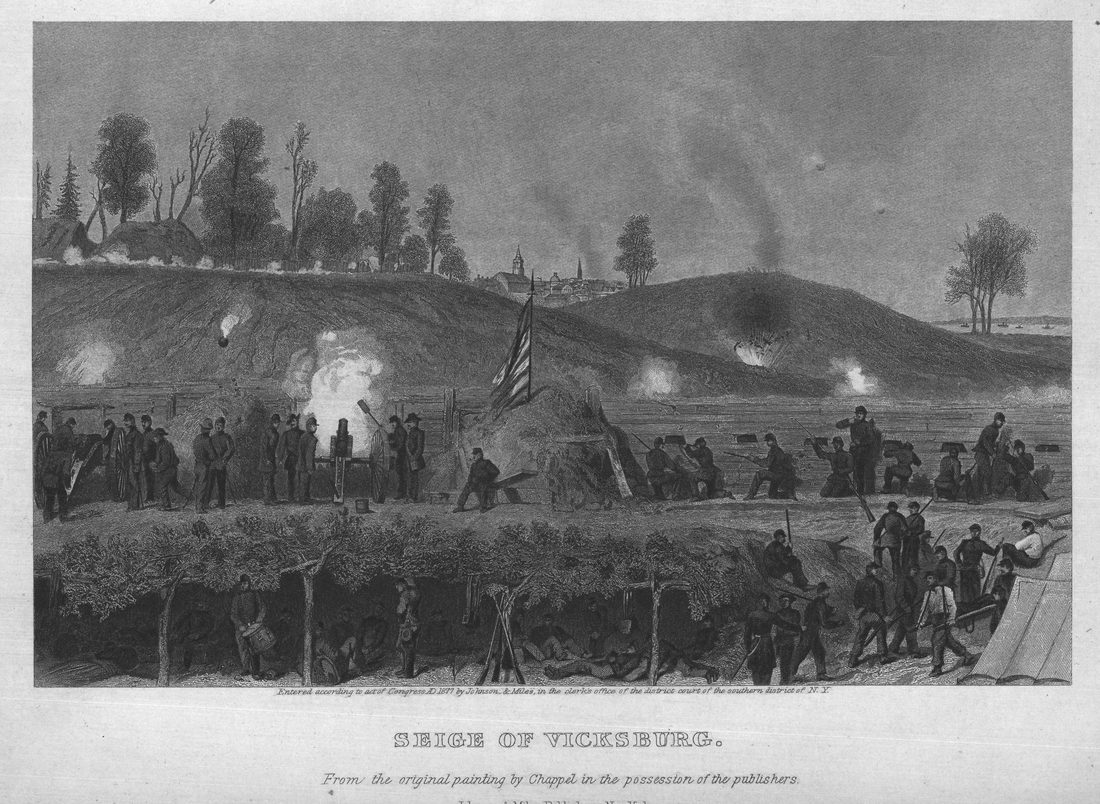
Every day, shot and shell were hurled upon the city and the insurgent camps, from land and water. The inhabitants were compelled to seek shelter in caves dug out of the clay hills on which the city stands. In these, whole families, free and bond, lived for many weeks, while their houses without were perforated by the iron hail. Therein children were born, and persons died, and soldiers sought shelter from the tempest of war. Very soon famine afflicted the citizens. Fourteen ounces of food became a regular allowance for each person for forty-eight hours. The flesh of mules made savory dishes toward the end of the siege. Finally the besiegers undermined one of the principal forts of the enemy, in the line of the defences on the land side, and it was blown up with fearful effect. Other mines were made ready for the infernal work, when Pemberton, despairing of expected aid from Johnston, made a proposition to Grant to surrender the post and his army. The generals met under the shadow of a live-oak tree in the rear of the town on the 3d of July to arrange the terms of surrender, and on the 4th the stronghold of Vicksburg, with twenty-seven thousand men and a vast amount of ordnance, and other public property, were surrendered to the leader of the National forces.
From the time of the battle at Port Gibson to the fall of Vicksburg, General Grant had captured thirty thousand prisoners (among them fifteen general officers), with arms and ammunition for an army of sixty thousand men; also steamboats, locomotives, railroads, a vast amount of cotton, etc. He had lost, during that time, nine thousand eight hundred and thirty-three men, of whom one thousand two hundred and thirty-three and been killed. By the experience of those few weeks, he had ascertained the real weakness of the Confederacy in that region.
On the night of the 4th of July (1863), the powerful fleet of Vice-Admiral Porter was lying quietly at the levee at Vicksburg, and in commemoration of that National holiday, our troops regaled the citizens with a fine display of fireworks more harmless than those which, for more than forty nights, had coursed the heavens above them like malignant meteors.
Galveston had been recaptured by the Confederates on the first of January, 1863; but that victory was rendered almost fruitless by a close blockade of the post by National vessels. From that time General Banks had been co-operating with General Grant, and making efforts to "repossess" Louisiana. An expedition under General Weitzel and Commodore McKean Buchanan took possession of the remarkable Teche country in that State, when Banks concentrated his troops, about twelve thousand in number, at Baton Rouge (which was then held by General Grover), for the purpose of assisting Commodore Farragut in an attempt to pass the formidable batteries at Port Hudson, twenty-five miles up the Mississippi. That attempt was made on the night of the 13th of March, when a terrible contest occurred, in the darkness, between the vessels and the land batteries. Only Farragut's flag-ship (the Hartford) and another succeeded in passing by.