Invasion of South Carolina
HAVING military possession of Georgia, General Prevost prepared to attempt the subjugation of South Carolina. Informed that Lincoln was far up the Savannah River, and assured by timid men who professed loyalty and took protection from Prevost, to save their property, that Charleston might be easily captured, the British leader, with about two thousand regulars and a body of Tories and Indians, crossed the river at Purysburg, and took the nearest road leading to that city. When Lincoln heard of this movement, he resolved to attempt to regain possession of Georgia. He was then at the head of five thousand men. Sending a detachment, under Colonel Harris, to reinforce Moultrie, who was flying before Prevost, he crossed the river near Augusta, and marched down its Georgia side for Savannah, hoping to recapture that place, or to recall Prevost. When he discovered that the latter continued to press on toward Charleston, Lincoln recrossed the Savannah, and gave chase. At the same time Governor Rutledge, who had been gathering recruits near Orangeburg, was hastening toward Charleston with six hundred men; and at the beginning of May was seen the interesting spectacle of four armies marching upon the South Carolina capital.
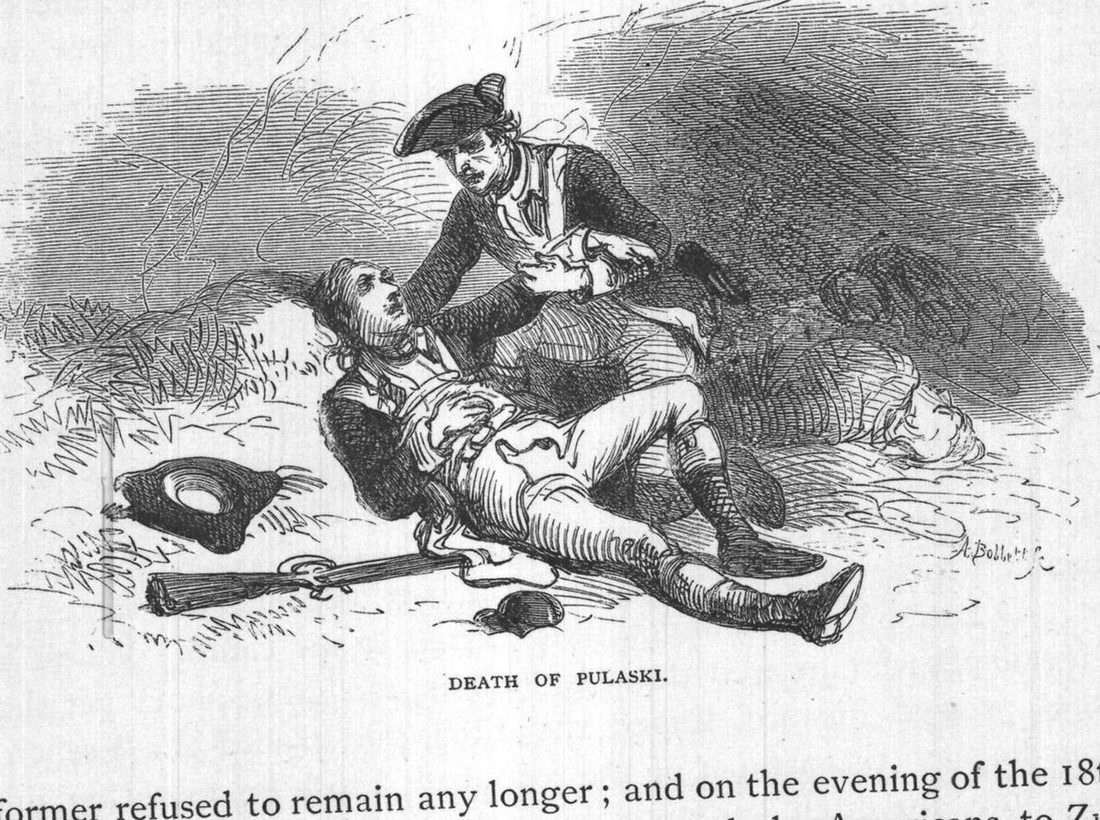
Prevost had marked his pathway with plundering and fire; and Lincoln was hailed as a deliverer by the people who swelled his ranks. Stopping to exercise cruelty, Prevost was so tardy, that Rutledge, Harris, and Moultrie were allowed to reach Charleston before his arrival, and the inhabitants were given an opportunity to cast up strong intrenchments across the Neck. It was the morning of the 11th of May before he appeared in front of these works and made a demand of the instant surrender of the town, which was met by a prompt refusal. The works on the Neck were well manned. Fort Moultrie, in the harbor, was well garrisoned; and the leaders of the troops felt confident that they could protect the city. The day was spent by both parties in preparations for a serious conflict; and the succeeding night was a fearful one for the citizens of Charleston, for they expected to be greeted at dawn with bomb-shells and red-hot shot. During that day of preparation, Count Pulaski, who was at Haddrell's Point, with his legion, was ferried over the Cooper River, and at noon he led his infantry to attack the British advanced-guard, when he was repulsed with heavy loss.
That evening there was an important executive council held by Governor Rutledge, in Charleston. The Continental Congress had been advised of the exposed condition of both Georgia and South Carolina, and the difficulty of raising recruits there, because the planters, fearing a servile insurrection, would not leave their homes. Washington's army was too weak to allow any reinforcements to be sent to Lincoln. When young John Laurens heard in the camp of the peril of his State, he was anxious to fly to its protection, proposing to place himself at the head of a regiment of faithful slaves. His friend, Colonel Alexander Hamilton, in a letter to the President of Congress, recommended the arming of the negroes; and Laurens said to Washington, that with three thousand of such black men as he could raise, he could drive the British out of Georgia. But Washington shook his head in doubt. The Congress, however, having nothing better to offer, recommended the extreme Southern States to select three thousand of their most trusted slaves, and arm them for battle under white officers.
While the British were marching on Charleston, Laurens arrived from Philadelphia, with the recommendation of the Congress. The South Carolinians were greatly irritated by what seemed the indifference of the Congress to their imminent danger. Many of them regretted having entered upon the struggle for independence, and were favorable to secession from the Union and assuming a neutral position. Governor Rutledge, dreading the taking of Charleston by storm, sent a flag to Prevost to ask his terms for a capitulation, and was answered: "Peace and protection for the loyal; the condition of prisoners of war for the remainder." Some of the military officers who were invited to the council, declared the ability of the troops to successfully defend the city, and leading patriots decided in favor of resistance; but a majority of the council declared in favor of neutrality, and leaving the question as to whether South Carolina should finally belong to Great Britain or the United States, to be decided by a treaty between those powers. Young Laurens was requested to carry a message to that effect to Prevost, but he scornfully refused the duty. A civilian was sent, but Prevost refused to treat with the civil power, and demanded the surrender of the troops as prisoners of war. Moultrie, who was present, said to the governor and his council: "Then we will fight it out," and left their presence. Gadsden, the stern patriot, and another, followed Moultrie out, and said to him: "Act according to your own judgment, and we will support you."