Heroism of Major Anderson
MAJOR ANDERSON and his little band of soldiers were in extreme peril from the hour when they entered Fort Sumter. His friends knew that he was exposed to treachery within and fierce assault from without, and were very anxious. His devoted wife, daughter of General Clinch of Georgia, was an invalid in New York. She resolved to go to her husband with a faithful servant whom he might trust, if she could find him. It was Peter Hart, who had been a sergeant with Anderson in Mexico, and was warmly attached to his person. After much search Mrs. Anderson found he was attached to the police force in New York, and she sent for him. He came, accompanied by his wife. "I have sent for you," said Mrs. Anderson, "to ask you to do me a favor." "Anything Mrs. Anderson wishes, I will do," was Hart's prompt reply. "But it may be more than you imagine," Mrs. Anderson said. Hart again replied, "Anything Mrs. Anderson wishes. "I want you to go with me to Fort Sumter," she said. Hart looked at his wife a moment, and then promptly responded, "I will go, madame." Then the earnest woman said, "But, Hart, I want you to stay with the major. You will leave your family, and give up a good situation." Again Hart glanced inquiringly toward his wife, and perceiving consent in her expression, he quickly replied, "I will go, madame." "But Margaret," said Mrs. Anderson, turning to Hart's wife, "what do you say?" "Indade, ma'am, and its Margaret's sorry she can't do as much for you as Pater can," was the reply of the warm-hearted woman.
Twenty-four hours after this interview, Mrs. Anderson, contrary to the advice of her physician, started by railway for Charleston, accompanied by Peter Hart in the capacity of a servant. From Thursday night until Sunday morning, when she arrived at Fort Sumter, she neither ate, drank, nor slept. In the cars in southern Virginia and through the Carolinas, her ears were frequently assailed by curses of her husband and threats of violence against him, by men to whom the delicate, pale-faced woman, the wife of the man they hated, was a stranger. On Sunday morning, after some difficulty, she procured permission to visit Fort Sumter, with Peter Hart. As the little boat touched the wharf of the fortress near the sallyport, and the name of Mrs. Anderson was announced to the sentry, the major, informed of her presence, rushed out, and clasped her in his arms with the exclamation, in a vehement whisper intended for her ear only, "My glorious wife!" "I have brought you Peter Hart," she said. "The children are well; I return to-night." She then partook of refreshments, and after resting a few hours, she was on her way back to New York, where she was threatened with brain fever a long time. She had given her husband the most faithful friend and assistant, under all circumstances, in the fort, during the three months of severe trial that ensued. She had done what the Government would not or dared not do-not sent but took a most valuable reinforcement to Fort Sumter.
While excitement was vehement in Washington because of events in Charleston harbor, it was intensified by a new development of bad faith or crime in the Department of the Interior, of which Jacob Thompson, of Mississippi, was chief. The safe of the Department was rifled of bonds to the amount of $800,000, which composed the Indian Trust Fund. The wildest rumors prevailed as to the amount abstracted, making it millions. It was known that Cobb had impoverished the Treasury, and the public was inclined to believe that plunder was a part of the business of the cabinet, for Secretary Floyd was deeply implicated in the Bond robbery. The public held Floyd and Thompson responsible for the crime. The grand jury of Washington city indicted Floyd for "malfeasance in office, complicity in the abstraction of the Indian Trust Fund, and conspiracy against the Government; and a committee of the House of Representatives mildly reported that Floyd's conduct was irreconcilable with purity of motives, and faithfulness to public trusts." But before the action of the grand jury and the report of the committee were known, the offending Secretary of War had fled to Virginia, where he was received with open arms by the Secessionists, and made a military leader with the commission of brigadiergeneral. His place in the cabinet was filled, as we have observed, by Joseph Holt, a loyal Kentuckian.
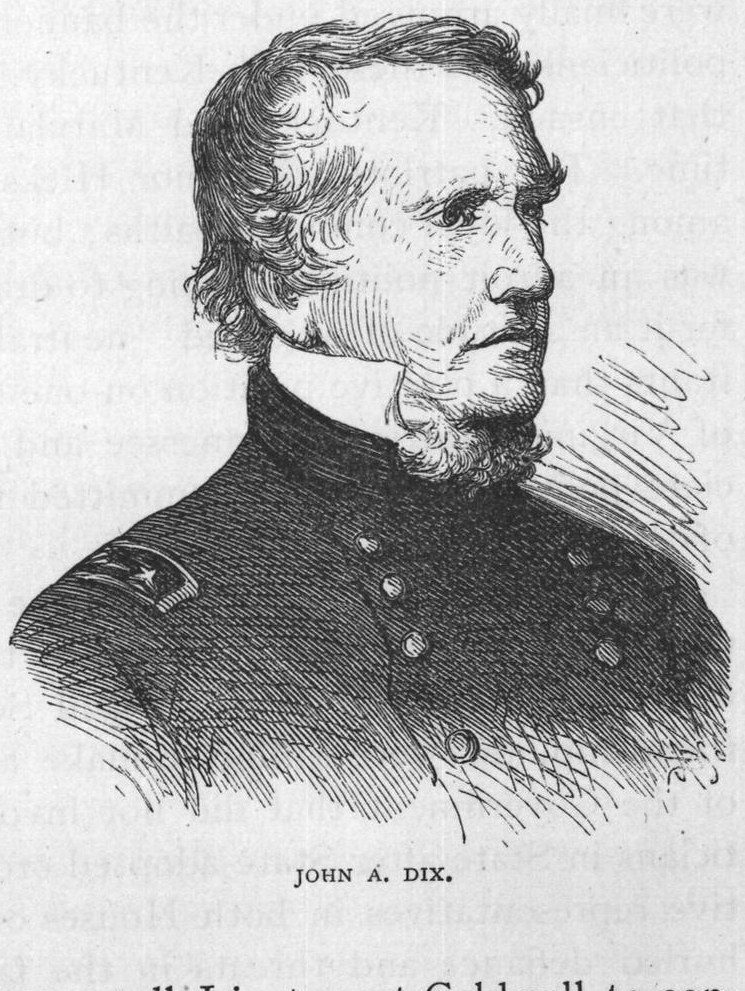
General Cass, the Secretary of State, had resigned, and Mr. Black, the Attorney-General, took his place, when the last-named office was filled by Edwin M. Stanton, afterward the efficient Secretary of War. John A. Dix, a staunch patriot of New York, was called to the head of the Treasury Department, and Secretary Thompson left the Department of the Interior and returned to Mississippi to help his fellow Secessionists make war on the Republic. These changes in the cabinet caused the loyal people of the country to breathe freer and indulge in hope.