Gates in the Northern Department
WHILE important events were occurring near the city of New York, others were in progress near the northern frontiers of the Union, where we left the shattered army that came out of Canada with Sullivan, in June, as recorded in Chapter XX of this Book. That army, sick and dispirited, halted, as we have seen, at Crown Point, whither General Gates was sent to take the command of them, General Sullivan retiring. Gates at once aspired to be chief of the Northern Department, then under the command of General Schuyler, and his pretensions were supported by a small faction in the Congress. He began to exercise authority which belonged exclusively to Schuyler. The latter resented the affront and referred the subject to the Congress, when a majority of that body lowered the pretensions of Gates by a resolution which instructed him that he was a subordinate in the Northern Department. He was greatly chagrined and irritated; and from that hour he continually intrigued for the place of Schuyler, until he aspired to the more exalted position of commander-in-chief, and conspired with others to obtain it, as we shall observe hereafter.
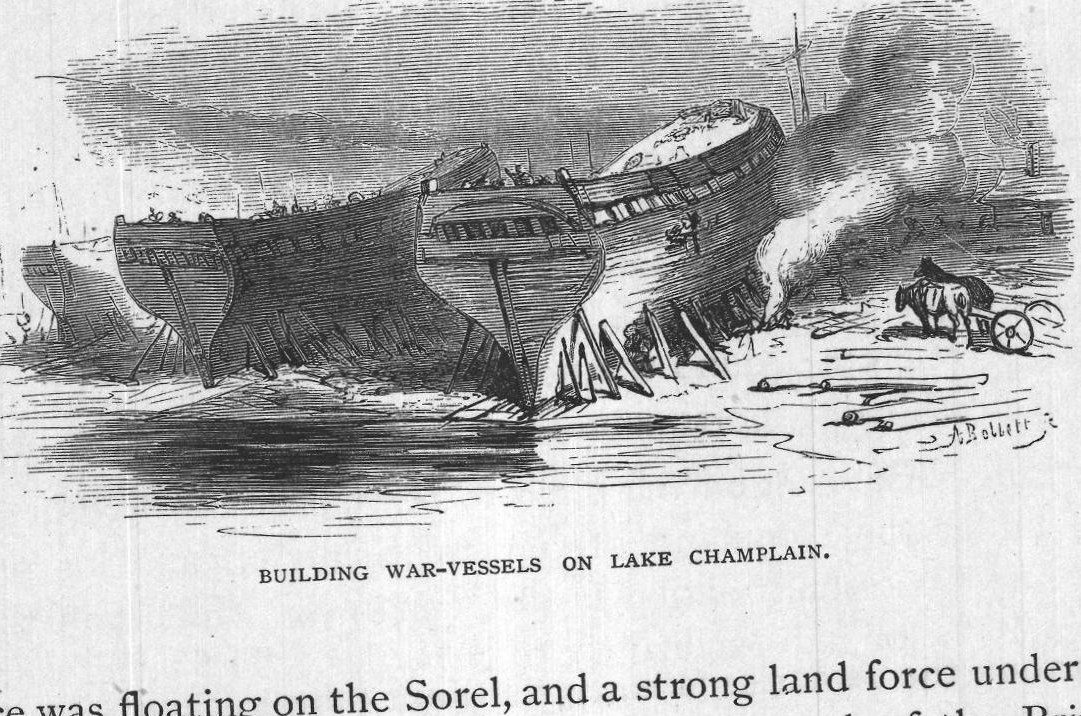
Satisfied that Carleton would attempt the recapture of the Lake fortresses, so as to control the waters of Lake Champlain, the little army, by order of General Schuyler, withdrew from Crown Point and took post at Ticonderoga, where they began the construction of a flotilla of small war-vessels. By the middle of August, a little squadron was in readiness for service at Crown Point, and General Arnold was appointed its chief commander. It consisted of one sloop, three schooners, and five gondolas, carrying an aggregate of fifty-five guns which Forts Ticonderoga and Crown Point had furnished. The schooner Royal Savage was Arnold's flag-ship, and he had brave commanders of other vessels under him. With this little squadron he sailed down the lake toward the close of August, almost to the present Rouse's Point, and anchored. Seeing British and Indian warriors prowling along the shores of the narrow lake, he fell back to Isle la Motte, where his flotilla was joined by other vessels, increasing it to almost forty sail. With these he roamed the lake defiantly.
When Carleton heard of the ship-building on the lake, he sent about seven hundred skilled workmen from Quebec to St. John, to prepare a fleet to cope with the Americans. In the course of a few weeks a considerable naval force was floating on the Sorel, and a strong land force under Burgoyne were on Isle aux Noix. Ignorant of the real strength of the British armament, Arnold withdrew to Valcour Island, not far south of Plattsburgh, and anchored his vessels across the channel between that land and the western shore of Lake Champlain, leaving the main channel free for the passage of the vessels of the enemy. This disastrous blunder was approved by Gates, who was as ignorant of naval affairs as Arnold.
Early on the morning of the 11th of October, the British fleet appeared off Cumberland Head. It was commanded by Captain Pringle. It bore twice as many vessels and skilled seamen against untutored landsmen, as the American force presented. The flag-ship--the Inflexible--was a three-masted ship, carrying eighteen 12-pounders and ten smaller guns. This formidable fleet swept by Valcour Island without opposition, and gaining the rear of Arnold's squadron, attacked it at noon. The Carleton, Captain Dacres, assisted by gun-boats, fell upon the Royal Savage and soon crippled her. As she was returning to the lines, she grounded and was burned. Arnold and his men escaped to the Congress galley, and in her fought desperately. Arnold was compelled to act as gunner, and pointed every cannon that was fired from the Congress. She was soon dreadfully bruised in every part--her mainmast was splintered, and her yards shivered. She was hulled twelve times, and seven times she was hit between wind and water. The Carleton, also, was badly hurt, as were most of the vessels on both sides. The British landed some Indians on Valcour Island, whence they poured volleys of bullets, but without much effect, upon the Americans. Night closed the fight, after a contest of almost five hours, without victory for either party. More than sixty of the Americans and forty of the British had been killed or wounded.