Fire-Ships
THE patriots who marched from the city to Harlem Heights were drenched by a shower, and slept in the open air that night. The stars were hidden by clouds until morning. Before the dawn of the 16th, a ruddy light suddenly glared along the Palisades and illumined the Hudson many miles. It was the flame of Captain Silas Talbot's fire-brig, with which he attempted to burn the British shipping in the Hudson. He failed, but the vessels were scared away, leaving a free communication between the strong work on Mount Washington and Fort Lee, on the crown of the Palisades opposite.
A few hours later some Virginians under Major Leitch, and Connecticut Rangers commanded by Colonel Knowlton, were engaged in a severe fight, on Harlem Plains, with British infantry and Highlanders, using several pieces of artillery, and commanded by General Leslie, who was in charge of the British advance-guard. They fought desperately with varying fortunes, till Washington reinforced the Americans with some Marylanders and New Englanders, with whom Generals Putnam, Greene and others took part to encourage the men. The British were pushed back, and climbed to the high, rocky ground at the northern end of the Central Park east of the Eighth Avenue. There they were reinforced by Germans and Britons. Washington now fearing an ambush, and unwilling to bring on a general engagement, ordered a retreat. This affair greatly inspirited the Americans, though Major Leitch and Colonel Knowlton were killed, and about sixty others were slain or wounded. Howe was displeased with Leslie's movement, and rebuked him for imprudence. The British chief did not make any aggressive movement for about three weeks afterward.
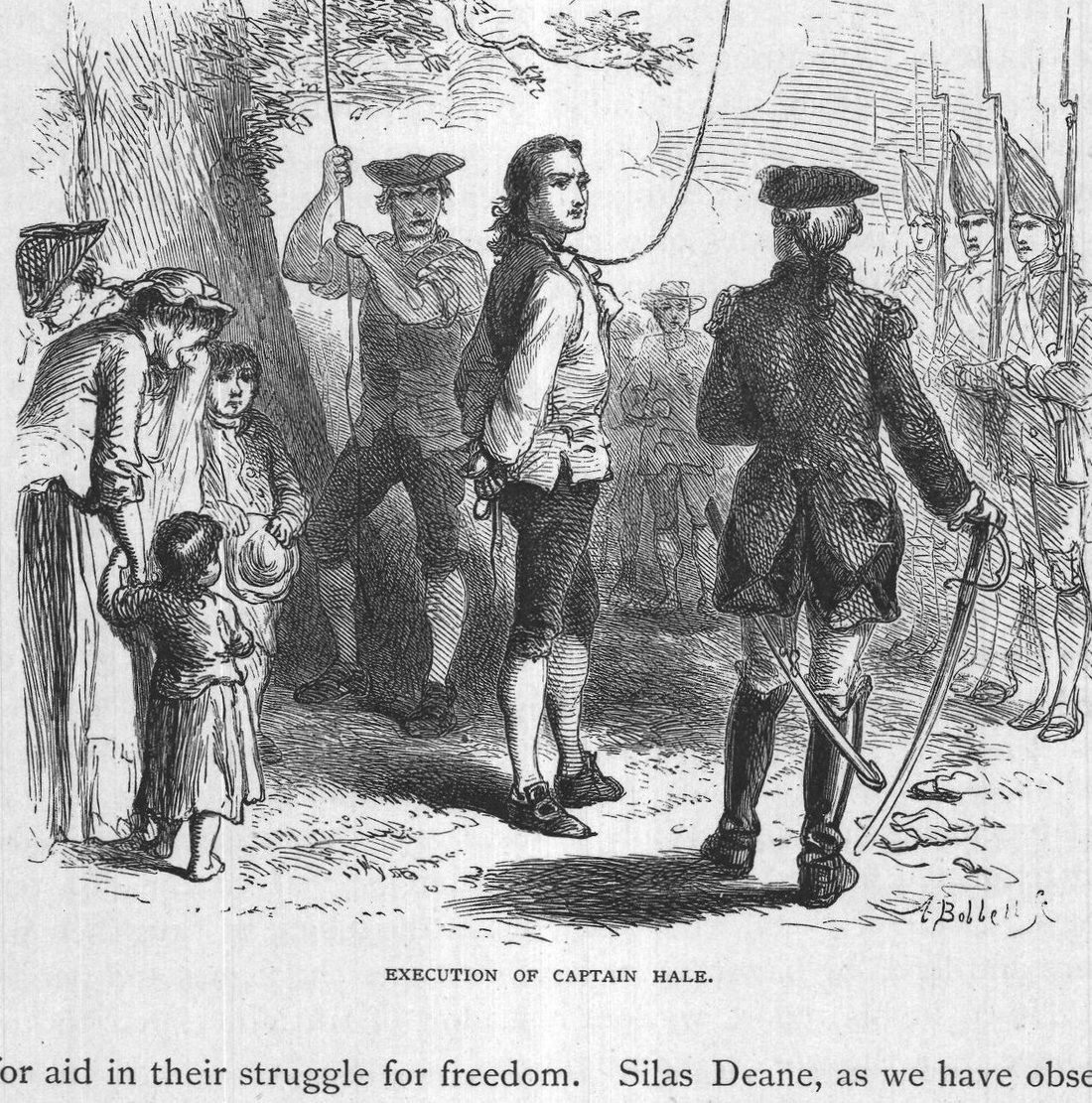
During that period Washington strengthened his defences, and gained much information respecting the British army. He greatly lamented the death of Knowlton, whose Rangers, called "Congress' Own," had acted as a sort of body-guard for the commander-in-chief before the Life-Guard were organized. Captain Nathan Hale, before mentioned, was one of Knowlton's most trusted officers, and was chosen by his colonel from among other volunteers for the perilous service of a spy. He entered the British camp as a plain young farmer, and made sketches and notes unsuspected. At length a Tory kinsman betrayed him, and he was taken before General Howe at the Beekman mansion. Hale frankly avowed his name, rank, and his character of a spy, which his papers revealed, and Howe ordered him to be hanged the next morning (September 22, 1776), without even the form of a trial. All night he was tortured by the taunts of a brutal jailer in Beekman's green-house, in which he was confined; and in the morning he was delivered to the savage Provost-marshal Cunningham for execution. Hale was denied the services of a clergy man and the use of a Bible; but the more humane officer who superintended the execution, furnished him with materials to write letters to his mother, betrothed, and sisters. These Cunningham destroyed in the presence of the victim of his brutality, while tears and sobs marked the sympathy of the multitude of spectators of the scene. Hale met death with firmness. With unfaltering voice he said: "I only regret that I have but one life to lose for my country." These were the last words uttered by the young patriot, then only a little more than twenty-one years of age.
At that moment the smoke of the smoldering embers of a great conflagration was hovering over the city of New York. At one o'clock in the morning of the 21st, a fire burst out in a low "groggery" near Whitehall. It swept up and across Broadway, laying Trinity Church and more than four hundred tenements in ruins. While it was raging the exasperated soldiers, who had expected winter shelter in the buildings, charged the disaster to the Whigs. Some of them, who came out in the gloom to save their property, were murdered by bayonets, or were cast into the flames and perished. General Howe, in his report, without a shadow of truth, declared the accident to have been the work of conspirators.
Let us leave the belligerent armies for a moment, and see what was doing in the halls of legislation. We have seen how eagerly France watched for rebellion in America from the days of the Stamp Act excitement, as a means for avenging the injuries she had received from Great Britain. We have seen how, from time to time, emissaries were sent to America by the French government, during the quarrel between Great Britain and her colonies, to ascertain the true state of public feeling here, with the hope of finding in the dissatisfied Americans powerful allies in her intended struggle to recover what "perfidious Albion" had taken from her. She was always saying pleasant things to the Americans, and trying to attract them to herself by professions of friendship and sympathy. This coquetry was taken seriously by the colonies, and when the "time that tried men's souls" arrived--when Great Britain had hired German soldiers to butcher or enslave her subjects in America, the colonies naturally turned first to the French to ask for aid in their struggle for freedom. Silas Deane, as we have observed, was sent to France by Congress in the spring of 1776, as a commercial agent to obtain supplies for an army.